
Rare formations, cool temps: Why Northern CA’s caves are a top summer adventure
Northern Californians love spending time in the outdoors — it’s hard not to with so many opportunities in the region — but the summer weather conditions often make activities under the sun a miserable endeavor.
Tucked into the base of the Sierra Nevada foothills are a number of ancient respites from the beating sun and harsh winter days. Northern California’s cave systems span hundreds of miles and descend deep into the mountains, having become popular tourism spots since gold prospectors landed in the area in 1849.
Gold Country Adventures has operated walking tours out of two area caves for only about 10 years of the region’s 177-year tourism history, taking visitors up to 100 feet underground into glistening caverns formed over millions of years.
Black Chasm Cavern in Amador County and California Cavern in Calaveras County are open year-round, and due to natural phenomena, they both stay cool at a consistent 54-58 degree temperature regardless of the weather outside.
As family-friendly expeditions, these cavern tours are popular ways for parents to get their kids outdoors, yet out of the heat, all while learning about California’s geological history. Here’s how you can check them out.
A walk into history
A gravel road up one of the hills in a small Amador County town called Volcano leads to a cabin-like gift shop near the entrance to Black Chasm Cavern.
The real cave entrance sits beneath the gift shop’s back patio, only seen as a gated door adjacent to a hole, about the size of a person, in the limestone and marble rock. Visitors enter and immediately descend a steep metal staircase into the refreshing 58-degree air.
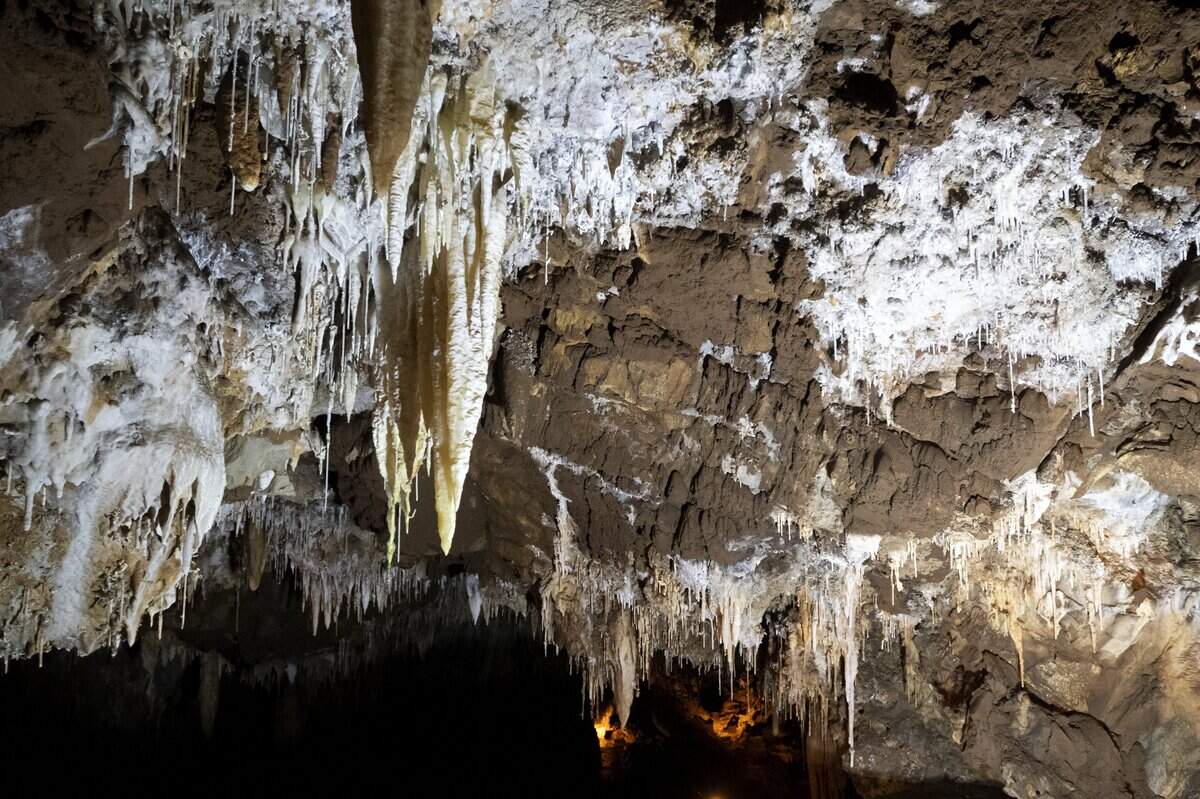
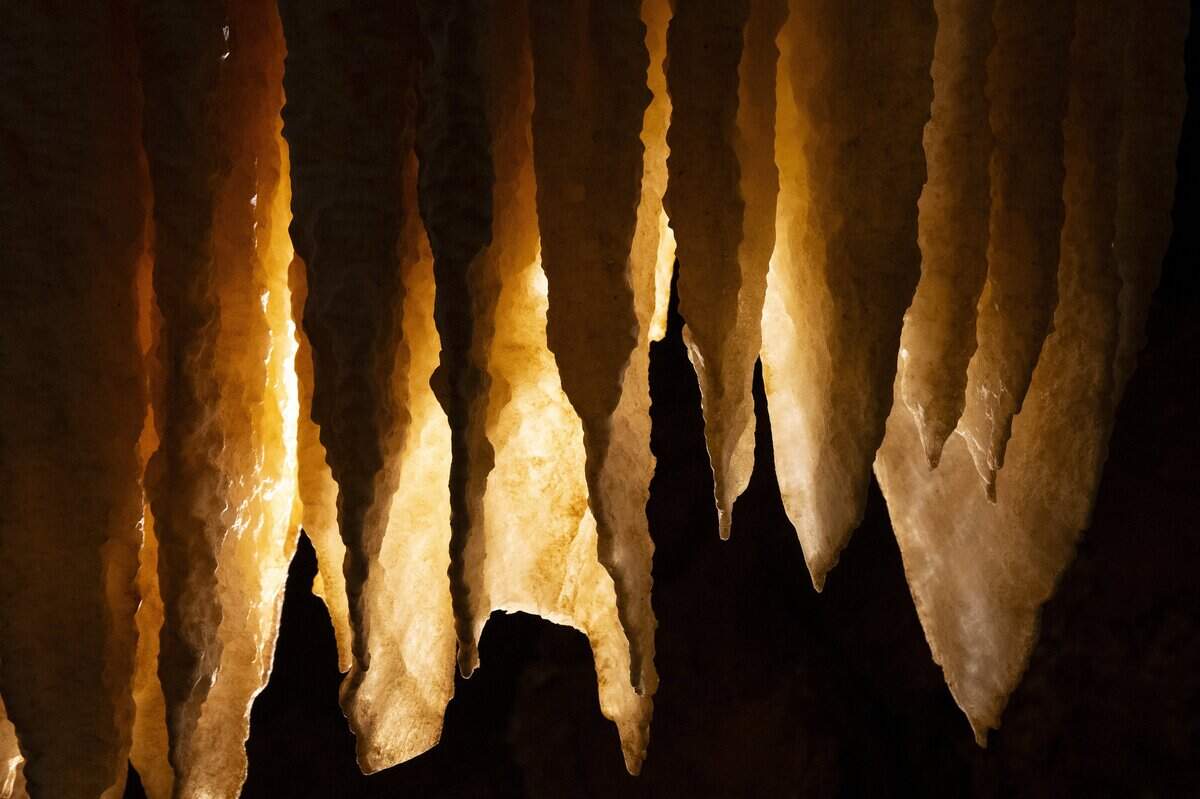
Three internal chambers open to an ecosystem of stalactites, stalagmites and numerous other mineral formations created over hundreds of thousands of years. A deep cave lake sits more than 80 feet beneath one of the platforms inside the cavern, providing a staggering sense of the cave’s scale.
Black Chasm tour guide Kristopher Larson provides a history lesson and a slew of dad jokes throughout the 45-minute tour.
“When a stalactite and a stalagmite meet in the middle, what do you call ‘em? A column,” he quipped to a group of mainly elementary-aged kids and their parents.
Though Black Chasm Cavern undoubtedly has history with the area’s Indigenous tribes, much of its recorded history started alongside the Gold Rush. According to Larson, prospector E. Samus claimed ownership of the territory Black Chasm Cavern’s entrance is now on, and he discovered the space in 1854 by observing steam coming out of the ground.
Due to the cave’s consistent internal temperature, during the wintertime it is often warmer than the outside temperature, leading to steam venting out, which reportedly gave the town of Volcano its name, Larson said.
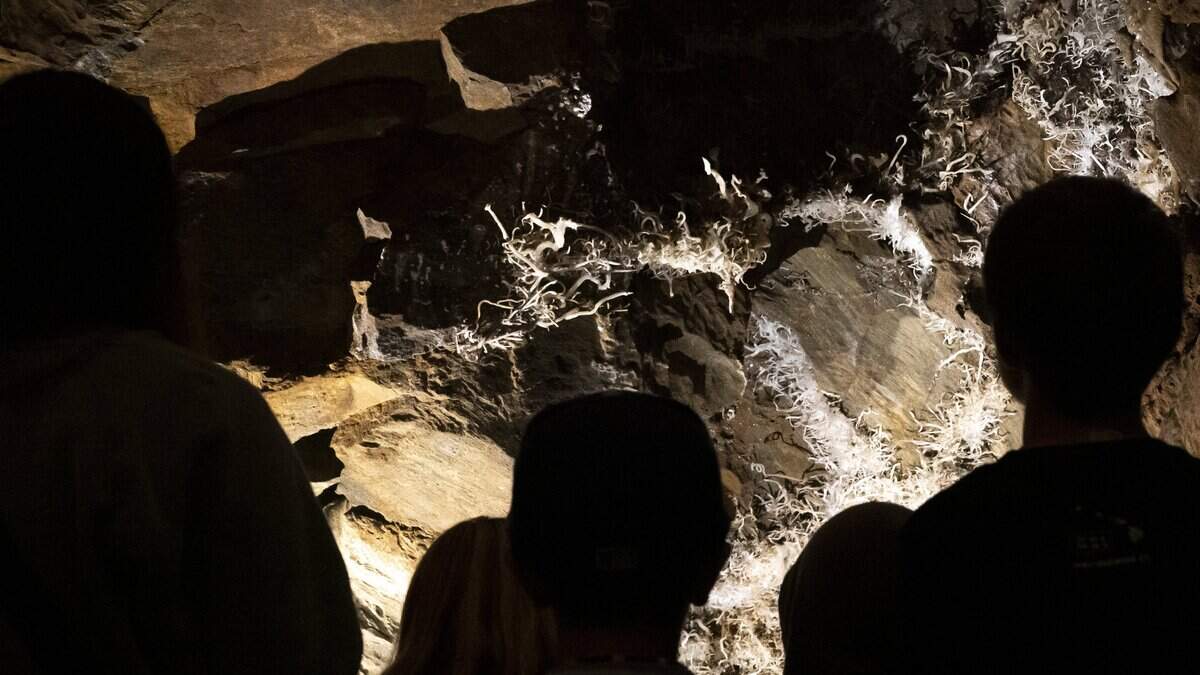
Today, Black Chasm is exclusively a tourist destination, though speleologists studied the cave throughout the 2000s, Larson said. It is also one of only three caves in the U.S. that have an abundance of helictites — twisted mineral formations developed under hydrostatic pressure. (The other U.S. caves known for their helictite formations are Timpanogos Cave National Monument in Utah and Caverns of Sonora in Texas.)
Going in deeper
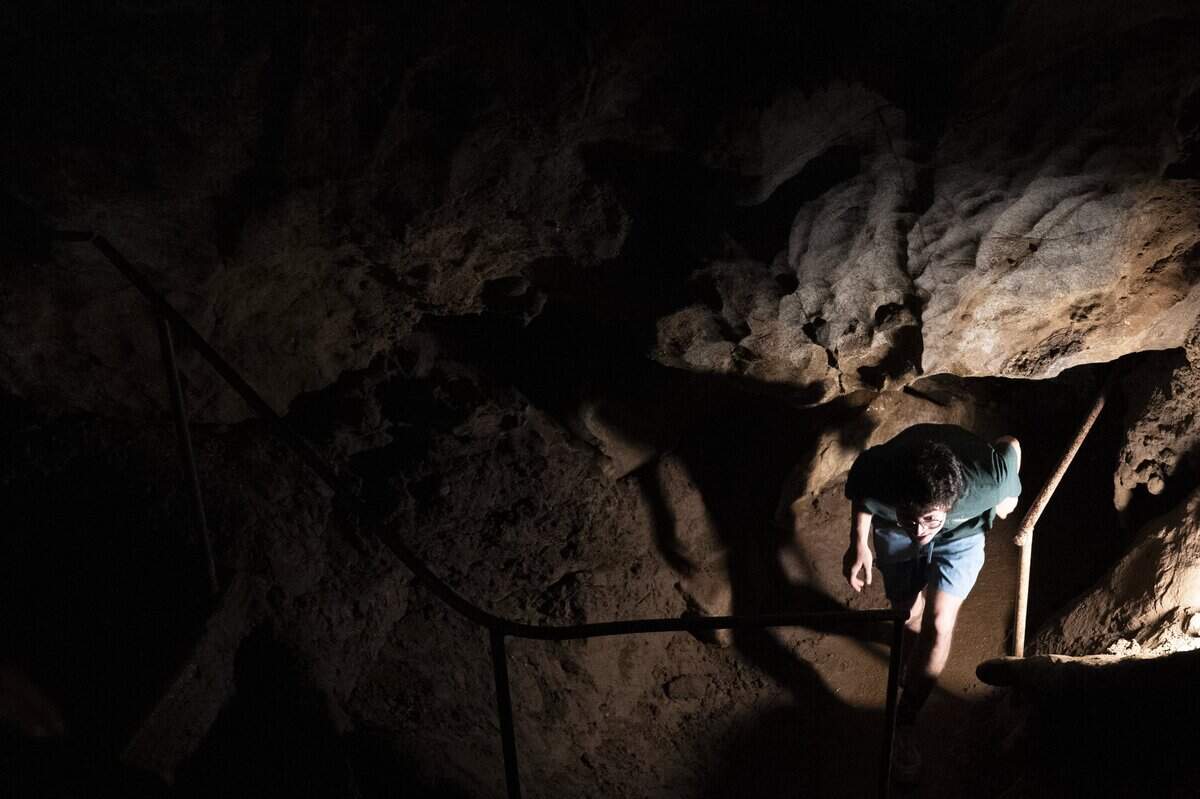
About an hour south of Black Chasm in Mountain Ranch is Gold Country Adventures’ other cave, California Cavern. While the former cave is a vertical formation, the latter offers a more horizontal and rugged experience with tight rock walls and muddy floors in place of a narrow staircase.
At 54 degrees and 95% humidity, California Cavern is similarly refreshing after the five-minute walk from the gift shop to enter. Experienced cave guides like Jojo Hinojosa also share some of the cave’s history, which is much more documented than Black Chasm Cavern’s, thanks to its more easily traversable terrain.
The Calaveras County cave had an extensive history of tourism and gatherings through the Gold Rush era. One particularly acoustic chamber, known as Bishop’s Palace, was used as a church space for miners, while the Bridal Chamber hosted miner wedding ceremonies and receptions in front of a then-pristine white limestone column.
“The miners spent a lot of time in here, they hung out, they touched (the formations) ... Every time they touched a formation with their bare hands, the oils from our skin hung on the formation, and it repels heavy water from allowing the calcite to deposit,” Hinojosa said. “Unfortunately (some of the cave’s formations are) just not getting enough water from above to wash away any of those dirts and oils anymore.”
Though much of the cavern is now covered in a layer of brown mud and oil from historical human intrusion, one chamber is far more well-preserved thanks to some thoughtful researchers. The Jungle Room was discovered in the 1960s by speleology students from UC Berkeley, who chose to hide the space from its former owner.
“I think it says a lot about the previous owner’s intention for the cave, but (the students) kept it to themselves for 15 years,” Hinojosa said.
If the slippery floors and low passageways aren’t enough of a thrill for you, California Cavern also offers two spelunking expeditions, allowing adventurers to crawl and squeeze through the smallest passages.
The cave’s more strenuous experience, Middle Earth, even requires participants to raft across a lake 60 feet underground and scramble through more than a mile of cave passages.
“It took (explorers) 10 years to make it through there ... Once they made it through, it led to us having the largest cavern system on the West Coast with over 2 1/2 miles of cave system,” Hinojosa said. “Yeah, it’s pretty intense.”
How to go cave exploring in Northern California
Gold Country Adventures walking tours cost $23 per visitor ages 13 and up and $15 per child ages 4-12. Children 3 and under may enter for free, according to the company’s website.
Food, drinks, water bottles, large bags and backpacks, selfie sticks, walking sticks and extra camera attachments are not allowed inside the caves. Due to the terrain inside the caverns, they are not wheelchair accessible.
Tours at Black Chasm Cavern are offered seven days a week, starting between 10 a.m. and 4 p.m. California Cavern’s tours run between 10 a.m. and 3 p.m. five days a week during the summer and four days a week during the fall and winter.
Walk-ins are accepted at both locations. Completing both tours in one day is possible, but the drive between the caves is approximately one hour, so Gold Country Adventures’s website encourages visitors to plan accordingly.
Spelunking expeditions at California Cavern are only available by advance reservation, and are offered on a more limited basis. The 2-3 hour Mammoth Cave Expedition costs $99 per participant and accepts kids as young as 8 years old. The Middle Earth Expedition, priced at $199 per participant, requires a higher level of stamina to complete the 3-4 hour tour, and participants must be at least 16 years old.
.jpg)