
FBI targets India crime mob California connections. ‘What the real thing looks like’
AI-generated summary reviewed by our newsroom.
- Federal authorities charged 37 defendants and arrested 24 across multiple countries.
- Prosecutors allege Lawrence Bishnoi’s network linked to the 2023 killing of Nijjar.
- Agents seized about 1,000 kilograms of cocaine, a dozen firearms and $40,000 cash.
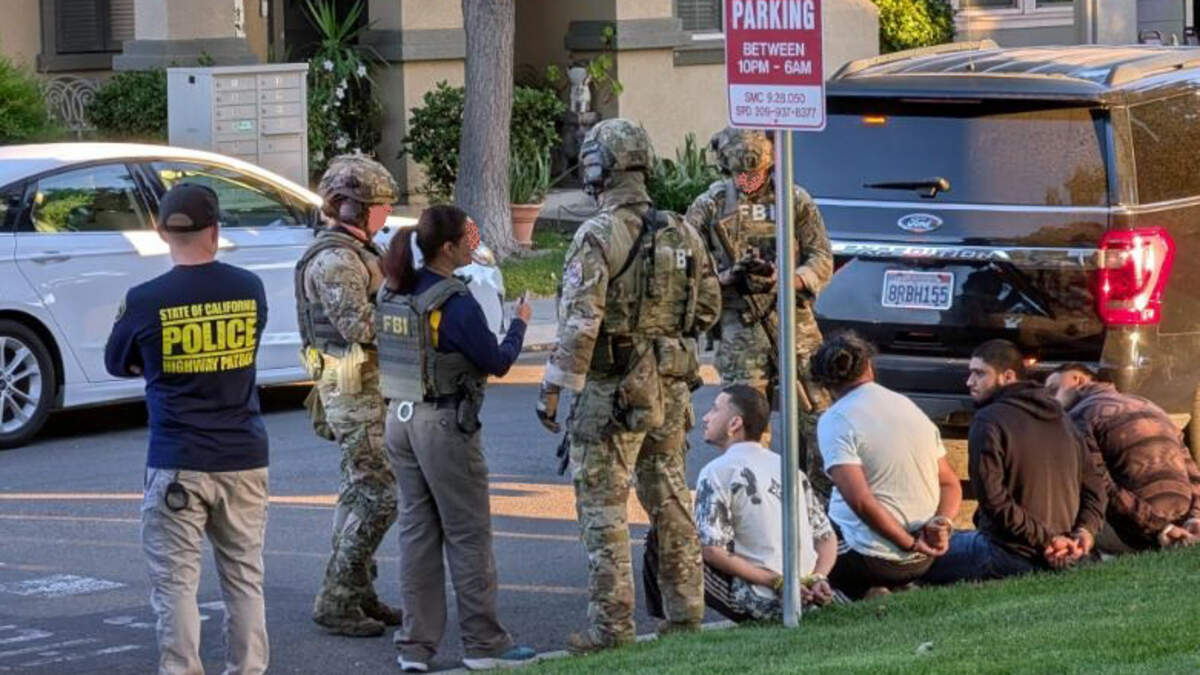
An FBI sweep dubbed “Operation Hard Ball” led to arrests across California Tuesday, including Sacramento, in a coordinated strike against organized crime rooted in India.
Federal prosecutors in Los Angeles accompanied by FBI agents at a news conference unsealed charges against dozens of defendants tied to three India-based syndicates. One is Lawrence Bishnoi, the jailed gang boss whose network U.S. authorities have now linked to the 2023 assassination of Sikh leader Hardeep Singh Nijjar in Canada.
Previously the Canadian government had said that the Indian government of Prime Minister Narendra Modi had ordered the killing of the Sikh leader. The link to Bishnoi has long been rumored, but this is the first time it has been alleged by U.S. prosecutors.
The arrests spanned continents. Federal authorities charged 37 defendants and arrested 24 — 11 in California, including one in Sacramento. Arrests also occurred in Canada and Spain. The U.S. Attorney’s Office said agents executed more than 50 search warrants in seizing roughly 1,000 kilograms of cocaine, a dozen firearms and $40,000 in cash.
Indictments unveiled by prosecutors Tuesday describe cartel-style bosses — among them Bishnoi and Jaggu Bhagwanpuria, a former associate and now rival of Bishnoi. Despite both men being locked in prison cells in India, prosecutors said the crime bosses orchestrated murder, extortion and drug-trafficking using contraband cellphones and encrypted apps to order killings and shake down shopkeepers an ocean away.
“Today’s coordinated operation strikes at the heart of three brutal transnational organizations that have terrorized families, exploited communities, and stolen lives through ruthless acts of violence in the U.S. and abroad,” Patrick Grandy, Assistant Director in Charge of the FBI’s Los Angeles Field Office, said in the news release.
At the news conference in Los Angeles, First Assistant United States Attorney Bill Essayli described how a top official at a police precinct in Punjab arrested two relatives of a Los Angeles family and charged them with ordering a contract killing. The official held a news conference in India to publicize the charges.
He said relatives in Los Angeles were then approached by one of the men indicted Tuesday and told the charges would be dropped if they paid $400,000.
Local reaction
In Sacramento and the Central Valley — home to an estimated 250,000 California’s Sikhs — the reaction to criminal sweep was a mix of gratitude, caution and frustration because the indictments did not mention what experts call “transnational repression,” how foreign governments target opponents.
“I am grateful to the FBI for their consistent and unwavering commitment to addressing these threats, which have spread fear and intimidation throughout the Sikh community,” said Assemblymember Jasmeet Bains, D-Delano.
But Bains criticized Gov. Gavin Newsom for vetoing SB 509, which unanimously passed the assembly in 2025 and would have offered training to law enforcement to recognize the signs of TNR.
In California, a pickup truck carrying three Sikh activists was shot at on Interstate 505 near Sacramento in 2024, threats were made against Khalistan supporters at a Stockton gurdwara in 2023 and Sacramento State student Bobby Singh, who had been friendly with Nijjar, was threatened.
Singh said Tuesday that he was shocked when he received death threats and was visited by the FBI in 2024.
“After reading this indictment, I’m understanding the bigger picture,” he said.
Dan Stanton, a former Canadian intelligence officer who spent more than three decades at the Canadian Security Intelligence Service and is an expert in transnational repression, said that the arrests are significant.
“I’m sure 90% of the criminal activity which is being exposed is just straight-up gangster activity,” he said.
But he said, state actors, including Iran and India, have funded organized crime for political aims to target opponents.
“That’s what led to Canada’s decision in September 2025 to designate the Bishnoi group a terrorist entity,” he said.
Both the FBI and the U.S. Attorney’s Office for the Central District of California declined to answer questions about the relationship between transnational repression and the Tuesday arrests, referring reporters to the indictments. Laura Eimiller, a spokeswoman for the FBI’s Los Angeles field office, said in an email the investigation is focused on criminal groups “victimizing communities.”
‘How can all of a sudden these things happen?’
In the Central Valley, fear has moved faster than the answers as extortion and threats of violence have become more commonplace.
Gurminder Sangha, vice president of equity and institutional effectiveness at Madera Community College, said the surge of violence has unsettled the community.
“How can, all of a sudden, these things happen?” he said. “There must be some support somewhere.”
Sangha said that gangsters intimidating immigrants in the Central Valley is far more prevalent than reported. “If four or five Sikhs get together, the conversation invariably turns to someone who has been terrorized and intimidated. A lot of people just pay.”
Sangha said one case of extortion targeting a Sikh happened to a local restaurant owner in Madera.
The restaurant owner, who did not wish to be identified because his family is still in India, said extortionists have threatened to kill them.
“They’re just targeting mostly the Sikh people, the Sikh community,” he said.
He said at 2 or 3 in the morning in December someone fired roughly 10 rounds into his restaurant, leaving bullet holes.
He said a caller the next day claimed to be from the Bishnoi gang and demanded half a million dollars.
He said, and according to news reports, gunmen in India shot his uncle 10 days later. After his uncle was shot, he said he received a call at the restaurant to make sure he understood the two events were connected.
The demands kept coming he said. On June 8, the Madera restaurant was hit again by another burst of gunfire. A call came from the extortionists as police investigated the next day.
The business owner said he has reported every incident to police. He was contacted by the FBI in June and attended an interview with two agents, he says, on June 28 in Fresno.
Sikhs say more needs to be done
Dr. Pritpal Singh, of the American Sikh Caucus Committee, whose home security footage shows was targeted by surveillance on several occasions, received an FBI warning that his life could be in danger on June 23, 2023 — five days after Nijjar’s assassination.
“These three indictments are a hard read for any American who cares about public safety, sovereignty and freedom,” he said
He credited federal and local agents with disrupting the networks — “their work likely saved lives” — but said the work cannot stop at arrests.
“Indictments are the beginning, not the end,” he said.
For Naindeep Singh — a Fresno school board who was falsely accused of having ties to terrorism — the charges leveled in “Operation Hard Ball” he said were deeply troubling.
“I know what it costs when people can’t tell a real threat from a made-up one, because I was falsely accused of ties to organized crime...” Singh said. “These indictments show what the real thing looks like. And we still haven’t built a policy response to answer it.”
Singh, who also leads a youth organization called the Jakara Movement, said the false accusations made haven’t deterred his desire to serve. He is running for City Council in Fresno where he finished first in a tightly contested primary. The runoff is set for Nov. 3.
“Everyone deserves to be safe and to be free from intimidation,” he said. “Otherwise democracy is in jeopardy.”