
The last days of the Hotel Marshall
This story, published in 2014 with a special presentation, was updated in 2021 to restore some of the original photography.
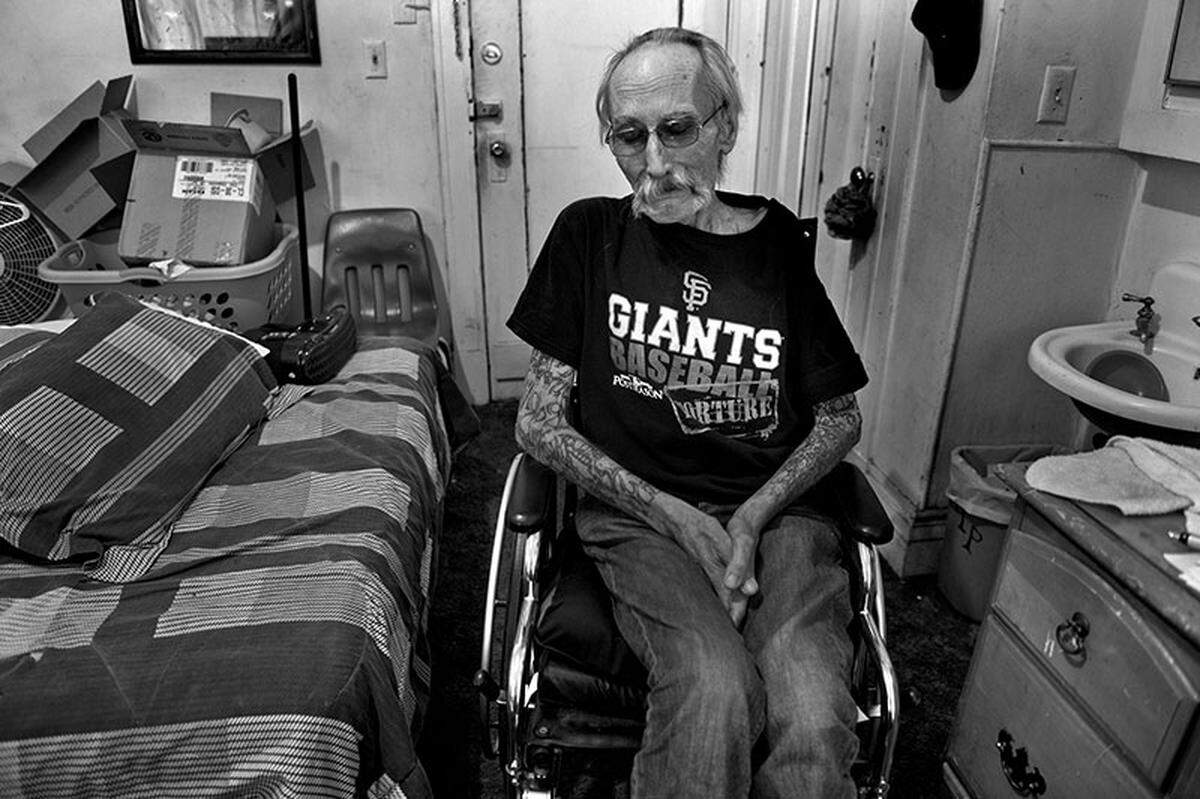
Terry Sackrider’s spindly frame listed in his wheelchair on the sidewalk in front of the old Hotel Marshall in downtown Sacramento. For five years, he had called the place home, sharing booze and TV westerns with his pals before collapsing for the night on his sagging mattress, a photo of his grandson smiling down from the shelf above.
Now he had been ordered out. Thirty-four days to find a new place to live.
The timeline weighed upon him.
It was a warm afternoon in late May, and Sackrider was woozy from the heat, too little food and the prescription painkiller in his blood. “Who’s going to take me?” he asked, lifting skinny arms dappled with tattoos. Tears welled in his eyes. “What am I going to do?”
The Hotel Marshall, long Sacramento’s residence of last resort for the indigent mentally ill, addicts and sex offenders, was preparing to close. The Sacramento Kings had approval to construct a glimmering new arena just a block away, and if everything went according to plan, the vermin-infested brick building that had stood at the corner of Seventh and L streets for more than a century would be transformed into a fitting and lucrative neighbor: a market-rate hotel soaring high into the downtown skyline.
Like Sackrider, many of the hotel’s tenants had lived at the Marshall for years; some of them for decades. They paid $495 monthly for dilapidated rooms with bad plumbing, leaky ceilings and bedbugs. They celebrated birthdays together with cookies and coffee, and holidays with turkey dinners. And they shared food and booze at the end of the month when money from Social Security checks ran low. Younger, healthier tenants protected residents whose feeble minds or physical disabilities left them vulnerable to abuse.
Was it clean? No. Safe? In relative terms. Loud disagreements were common, but most grudges got settled without police interference. Many of its residents had lived in prison and on the streets, and the Marshall offered something more stable, something akin to family.
Now their world was busting up thanks to plans for the new arena, envisioned as a $477 million celebration of airy architecture and high-tech innovations with the potential to single-handedly reinvigorate the city’s languishing downtown. Peter Noack, the Marshall’s owner, had been waiting years for this kind of catalyst.
First, Sackrider and 56 other long-term residents of the hotel had to go. But where?
To reinvent the Marshall, Noack first had to help its tenants find homes. The city requires developers who convert low-rent residential hotels into other types of buildings to work with residents to find comparable places to live, and help pay for their relocation.
For men like Sackrider, it was a tall order. A retired roofer and reformed heroin addict, he was 60 years old with a criminal history, a broken back and too few teeth. His daily pharmaceutical needs included psychiatric meds, methadone to quell his drug cravings and Fentanyl for his back and neck pain.
Unlike the Marshall, which accepted all comers, most of the city’s low-rent hotels and apartments screened prospective tenants. Some refused people with felony backgrounds or untreated mental illness or addictions. Many of the Marshall’s tenants fit into all those categories.
Noack was offering $2,400 and relocation assistance to every resident who would leave voluntarily. He was working with the Sacramento Housing and Redevelopment Agency, the Sacramento Housing Alliance and an array of social services groups on the relocation project. But there were no illusions: The task at the Marshall, agency officials agreed, would be one of the most challenging ever attempted in the city.
For good or ill, it would mark the end of an era. These would be last days of the Hotel Marshall.
Chapter One • Vodka and smokes
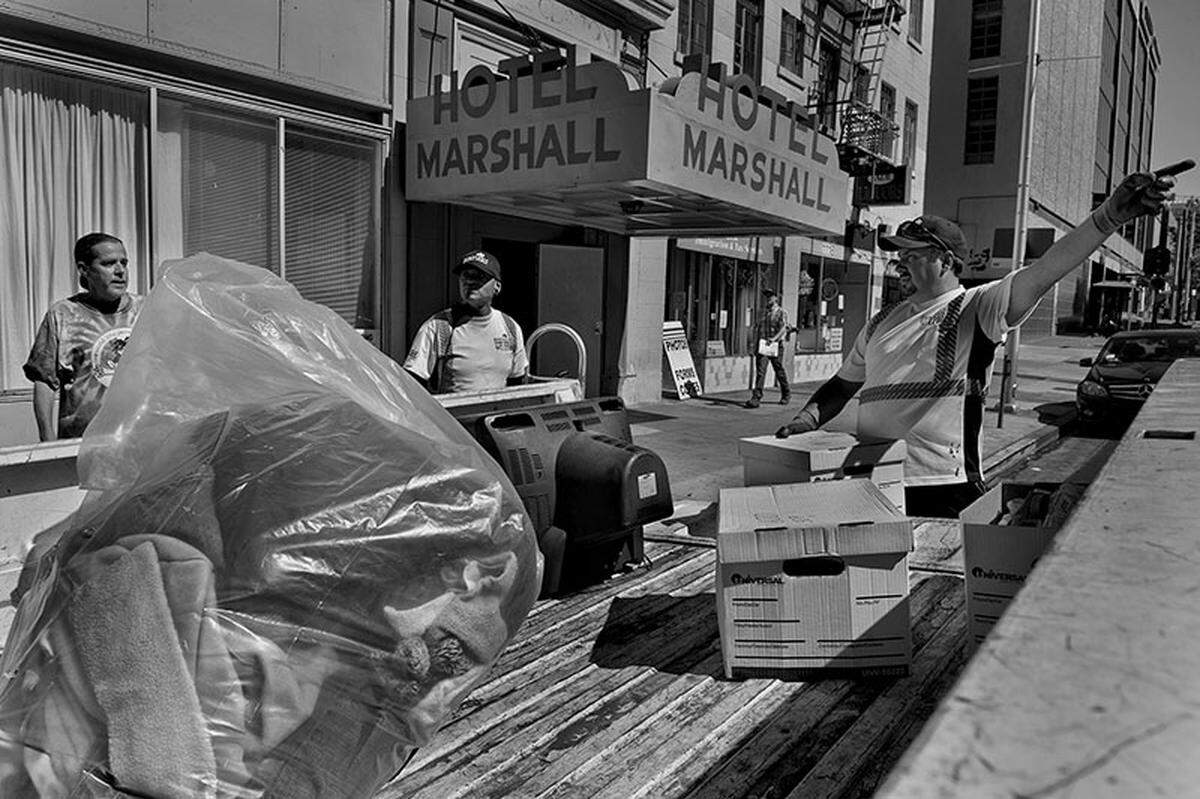
The first notices to tenants went out May 1, single sheets of paper slipped into mailboxes: They were “to vacate the premises” by June 30. Along with the memo, they received a list of comparable rentals, including other residential hotels. Tenants were told a representative of Overland Pacific & Cutler, a company with experience finding housing for low-income tenants, could meet with each of them.
Three weeks later only four people had departed, despite gentle nudges each day from the hotel’s day manager, Mannan Viloria.
“Every time I see people, I remind them,” said Viloria, 52. “But they’re ignoring the process. They’re afraid of change. This place is all they know.”
Viloria, born in the Philippines, came to the Marshall as a tenant in 2010, a dark period of his life he declines to discuss. Three years ago he was hired as manager. He will always be grateful, he said, for the chance to earn a paycheck when he was struggling to find a job.
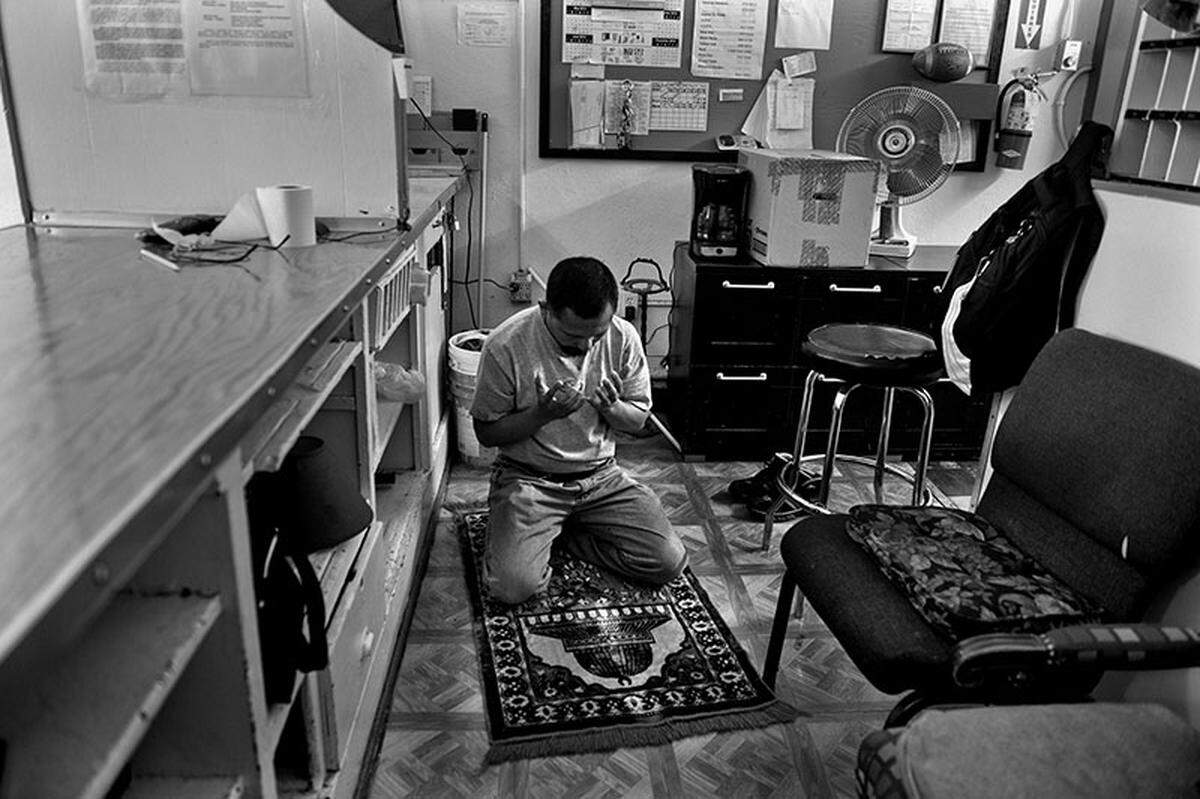
Slightly built and a devout Muslim, Viloria knelt in prayer on the rug behind his desk three times a day, a practice he said kept him centered. Over the years, he had come to know each resident by name and habit, and he took pride in his efforts to treat everyone with kindness.
“We’ll see what comes,” Viloria said of the Marshall’s closing. “I don’t fear anything but God.”
Floyd Merchant was among the tenants on the clock.
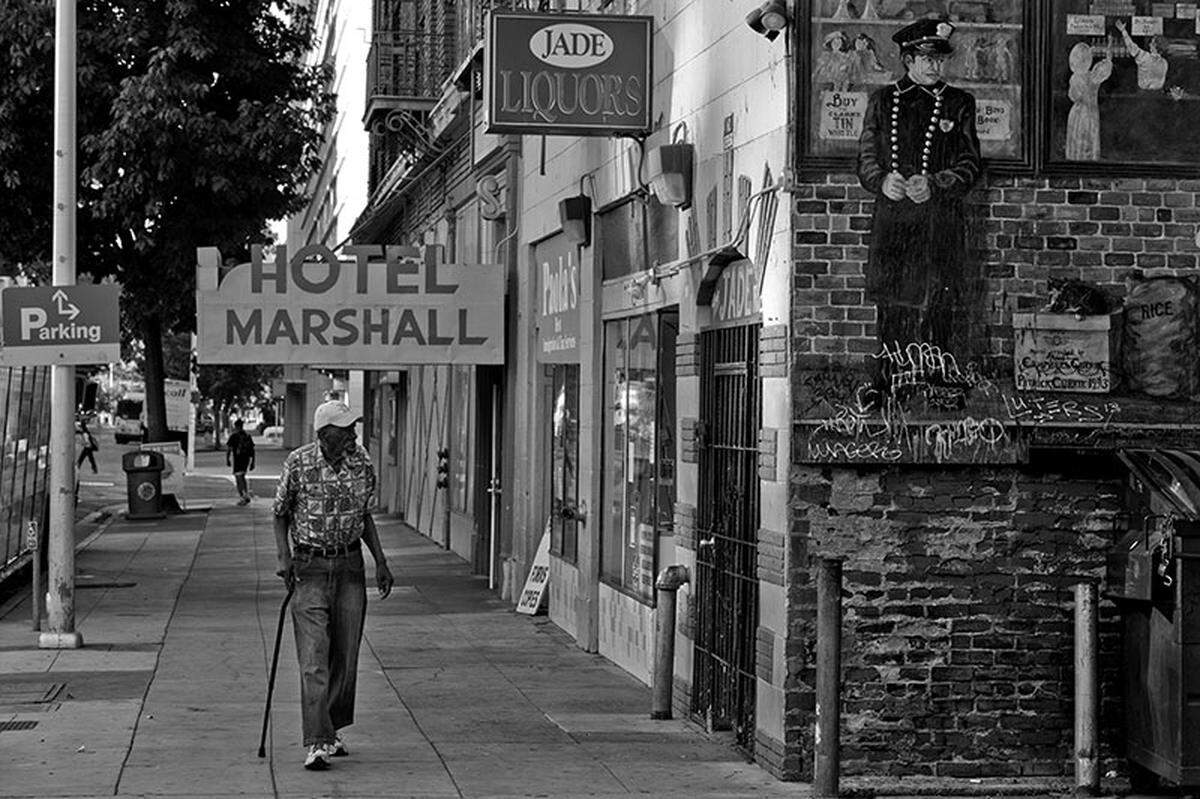
Leaning on a cane beneath the hotel’s weathered sign one afternoon in early June, Merchant surveyed the street. He was 73, tall and lean, with the large, calloused hands of a construction worker. He wore gym shoes and a plaid shirt tucked neatly into denim pants. Perched on his head was a white cap stitched with the biblical reference John 3:16, which begins, “For God so loved the world …”
“I don’t know it,” Merchant said. “I bought this hat at the liquor store.”
He had lived at the Marshall since 2005, and was a regular in the social scene that unfurled each day on the sidewalk out front. Every morning starting around 8, Marshall’s residents and their cronies gathered along Seventh Street to smoke and shoot the breeze. Some swigged from brown bags swaddling bottles of vodka or peach schnapps.
The hotel, across from a light-rail station and next to a city bus stop, straddled stores peddling Slim Jims, Flamin’ Hot Cheetos, cigarettes and booze. The hum of Regional Transit trains, their bells clanging, provided a familiar backdrop as Merchant and others traded stories about cheating girlfriends, parole worries and stolen bikes.
The buzz in recent weeks was the hotel’s closure. Was management really going to kick them out?
“You leaving? Where you going?” Bruce Presley, a former tenant who managed the Jade apartment building adjacent to the Marshall, asked Merchant.
“I would like to stay on here,” Merchant said in a deep baritone. “But I guess I have to leave.”
Daryl Cullins, 49, had been homeless before moving to the Marshall about three years earlier, and spoke wistfully about the impending closure. A former magazine salesman, he arrived with a few dollars in his pocket and a brain scrambled by drugs, he said.
“We’re all from different walks of life here, but we get along,” Cullins said. “We get up in the morning, we watch movies together, watch games. We take care of one another. I have feelings for these guys. I’m gonna miss ’em.”
Dennis Jenkins, on the other hand, fumed that he wasn’t being offered the $2,400 relocation payment. He had lived at the Marshall 32 years before he was booted out in March after a dust-up with management involving drugs.
“They owe me!” he said, fists clenched, his voice shaking. It was a terrible way, he said, to treat an Air Force veteran who put his life on the line in Vietnam.
After he left the Marshall, Jenkins said, he bounced between shelters and the streets for about a month until he got his next Social Security check. Then he scored a room one block away at another residential hotel, the stylishly refurbished Studios at Hotel Berry.

His living circumstances were infinitely better, Jenkins said. Still, on most days, you could find him right here in front of the Marshall, in his gym shorts and sunglasses, shuffling along in leather slippers.
“I seen the whole city come up over the years right here on Seventh Street,” said Jenkins, 67, his words slurred as he gestured toward the bank buildings and government offices in the distance.
So, too, had Elizabeth Ricci, the Marshall’s sole female tenant. At 67, she had called the Marshall home for more than two decades. But she had no interest in nostalgia on this day.
A blue canvas bag slung over her shoulder, her gray hair in a loose bun, Ricci gave the men on the sidewalk barely a glance as she passed them and dramatically yanked open the hotel’s glass door. Hands on hips, Ricci stood in the lobby entrance, between an old pay phone and a bank of candy machines that once served up M&Ms and Boston Baked Beans for a quarter. It had not been filled in months.
Rumor had it that Ricci had once been a schoolteacher, but no one had confirmed it. She never allowed anyone into her room, even Presley, who considered himself her friend. She spent her days walking purposefully through downtown, occasionally stopping at a coffee house to rest. She read newspapers and books, according to other residents, and in her lucid moments was capable of talking eloquently about such subjects as art and Darwinism.
“These people who make the laws, what do they know?” she railed now, to no one in particular. “It’s not my fault,” she said, glowering. “Not my problem. If you want new laws, you’re going to have to go somewhere else!”
From his perch behind the front desk, Viloria glanced at the TV news, then back at Ricci.
“Elizabeth,” he said. “Listen to me. You’ve got to be out by the end of June. You know that, right? You’ve got to get going!”
Muttering curses, Ricci turned and stomped upstairs.
Chapter Two • ‘God Bless Our Home’
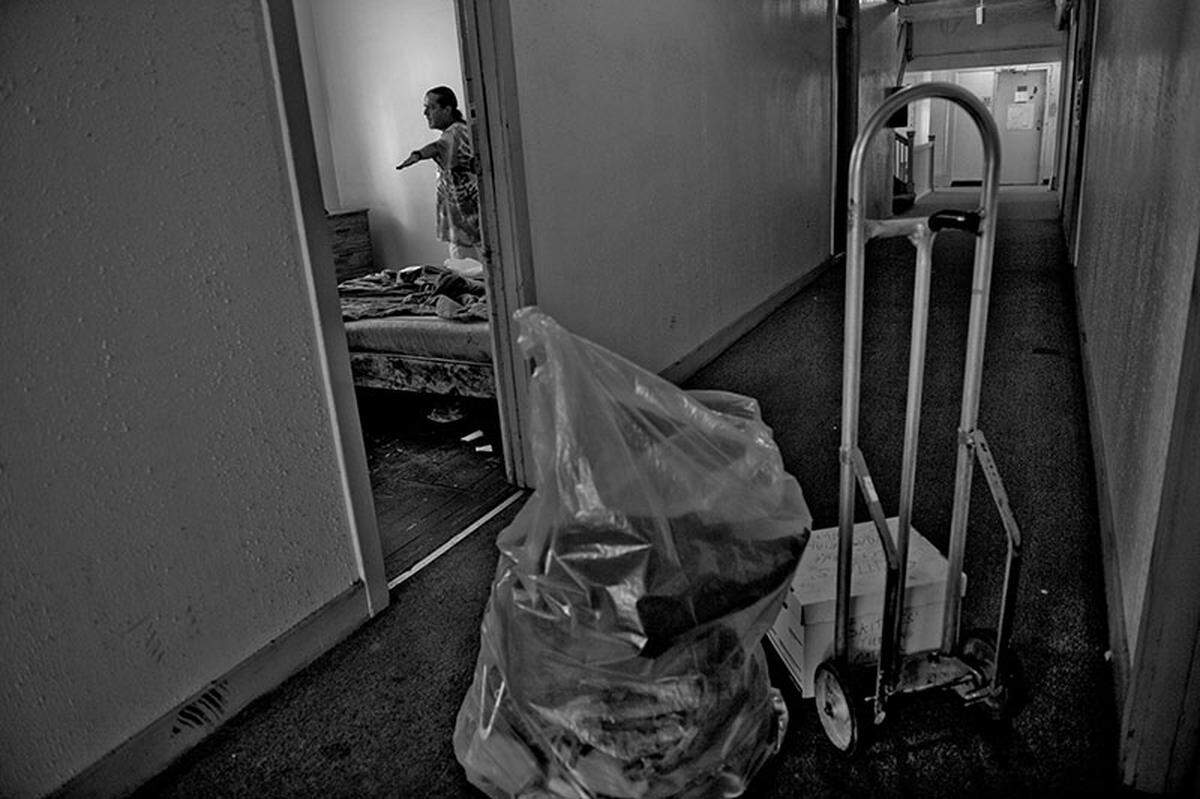
Alvin Keahey strolled down the dim hallway, past doors damaged by fists, dodging piles of discarded bedding.
“This is how I live,” Keahey, 54, said on a summer afternoon, turning the key that opened his room on the Hotel Marshall’s second floor.
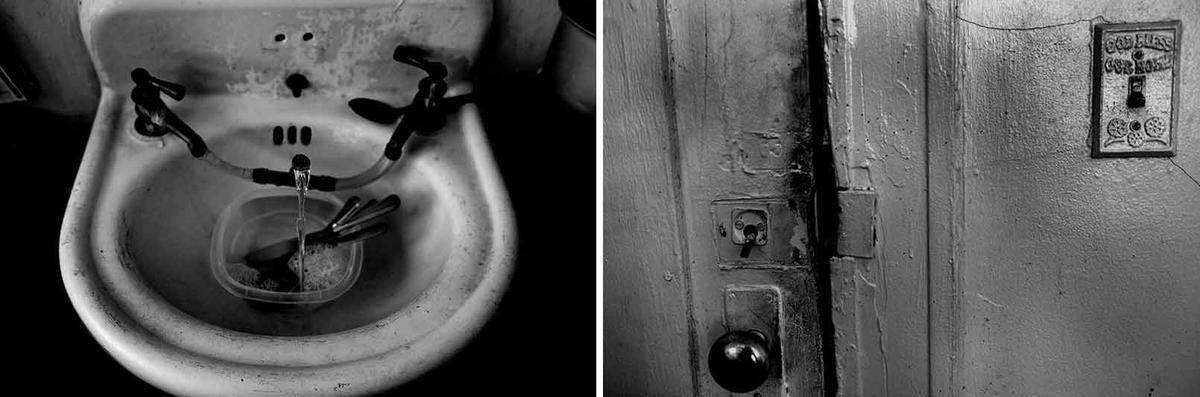
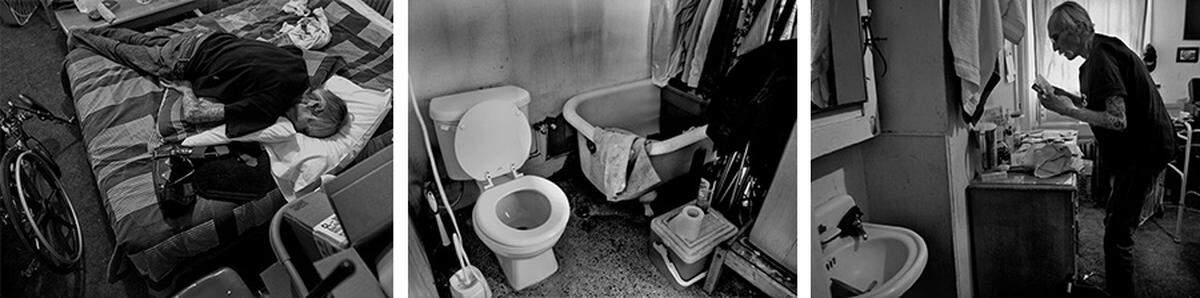
The main portion of his room was about 10 feet square, not much bigger than a cell, with space for his bed, a small sink, a desk and a shelf where he kept bottled water and other provisions. To the right was a bathroom with a hole in the wall and a broken tub where Keahey stored his bleach, mop and disinfectant. He used them, he said, to clean the communal bathing room down the hall, which often was smeared with feces or vomit. He never ventured in without his plastic sandals.
His toilet flushed properly, unlike many in the building, he said. But his windows were unscreened, and took effort to open and close. The hot water tap produced just a trickle. For months, he said, he had no hot water at all, until he jerry-rigged the faucet with plumbing skills he learned at Avenal State Prison, where he did time for lewd behavior.
Next to his front door, studded with the dings and marks of prying attempts, a light switch cover offered an inspiring message. “God Bless Our Home,” it read.
Good riddance to it, said Keahey.
Now that he was on his way out, he was eager to expose conditions at the Marshall. He maintained an arsenal of insect sprays to combat invasions by cockroaches and bedbugs. Bats had formed a colony in one of the vacant rooms and occasionally flew through the hallways. Mousetraps lined the floor next to his bed.
“This place is terrible,” he said. “They don’t take care of it. They don’t fix anything.”
A couple of weeks earlier, the hotel’s finicky elevator had rumbled to a halt. Keahey, disabled by a series of strokes, hobbled up and down the stairs for a week before it was repaired. Sackrider, trapped with his wheelchair on the fourth floor, relied on his buddies to bring him food and cigarettes.
Nothing much had changed at the Marshall since Keahey arrived, right out of prison, about three years ago, he opined. “This was the only place that would take me,” he said. “I was grateful at first for a place to live.”
To avoid trouble, he kept a low profile. He woke up before the sun, charged the electronic monitor attached to his ankle, brewed coffee, watched TV news. He generally left his room only to buy groceries and wash his clothes. For him, it was lights out by 10 p.m., although fights jolted him awake many nights.
Now, he had a line on a room just down the street, and intended to move as soon as he got his $2,400 relocation check. Rinsing a plastic bowl in his tiny sink, he contemplated the Marshall’s future.
“If I owned it, I know what I would do,” he said. “I’d blow the whole thing up and start over.”
In its day, the hotel was considered the height of style. It opened in 1911 as the Clayton, built by a pioneering Sacramento family who helped found the county hospital that became UC Davis Medical Center. In the late 1930s the property changed hands and became the Hotel Marshall in honor of James Marshall, the man who discovered gold in California.
For years, the building’s basement nightclub was a hotspot, one of many jazz venues in a bustling middle-class neighborhood. Cab Calloway and Billie Holiday played there, among other notable performers.
Then came the suburban exodus and downtown’s slow decline. The residential hotels left standing became havens for people without other choices.
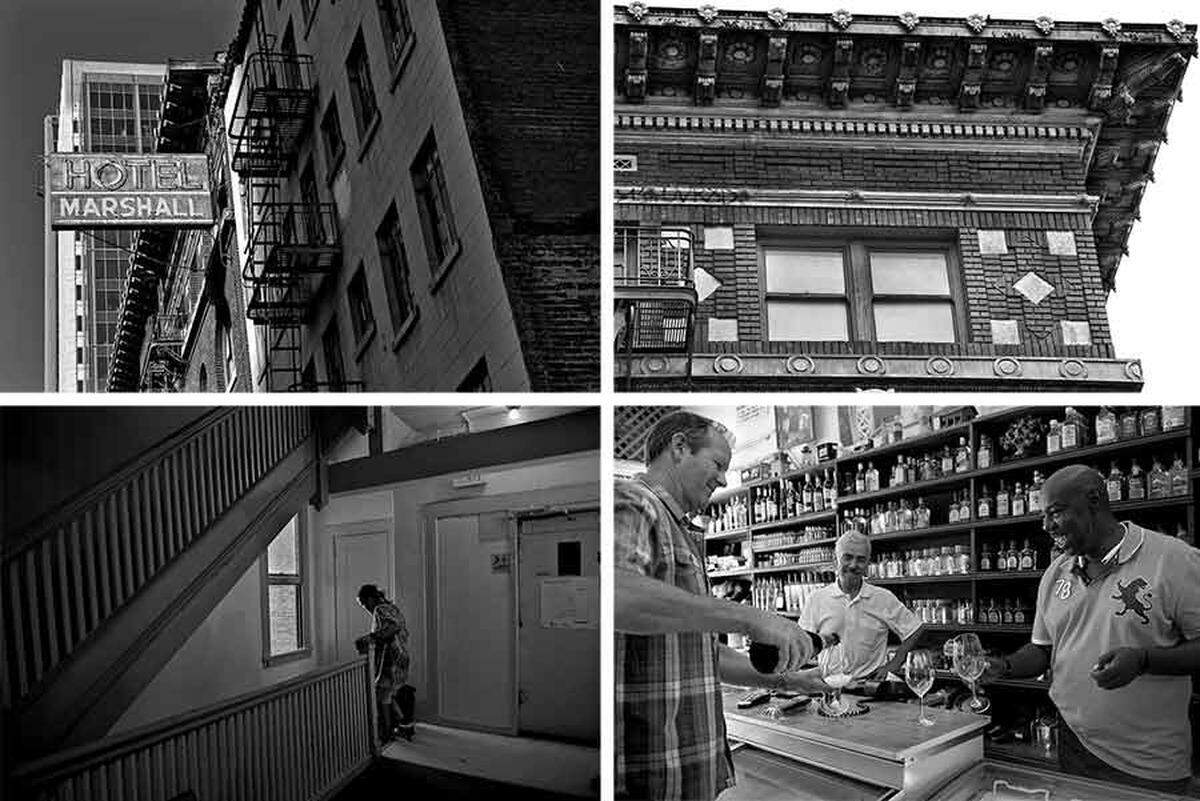
Architecturally, the Marshall remains a thing of beauty, with its brick façade, arched windows and elaborate floral cornice rooflines. Noack, whose family’s jewelry store once was a mainstay of downtown, acquired the building a decade ago for $3 million, with an eye toward transforming it into an upscale hotel that might help jump-start the city core. The double whammy of a bad economy and the disappearance of redevelopment funds delayed that plan for years.
Instead, Noack became landlord of what was widely regarded as one of the worst dumps in town.
“I didn’t buy the building to run this kind of thing,” he said, sitting in the conference room of a 1980s-era condominium complex on N Street that he is redesigning. He wore jeans, and, on his left foot, a walking boot, the result of a softball injury.
“Let’s face it, the Marshall was scary,” Noack said. “It still is scary. But I was never afraid of it.”
The hotel provided a reliable if not spectacular income stream, as most of the building’s tenants received monthly government disability checks. But the property was a magnet for vandals and drug dealers. Tenants regularly shattered windows and tore out light fixtures.
A code enforcement inspection last year discovered 17 violations, some described as dangers to life and health. Among other deficiencies, inspectors noted faulty electrical connections, missing smoke alarms, water-damaged ceilings and decayed plumbing fixtures.
Noack admitted he had little incentive to upgrade the property, knowing he would develop or sell it when the moment was right. But he said he has responded to complaints. “If I found out about an issue, I fixed it,” he said. “I never knew about a lot of these things until recently.”
Now, with the new arena rising a block away, Noack’s days as the Marshall’s landlord were numbered.
This month, his partner company, the Presidio Hotel Group of Fairfield, announced plans to transform the Marshall into a Hyatt: 10 luxury stories with condos or apartments on the top floor. The Marshall’s original façade will remain intact, because of its status as a historic building, but the interior will be gutted and rebuilt.
Noack had a bottle of champagne stashed away to celebrate the rebirth.
Chapter Three • Burned bridges
Raj Virk sat behind the Marshall’s front counter, flipping through a thick stack of files, pondering the task before him. “COOLING ROOMS ARE OPEN,” read a sign fashioned from a round pizza pan attached to the wall to his left. “NO SLEEPING.”
It was the first week in June, pushing 90 degrees in the early afternoon, and Virk’s deadline for emptying the Marshall loomed. A bank of wooden mail slots behind him suggested he was making progress. “GONE,” said a note attached to the slot for Room 402. “GONE,” said the slot for 406.
Twenty-four of the residents had collected their relocation checks and moved out. Four had gone to the nearby Capitol Park Hotel, operated by former Marshall owner Ronald Henry. Two had gone to the Hotel Berry, one to the Congress on 12th, one to Pensione K on Seventh, and two to boarding homes outside the central city. The others declined to disclose their new addresses. At least one, Viloria said, blew his check on “recreational things” before he moved into his new residence.
Thirty-three people remained, 19 of whom had identified themselves as physically or mentally disabled. It was Virk’s job to get them resettled by the end of the month. Renters could either work with him to find a new residence using the $2,400 to cover their costs, or sign a waiver and set out on their own.
Virk’s company, Overland, Pacific & Cutler, had plenty of experience relocating poor people displaced from their hotels and apartments. But given the hotel’s reputation, the Marshall was a uniquely difficult undertaking. SHRA was informally overseeing the process, which was expected to cost Noack around $300,000.
“This one is right up there in terms of challenges,” said Virk, who wears a thick beard and black turban reflecting his Sikh faith.
The city had enough low-budget rooms to accommodate the Marshall’s tenants, Virk said. It was a question of persuading residents to cooperate, and finding landlords willing to house them.
Most of the places agreeing to take the Marshall tenants were other residential hotels accustomed to dealing with people with mental illness and criminal backgrounds. But some banned tenants with felonies. Most had tighter rules on visitors, curfew and loitering.
At least a third of the Marshall’s residents had served time for serious offenses. Sackrider’s felony record includes weapons charges, indecent exposure and possession of methamphetamines. Keahey had served time for lewd acts with a child. Others, such as Donald Kraus, 57, had racked up dozens of offenses, including felony drug possession and child molestation.
By The Bee’s count, more than half of the Marshall’s 57 tenants had felony records. Probation officers knew the building as a hub for convicted sex offenders, and visited the hotel regularly to make sure they were abiding by court orders.
Beyond their criminal histories, many of the Marshall’s residents were battling alcoholism, addiction or mental illness. Few had cars, bank accounts or decent credit histories. Some were unable to read or follow instructions.
Virk made appointments with landlords on behalf of residents who never showed up. He helped them fill out paperwork that they lost or threw away. Cellphone to his ear, he frequently consulted with Noack, updating him on who was still hanging on. “Any ideas about what we’re going to do about 302?” he said one day, referring to Ricci.
Sackrider was trying to cooperate with the move orders, he said. He really was.
But despite meeting with one of the relocation people and making a few calls, he had no clue about where he might land. He had scratched out a list of possibilities on a piece of paper he kept in his pocket. No one was interested in renting to him, he said, and he could hardly blame them.
His criminal record discouraged some landlords. Others said they would have trouble accommodating a recovering addict who used a wheelchair and needed help bathing. Some places were out of his price range, since he earned about $1,000 a month from his Social Security and a small pension.
Sackrider grew up in Carmichael, but going home to family was not an option. He was 16 when he first tried heroin, he said, and had long ago burned his bridges. He had an estranged wife, a son named after him and a grandson whose baby picture he kept in his room. “But I haven’t seen him in a couple of years,” he said.
He worried aloud about ending up on the streets, another homeless man sleeping under a bridge. “I wouldn’t last,” he said, his eyes widening behind wire-rimmed glasses.
Word had begun to circulate that Marshall’s management would bring in sheriff’s deputies at the end of the month to get rid of the stragglers.
Skittles Larson, for one, had no interest in being extracted by cops.
A self-described street poet, he sat in the Marshall’s lobby one afternoon with a cardboard box of belongings. One held an umbrella, books and a framed family photo with a crack that scissored through the glass.
His blue eyes dancing and gray ponytail swinging, Larson told joke after corny joke as he waited for a friend to pick him up and help him move into his new digs.
“What did the stamp say to the letter?” he mused. “‘If you stick with me, we’ll go places!’”
“What did Mrs. Claus say to Santa when he asked about the weather on Christmas Eve? ‘There will be rain, dear.’”
Larson chuckled softly. “These things just come to me,” he said.
His new home would be Capitol Park, which he believed was safer than the Marshall.
Rising from the lobby’s worn sofa, he handed over his room key to Virk, who presented him with his check. Larson folded it and placed it in his pocket, then offered his hand to Virk. “Nice to know you,” he said with a smile.
Chapter Four • The final days
On the morning of June 29, Elizabeth Ricci approached Viloria at the front desk. She told him she wanted to pay her rent for the month of July. When he refused, she turned away, cursing him under her breath.
“Find a place to stay. Figure it out,” Viloria said sternly.
Later in the day, George Thornally appeared at the counter wearing a pullover sweater and hat better suited for winter than a hot summer day. He was in his 60s and had lived at the Marshall for a decade. Thin and balding, he avoided eye contact and rarely spoke.
“Are you ready to go, George?” Viloria asked.
“I’ll stay here,” Thornally said.
Virk frowned. “George, we’re closing down. We’ve talked about this every week for the past two months.”
Thornally looked confused. “Can I stay through July, sir?” he asked politely.
“No,” Virk said. “They have a room for you at Capitol Park.”
Thornally studied the floor. “There are angel machines there,” he said. “I wouldn’t want to go there.”
Hands in his pockets, he walked away.
The next morning, Viloria taped a “CLOSED FOR BUSINESS” sign at the lobby entrance. Curtains covered the front window, and the blinds were shut tight.
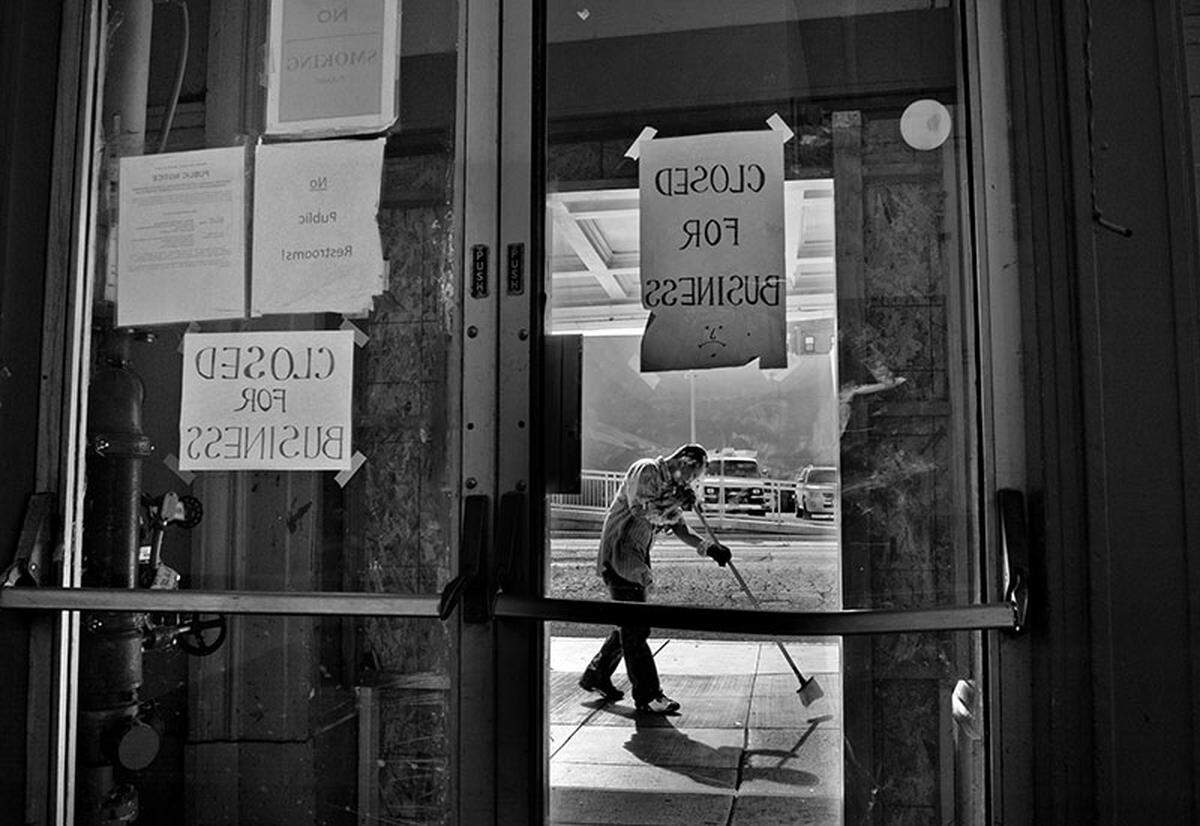
The Marshall was officially shuttered, but three residents remained: Ricci, Thornally and Bob Helms, a frail, wildly bearded man in his 60s. A contingent of others who had moved out were drifting back to see friends. Some raved about clean carpeting and central air conditioning, fresh paint and no bugs.
Sackrider would have joined them if he could, but he was stuck in the suburbs. He had moved into a tidy boarding home in Elk Grove that he shared with five other residents, and was “sleeping like a baby,” he said. His new home on a quiet cul-de-sac had a full kitchen, WiFi and caregivers to help with his physical needs.
But he longed for the Marshall and all of its freedoms. There, his door was almost always unlocked, and “people came in all day long to see me,” he said. “Me and my friends would get our booze and our cigarettes and sometimes some food, and we’d pretend we didn’t have any problems.”
The new place was more clinical. His new housemates kept their own counsel.
Floyd Merchant was having the same issue. He appeared at the Marshall’s front door that last day, as the street outside began to come to life with honking horns, rumbling trucks and the soft strains of a saxophone player. He wanted to see his old hideout one more time.
Posted next to the front counter was a notice about upcoming demolition on the block. Soon, it said, the area would boast an arena with “one of the most advanced designs in the world.” The building would “improve the quality of life throughout the downtown core,” the notice said.
Merchant was not so sure. He was already mourning his life at the Marshall. Everyone was scattered now, and the sidewalk gatherings had fallen away. Today would be his last day to watch old movies on the lobby TV. He wondered what would become of the framed poster of Monet’s “Parisians Enjoying the Park,” which Viloria insisted looked different from various angles in the room.
Merchant’s new place was comfortable. But “over there, people stay in their rooms all day, and there’s nothing to do,” he said. “It’s ‘You got your room, and I got mine.’ So I go out to K Street, sit for two or three hours and go home.”
“I like it here better,” he said, and settled into one of the three remaining lobby chairs, his cane resting in his lap.
Soon Dennis Jenkins showed up, smiling at first, then collapsing into Viloria’s arms for a slobbery goodbye.
“Oh, Dennis, what are you doing?” Viloria said, offering him a sheet of toilet paper from the roll on his desk. “Wipe your face. It will be OK.” Jenkins dabbed his eyes, and settled in next to Merchant.
The remaining residents had been given a noon deadline to leave. Helms had expressed a vague desire to live in San Francisco, but remained barricaded in his room. Thornally had rejected an offer from Capitol Park. Ricci had taken applications from a dozen places, but had refused to commit.
Noack agreed to give them all one one more night at the Marshall.
The next day, at 8 a.m., Virk reviewed his paperwork, as a fan stirred the warm lobby air. He wondered what would become of the Final Three.
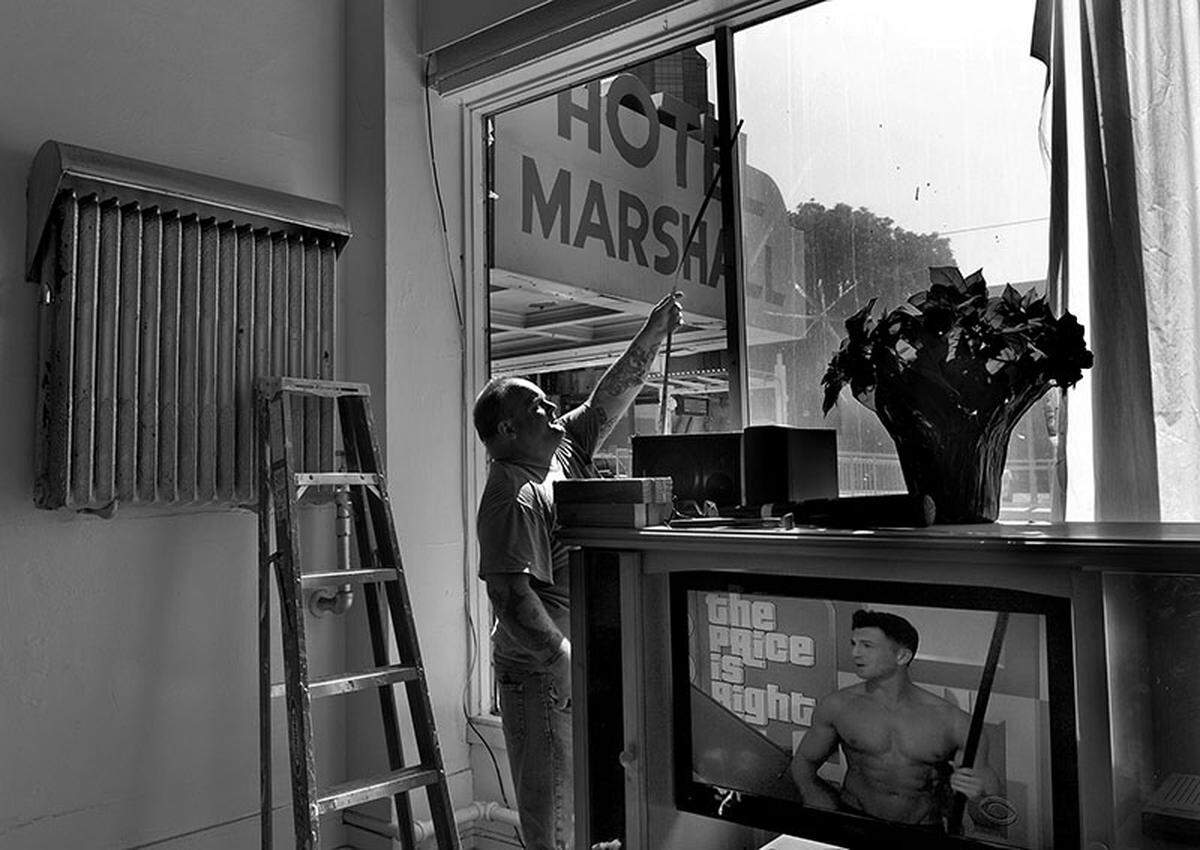
The blinds were open just wide enough to allow a splash of morning light. The lobby was quiet, and the television mutely broadcast the latest news from Wall Street. A shadow touched the front window. Virk glanced up and saw a wiry, unshaven man. Cursing loudly, the man reared back and hurled his backpack into the window, shattering it in a starburst pattern. Glass rained into the lobby.
Virk darted outside, punching 911 into his phone. He spotted former resident Bruce Presley chasing the man across L Street. By the time police arrived, Presley and Virk had wrestled him to the ground. His actions had nothing to do with the closure, it turned out. The Marshall was simply a convenient target for a drug-fueled rage.
The officers who responded, Michelle Lazark and Colette Chiamparino, were downtown beat cops familiar with the Marshall’s tenants. They agreed to take a crack at the three holdouts.
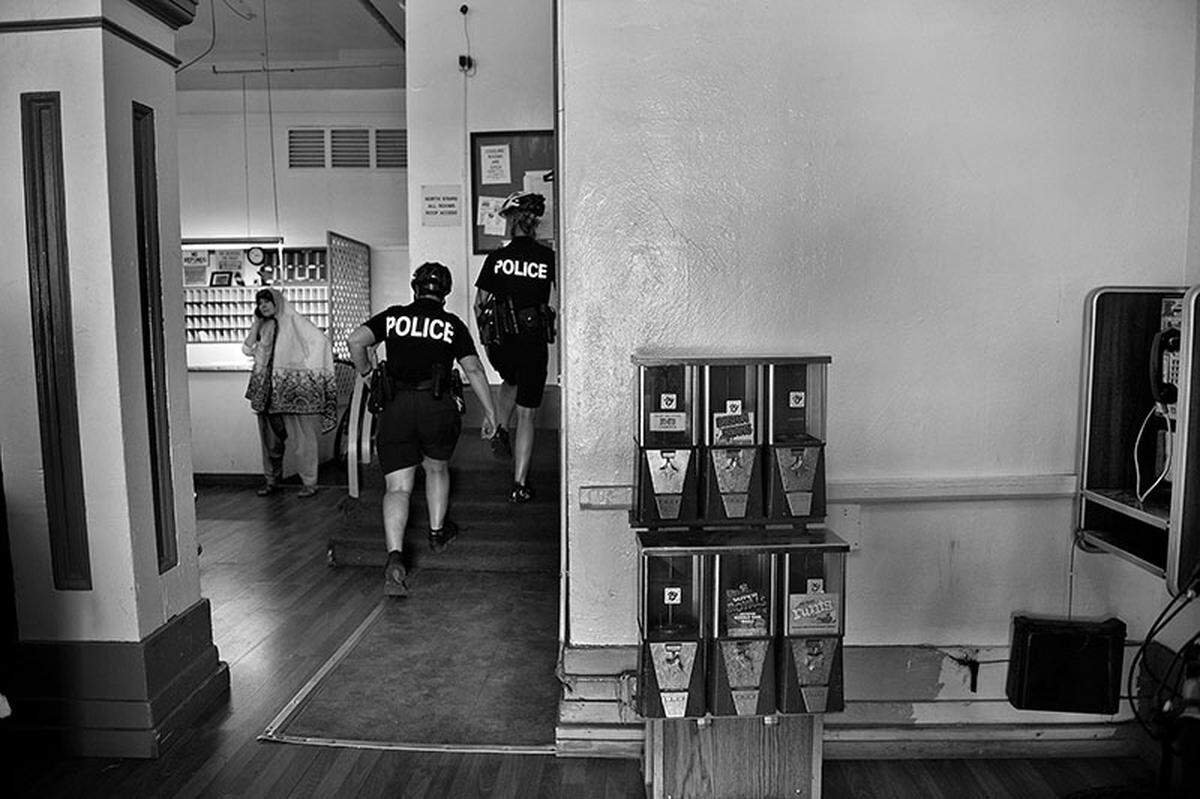
First, the women went to Thornally’s room, navigating rickety steps to the second floor. The floor of his room, covered with clothing, was barely visible, the odor nearly suffocating. They told him his new room was ready at Capitol Park.
“George, I understand you’ve been here for a long time,” Lazark said. “But there could be a better life for you outside of this place. I know it’s scary, but I want you to be brave. Have an open mind. I’ll take you over there, and I’ll come and check in on you.”
He agreed to gather his things.
The officers found Helms standing on the corner of Seventh and L, his long gray hair and beard obscuring his face as he dived for cans in a garbage bin. Lazark approached him cautiously.
“Hey, Bob, I hear you want to go to San Francisco?” she asked gently. Helms nodded. He had relatives in the city, he said. The officers would need to confirm that information before putting him on a train, Lazark told him. “Let’s look at a schedule and see about getting you on a train today, OK, Bob? Raj has a check for you.”
Helms, defeated, slowly retreated to the hotel.
A few minutes later, Thornally emerged, cradling a box, his cheeks pale and oozing blood. “I cut myself shaving,” he explained. With a hand on his shoulder, Lazark steered him to her police cruiser. Using the window as a mirror, he made a cursory attempt to scrub his face with saliva.
“Can we take you to Capitol Park now?” Lazark asked.
Silent, he climbed in the back seat, and they pulled away.
And so it had come down to Ricci, whom no one had seen all day. Unsure how to proceed, Viloria and Virk called Noack for consultation. If she appeared, Noack told them, let her into the building.
Just after 5 p.m., Ricci did return home from her daily stroll. The cops were gone, the lobby entry chained shut. Ricci pounded on the door, and a janitor opened it, greeting her by name.
Ricci stepped into the lobby and strode across its wooden floor and up the rickety steps, just as she had done every evening for nearly 25 years.
For at least one night, the Marshall was all hers.

Epilogue
Of the 57 tenants who received notice they had to vacate the Marshall, three ended up at Hotel Berry, 14 moved into Capitol Park, and one each to the Congress, Golden and Jade hotels. Two relocated to Pensione K, and four to a sober-living apartment called Pete’s Place. Seven moved to boarding homes. One was admitted to a hospital. Many refused to provide their new addresses.

Elizabeth Ricci refused to leave the Marshall for three days after the June 30 deadline. Sacramento County mental health workers were sent to assess her for an involuntary psychiatric hold. They determined she did not fit the criteria and suggested the eviction process move forward. Former resident Bruce Presley finally persuaded her to check into a downtown motel, where she stayed for a few nights before accepting her $2,400 relocation check and moving to an unknown destination.

Bob Helms never made it to the train that was supposed to take him to San Francisco. After collecting his relocation check, he went to Macy’s and bought new clothes. He got a hotel for at least a few days, Officer Michelle Lazark said, but now appears to be living on the streets.

George Thornally is still living at Capitol Park. His room is clean, and he has his own bathroom for the first time in years. “He’s happy,” Lazark said. “He’s settled in.”

Terry Sackrider nearly lost his place at his Elk Grove boarding home, he said, because of drinking and bad behavior. Since moving to the home in late June, he said he has spent time in a psychiatric hospital, undergone surgery for a cracked hip and tried to kill himself by overdosing on prescription drugs.

Floyd Merchant has since moved from Capitol Park to a senior community at Seventh and H streets, and is pleased with his new environment.

Mannan Viloria is looking for work as an industrial or mechanical technician. “I’ve sent out lots of résumés, but no one is calling me,” he said. He said he has not been back to Seventh and L since the Marshall shut down. “I miss the people,” he said, “but not the place.”
This story was originally published December 27, 2014 at 6:00 AM.