
John Sutter statue in midtown Sacramento vandalized with red paint
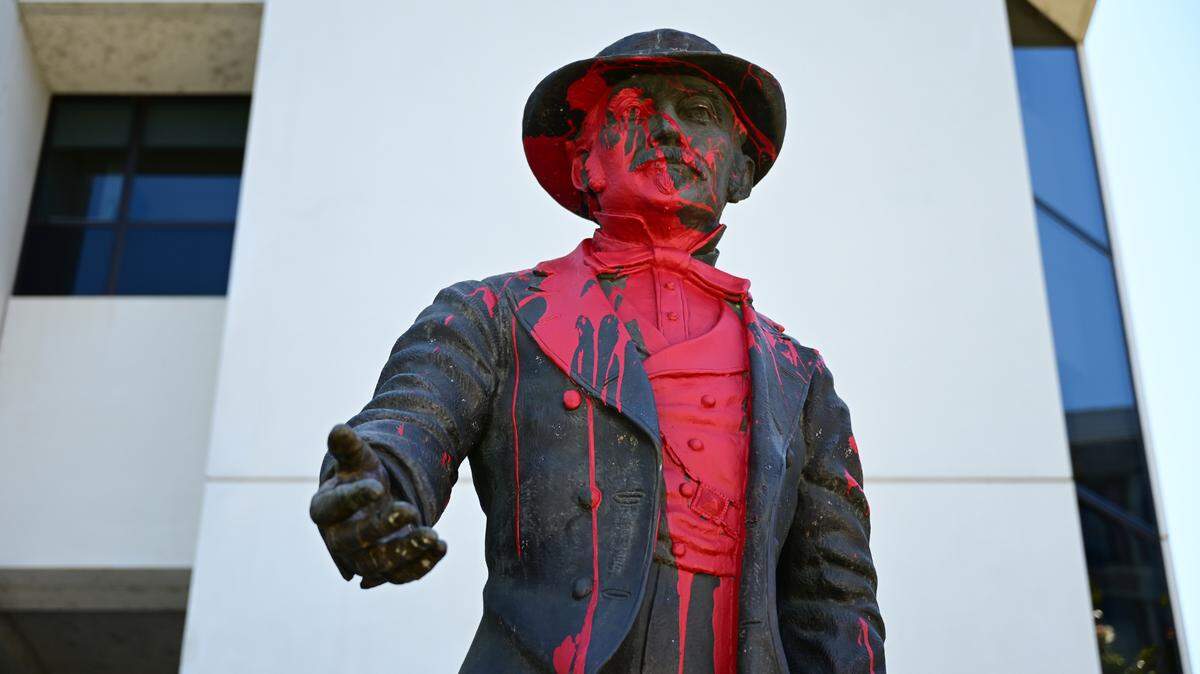
The statue of John Sutter, the Sacramento Valley’s first European settler, was vandalized Monday in midtown Sacramento.
The bronze monument, which stands outside Sutter Health Medical Center at 28th and L streets overlooking Sutter’s Fort to the west, was spattered with red paint. The act came about a week after many Sacramento businesses sustained damage when vandalism took place downtown following nonviolent protests over the death of George Floyd.
Officer Karl Chan, spokesman for the Sacramento Police Department, said an officer was hailed at 10:35 p.m. regarding the vandalism. The person told the officer they saw that red paint had been splashed on the statue.
The officer made a report and canvassed the area for witnesses, Chan said. The investigation is ongoing.
Sutter was a Swiss immigrant who is credited with building Sutter’s Fort and founding New Helvetia, an early settlement built near the confluence of the Sacramento and American rivers near where the city of Sacramento now stands.
The 8-foot-high, one-ton statue was erected in 1987 after the state Department of Parks and Recreation refused to allow its placement in Sutter’s Fort, fearing it would mar the fort’s authentic appearance. The $130,000 statue was donated to then-Sutter General Hospital by the United Swiss Lodge to commemorate “a man of vision and compassion,” according to the statue’s inscription.
In 1834, Sutter left Switzerland for the new frontier. He set out to build an agricultural empire and began by building Sutter’s Fort in 1839. The fort was a temporary refuge for pioneers during the 1840s. After James Marshall discovered gold in Coloma in 1849, the fort was overrun by squatters and others hunting gold in what was then the world’s largest voluntary migration. Sutter’s son, John Sutter Jr. founded Sacramento.
In the past three decades, Sutter’s treatment of American Indians has received renewed academic attention from historians, including the late Jack Forbes, a professor of American Indian studies at UC Davis.
“He was a rapist. He was an enslaver,” Forbes said of Sutter in 2006, when the city of Davis removed his name from what is now David Risling Jr. Court. “We can’t afford to honor men like that.” Forbes died in 2011.
Many of the historical accounts cite the writings of Heinrich Lienhard, a contemporary of Sutter, who described Sutter as using American Indians as slaves, locking them in rooms at night and sending posses to hunt and sometimes kill those who escaped. Lienhard also wrote that Sutter had sexual intercourse with American Indian girls as young as 12.
Steve Beck, then-archivist at Sutter’s Fort State Historic Park, told the Sacramento Bee in a 2006 interview that other writings from that era indicate that Sutter did pay his workers and treated them well. He added that Lienhard was jealous of Sutter for the attention he received from his association with the Gold Rush.
This story was originally published June 9, 2020 at 11:29 AM.