
As protests over systemic racism persist, Sacramento schools find themselves in the middle
Keilin Archie, a recent graduate of Monterey Trail High School, has a critical view of classroom discussions of race.
The curriculum remains the same throughout every grade level, Archie said, from kindergarten to senior year where he learned about slavery, the Civil Rights Act of 1964, Martin Luther King, Jr. and Rosa Parks.
“They teach it as if, ‘OK, slavery happened, then they abolished it. Then, you know, the last racists on earth killed Abraham Lincoln and died in prison,’” said Archie. “They do away with it as if it’s no longer an issue.”
Archie, and other like-minded students and teachers, say the new civil rights movement is looking for ways to provide a fuller and more nuanced view of race in classrooms at a time when Sacramento-area schools are caught at the friction point between Black Lives Matter protests and institutions struggling to adapt to the issues raised by the protests.
Several Sacramento school districts have been formulating plans to address racial disparities and create a more inclusive environment for staff and students alike. Changes are coming.
Floyd protests spark action
One of the issues raised by the protest movement is the presence of police-backed school resource officers at public schools.
After George Floyd was restrained and killed by Minneapolis police officers on Memorial Day, some students and educators called for the removal of police officers from schools. Locally, the Sacramento City Unified School District opted to not renew a $600,000 contract with the police for the school year that started in August.
Instead of staffing schools with police officers, the school board decided to create an Alternative School Safety Task Force, charged with studying what to do about violence in schools. It includes representatives from groups including the African American Achievement Task Force, Community Advisory Committee, labor groups, parents, staff and students.
Other schools haven’t been so quick to make changes on that issue or on broader matters of curriculum, some say. At Cordova High School, recent graduate Jordan Kaitapu said he joined the school’s new chapter of GENup, a student-led social justice group, to push for anti-racist curriculum and mandatory implicit bias training.
On July 17, GENup held a sit-in at the district office to advocate for its demands. “There was no response from the district whatsoever,” said Kaitapu. “They didn’t address us at all.”
Modern issues such as police brutality are “never talked about,” said Cordova senior Stephen Wiley.
The status quo
Keilin Archie’s teachers “kept the news, as far as (how) Black individuals are being treated, completely out of it,” he said. He began high school in 2016, and the lesson plans kept up with that year’s election extensively — yet, when it came to any of the Black people killed by the police, “Nothing. Not a single word.”
“It’s a complete joke,” said Jencie Ferraro, a white mother of five Black adopted children who go to school in the Elk Grove Unified School District. She said most of what’s taught about Black history focuses solely on suffering — like how Black leaders are killed — which has proved painful for her kids.
“There’s so much joy and brilliance that isn’t being taught,” she said.
Schools and teachers say they are making efforts to teach about racial justice and more extensively about Black history.
Keilin Archie’s mother, Tanya Archie, is a special education teacher in Natomas Unified School District. This past summer, she taught the history of Juneteenth to her students and their parents — none of whom knew about the holiday.
Kim Gavin Austin — a teacher at La Entrada High School in San Juan Unified School District — crafted an elective class on the 1619 Project, which reorients American history around slavery and the contributions of Black people. She said she’s also woven books such as Michelle Alexander’s “The New Jim Crow” into her lesson plans.
These teachers said they pushed for anti-racist curriculum beyond their own classrooms — beyond elective status — and that their respective districts dragged their feet.
In Tanya Archie’s face-to-face conversations with Natomas administrators and members of the board of trustees, “You get the, ‘Oh, that’s a good idea. We can put that on the table for next month and we’ll revisit it,’” she said. “Next month never comes. Revisiting it only happens when you bring it up again.”
Austin is pessimistic about the prospects for genuine change in the San Juan district. She said she is the only Black teacher at La Entrada and said the district is extremely far from reaching a standard of anti-racist education.
“I know how to teach white curriculum, because that’s all we teach,” said Austin. “But white teachers are not prepared to teach a diverse curriculum, so it’s going to take a lot of training for them to catch up.”
Trent Allen, a spokesman for the district, said SJUSD is implementing social justice standards throughout its curriculum. He said the district is working to add texts and materials that “reflect a diverse population and tell the counter-stories as opposed to dominant narratives.”
Allen said the district has sent “hundreds if not thousands of staff to custom training at the Museum of Tolerance. And more changes are coming, Allen said.
“We have recently created an eight-point commitment to educational justice to help call out and organize the actions we will take to build a school system and community that is more equitable and free of racism and other forms of prejudice,” he said. “Part of this work is to support and encourage others to develop their own skill sets. This work reflects conversations from prior years and intense dialogue that occurred after the tragic killing of George Floyd this summer.”
The debate isn’t just happening at the local level. The debate over including Pacific Islanders and Arab American communities in Asian American studies reached the state’s Instructional Quality Commission in August.
Keilen Archie emphasized that changing what students are taught about race is integral to changing school culture overall.
“When a kid doesn’t know much about something, he will poke fun at it. Out of that, you get racist remarks being thrown around campus,” she said. “A lot of teachers, they’ll see it, they’ll try to address it. But they’ll leave it alone, without realizing that their lack of acknowledging Black history is what’s fueling this ... ignorance.”
Looking forward
Diana Marshall, director of equity and student achievement at San Juan schools, said the district has worked with California State University, Sacramento to train teachers on the social justice standards put forth by the organization Teaching Tolerance. The 20 standards are grouped into the categories of identity, diversity, justice and action; lessons can include teaching students how to recognize stereotypes or how to write letters to their legislators.
Marshall said the implementation of the standards has been an ongoing effort for the past five years, but that a “real focus” right now is integrating them into distance learning lessons and formalizing them as a part of curriculum selection.
San Juan’s plans were, in large part, developed through six community listening sessions held in June, said Marshall. The inaugural two were open to all school stakeholders, and titled “A Time to Heal.”
Jorge Aguilar, superintendent of the Sacramento City Unified School District, said another issue driven by the focus on race in education is the disparity between suspension rates for Black students and others across all grade levels. Since last year, a team has focused on supporting schools most affected by this phenomenon.
Still, Aguilar said, “There’s no way that I’m gonna sit here in front of you and say that we have figured this out. We have to be able to look into the mirror, adopt an improvement mindset, and understand the extent to which how we have designed our system has created these disproportionate impacts in our communities.”
Doing so will be particularly important, he said, in light of distance learning and its unique implications for school discipline.
Aguilar cited one positive for Sacramento City: it is one of the first school districts to make ethnic studies a graduation requirement.
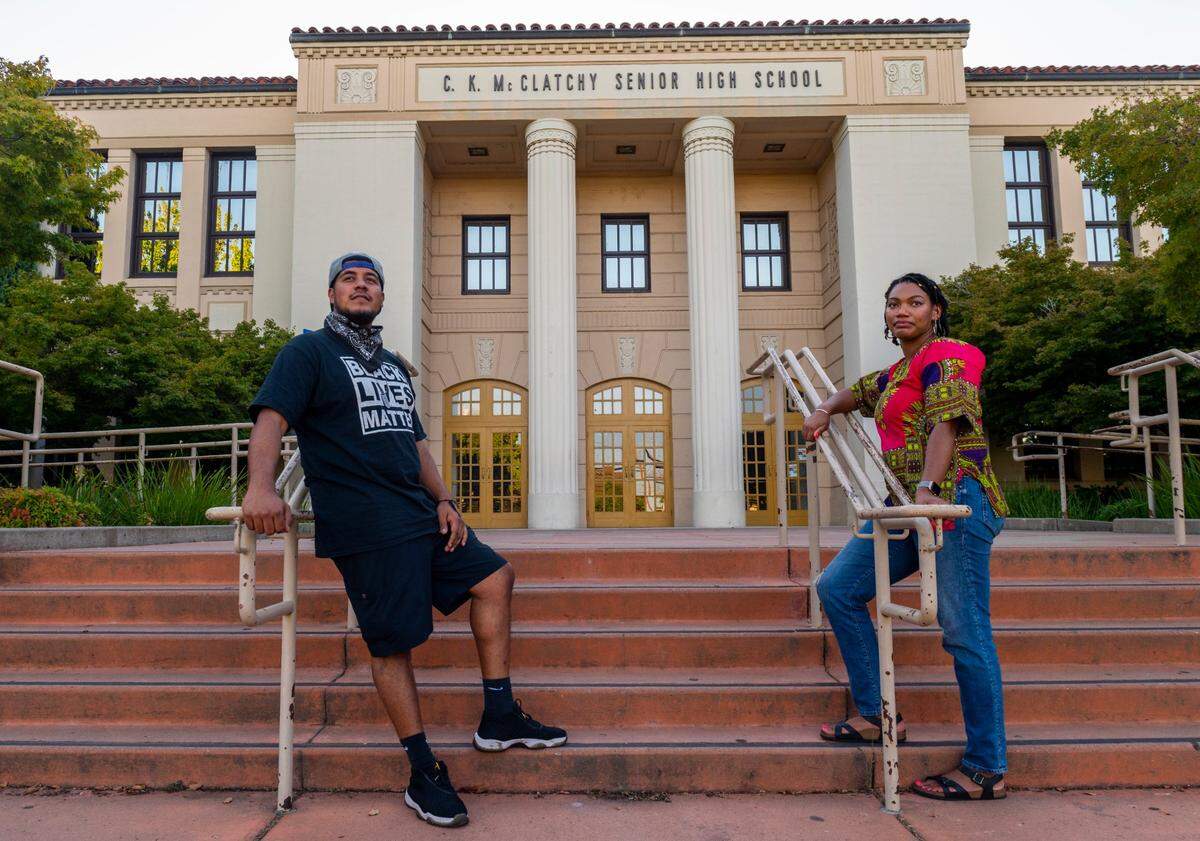
Dominique Williams, who teaches ethnic studies at C.K. McClatchy High School, described the course as a way of “looking at institutions and advocating for the needs of people of color,” as well as helping students to “heal from all kinds of internalized ideas about themselves and negative ideas about other people.”
The district redesigned its social and emotional learning plan for distance learning to explicitly speak about racial justice.
“We think this will help our students understand transformative justice, self-awareness, how we connect to others in our community — especially those that are different — and embracing diversity, equity, inclusion,” said Aguilar.
Teachers take initiative
Some teachers have taken it upon themselves to spark change within their schools.
Williams has partnered with Luis Guerrero — a math teacher at McClatchy — to hold a weekly two-hour anti-racism seminar for fellow staff members. She suggested part of the focus is holding teachers accountable when they are insensitive.
“Isn’t it kind of odd that we have this critique for cops to protect harmful cops, but we also exist in an institution that protects harmful teachers?” said Williams.
Williams and Guerrero seek to combine theory and practice, providing teachers with both the language to talk about racial issues and the tools to address them. They kicked things off with Ibram X. Kendi’s book “How to Be An Antiracist.” Later sessions focused on how McClatchy, specifically, may be perpetuating racial injustice.
According to Guerrero, the seminar asks questions like: “What does our grading policy look like? How does that impact our Black students? What about our discipline policy? What about the graduation rates? The going-to-college rates?”
About 30 teachers have consistently attended the seminar — a number that far exceeds Williams’ and Guerrero’s initial expectations. McClatchy’s new principal has dropped by several times.
“There’s hope. There are teachers really interested in, invested into, this work. The most important piece that I’m getting out of it is that teachers are showing that they’re about a growth mindset,” said Guerrero. “I think that’s the most beautiful thing that I’ve seen from this.”
This story was originally published September 17, 2020 at 5:00 AM.