
Controversial ethnic studies draft approved by California commission, moves to final round
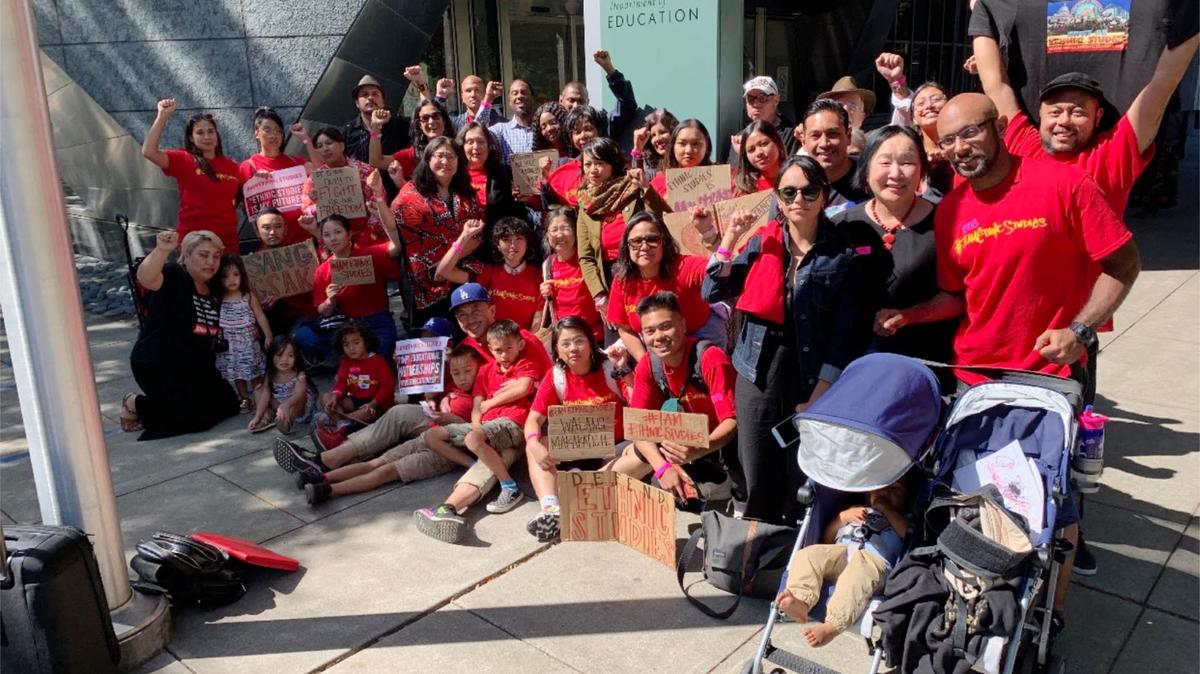
The state’s ethnic studies draft curriculum moved forward for final approval, but faced another round of controversy in a two-day state department meeting filled with hours of public comment, line edits to the current draft and debates on who gets representation and how.
The Ethnic Studies Model Curriculum serves as a guidance document to help school districts interested in adopting lesson plans. The curriculum was created with the intention to cover four areas: Black/African American studies, Chicano/a studies, Native American studies and Asian American studies.
But the state’s Instructional Quality Commission spent hours on Wednesday listening to public comments from dozens of people who demanded that Arab American studies be included in Asian American studies, reigniting the longstanding debate surrounding how Arab American narratives, particularly those for Palestinians, will be included in the draft.
Throughout the 12-hour meeting over parts of Wednesday and Thursday, the commission debated the definitions of racism, the inclusion of capitalism as a study topic and the use of terms like “third world” and “patriarchy.”
Much of the discussion covered how to organize the lesson plans and how to include other ethnic groups.
“We have been candid with folks that we need to hold some fidelity to these four groups, these four disciplines, that have made ethnic studies,” said California State Superintendent of Schools Tony Thurmond. “But we have also tried to create a nod to many other groups that faced oppression of some kind, and also sending a message about interconnectivity among groups. Many share similar immigration stories and stories of dealing with oppression.”
During Thursday’s commission deliberations, Assemblywoman Shirley Weber, D-San Diego, questioned whether the additional lesson plans outside of the four core groups might detract from teachings on the four original groups.
State Sen. Ben Allen, D-Santa Monica and chair of the California Legislative Jewish Caucus, and newly appointed IQC member Anita Friedman, who serves on Jewish Family and Children’s Services, pushed back on Weber’s assertion that additional lesson plans take away from the core groups.
“The idea that these additional lessons are going to take over the courses is not grounded in the way these lesson plans are developed,” said Allen. “They are one-day lessons.”
Thurmond told The Sacramento Bee that the additional lessons give the state more opportunities to include additional narratives and experiences into the curriculum from a wider range of ethnic groups to combat stereotypes and hate.
Controversy continues to loom over Arab American studies
State education officials placed those additional lesson plans in what they call the “bridge,” sparking an outcry from teachers and college professors who said communities like Arab Americans belonged in Asian American studies..
“Why would the CDE remove Arab American studies from its rightful place in Asian American studies? Relegating us to the ‘bridge’ must be understood as a political move and essentially mirrors ‘separate but equal’ policies,” said Lara Kiswani, executive director of the Arab Resource and Organizing Center.
Thurmond said the education department did not specify where exactly Arab American studies would be placed in the curriculum.
“We acknowledged that Arab American studies has a path in ethnic studies,” Thurmond said. “Some of the advocates made the case that its path is through Asian American Studies. We agreed with that publicly, and we still do. We also acknowledge that those who identify as Arab American may come from Asian countries originally or African countries. This whole process has been organic.”
The bridge itself, previously labeled as the “appendix,” also hosts Jewish American studies, Armenian American studies and Sikh American studies — communities that were vying for inclusion in the curriculum.
Several Jewish students and leaders stressed the importance of including a strong definition of anti-semitism in the curriculum and to cover the diversity in the Jewish community.
“We are encouraged that the California Department of Education has proposed that lessons on the Jewish American experience be a part of this model curriculum for all the state’s public schools,” said Tyler Gregory, executive director of the San Francisco Bay Area Jewish Community Relations Council.
The IQC ultimately adopted 29 newly submitted lesson plans approved by the Department of Education into the bridge, including an Arab American lesson plan. But that plan drew criticism from several Arab organizations and scholars for largely focusing on Arab stereotypes in literature and films such as “The Great Gatsby.” Contrary to other ethnic studies lesson plans, they said, it also failed to include contributions Arab Americans made to American society.
Arab American scholars and organizations submitted their own lesson plan in August, and later resubmitted edits, but their proposal was not reviewed during Thursday’s meeting.
Elias Serna, an English and Chicano studies professor and president of the Association of Mexican American Educators-West Los Angeles Chapter, said he was concerned about the failure to review those scholars’ suggestions.
“Where are the ethnic studies scholars and practitioners? It takes audacity to attempt to redefine the field of ethnic studies, and the ease and arrogance with which it is going on has to remind some of us that colonization has not ended,” he said.
Kiswani also objected, saying Arab American contributors to society, including elected officials like U.S. Congresswoman Rashida Tlaib, were suppressed from the lesson plan submitted by the original writers.
Penny Rosenwasser, who teaches classes on anti-Semitism and anti-Arabism at City College of San Francisco, said it was vital for Arab Americans to see Palestinian narratives included in the curriculum.
“My students thrived from inclusion,” she said. “Please don’t deny them that.”
What’s next?
With Gov. Gavin Newsom vetoing bill AB 331 in October, ethnic studies will not be a requirement for high school graduation — although Thurmond is hopeful a more robust bill will be introduced in the future.
For now, the model curriculum will serve as guidance for the nearly 1,000 California school districts — some of which have adopted ethnic studies requirements for their students.
“Every school district will have to make the decision to approve a curriculum locally,” Thurmond said. “Will they have the resources to train educators to deliver this work?”
Thurmond said he recognized the need for ethnic studies came more into focus this year after the killing of George Floyd, adding that he’s heard from high school students who want to see more people of color in their history books.
“It builds the self-esteem of students of color,” Thurmond said. “It’s important to tell the stories of oppression, and bigotry and hate, and it’s also important to tell the stories of accomplishments of people of color in California.”
The draft will be posted for a final 45-day period for review and public comment. State law requires the State Board of Education to take final action on the model curriculum by March 31, 2021.
This story was originally published November 20, 2020 at 5:00 AM.