
Roseville high school district keeps 5-day schedule after surveying parents and moving desks
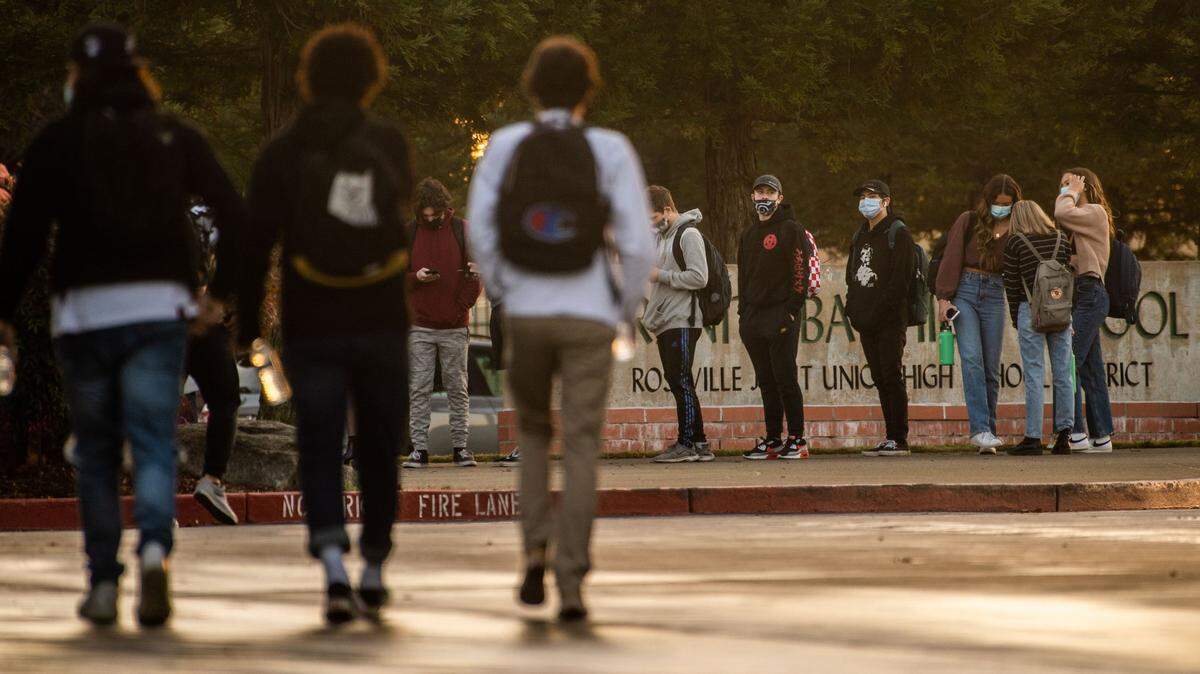
With permission from Placer County health officials and a green light from the state, a Roseville high school district is maintaining its five-day, in-person schedule, making the area’s public high schools among the few in the state to welcome most students on campus for nearly a full day.
Roseville Joint Union High School District considered returning to a hybrid schedule, bringing students back on alternating days, after learning that not all of its campuses would likely be able to adhere to new state guidance to have at least four feet between students in a classroom.
But board members voted on Jan. 26 to survey families within 72 hours, identify which students plan to return, and prepare classrooms at Roseville, Granite Bay and Antelope high schools to safely fit all returning students.
On Sunday, the district announced Antelope, Oakmont and West Park high schools will continue their five-day schedule with four feet spacing in classrooms. Granite Bay, Roseville and Woodcreek high schools will continue five-day schedule without four feet spacing.
Interim Superintendent Jess Borjon told The Sacramento Bee that Safe Schools for All official Dr. Naomi Bardach, who works to support safe reopening to in-person learning across the state, permitted the county health officials to make the call for the district to keep its schedule.
State officials acknowledged that there were some “unintended consequences” to the new Jan. 14 state guidance, and they are working to mitigate situations, including adjusting guidelines regarding physical distancing mandates for schools that have already safely reopened their classrooms.
Borjon said those schools that could not maintain a four-foot distance are being given a safety mitigation plan, which will be released this week by the state.
The California Department of Public Health “would like to ensure that schools that have currently opened, in a safe manner and continue to show that their safety mitigation measures are contributing to lower transmission rates, should not be forced to close in-person instruction,” read a letter from the Safe Schools for All team. “CDPH is in the process of developing a ‘Safety Modification Form’ that will consider requests for those schools that are currently providing in-person instruction and can show the circumstances in which they cannot meet current guidelines (e.g. current physical distancing guidelines) that would result in students returning back to distance learning.”
Some schools are expecting more students
Granite Bay Principal Jennifer Leighton sent an email to some families stating that “any form of distancing will not happen — sorry — classes have been large in January and could likely grow tomorrow since 300 more than we’ve had are planning to return.”
Greg Fisher’s daughter, a tenth-grader at Granite Bay High School, is one of those students. She’s been doing distance learning on Zoom since March, and Fisher was hopeful their campus would return to a hybrid model to provide more physical distance between students in classrooms.
Fisher said he is concerned that with more students showing interest in returning, there will be even less space between students in the classroom. His daughter opted to return to campus on Monday, even though it may not be as safe as under the hybrid model.
“That’s the conundrum,” he said. “We know that Granite Bay can’t do what the guidelines call for.”
Fisher and his daughter spent Sunday evening discussing options for Monday. She knows that one of her teachers said there was adequate spacing in her classroom, and another classroom has good ventilation. But with more students returning to campus, Fisher said he is worried teachers will have a difficult time teaching to both students in the classroom, and the handful of students on Zoom.
“We have the option of continuing to be online when the majority of kids are in class,” he said. “But that relegated her to being at the short end of the teaching. It’s hard for the teachers to do both.”
School staff worked to reconfigure classrooms
Nicole Haynes teaches English at Oakmont High — one of the high school campuses that can keep students four feet apart — where she spent a few hours on Sunday figuring out how to add two more desks to her classroom. But even with 22 desks, she can’t accommodate the 29 students signed up for her largest class, ninth-grade English, so she is slated to move the larger classes to other rooms with more space.
But Haynes, an advocate of the hybrid model, said she thinks the district is trading off effective instruction to provide a more traditional looking schedule. Seating students wall to wall in one classroom makes it difficult for her students in the class to see her and her instructions, and students on Zoom are less engaged, she said.
Haynes was able to create four feet of space between her students’ desks but under the new configuration seven students are right under the television and whiteboard she uses for daily instruction.
“It’s like having last-minute seats at the movie theater,” Haynes said. “And I can no longer access those boards, or else I would be too close to students and there is no room to stand there.”
Haynes said the current seating plan in her classroom is safer than what she had before Oakmont administration went classroom by classroom last week to space out desks and move bulky items out of rooms and into the hallway. In early January, Haynes had some students touching elbows, and students were 18 inches from the students in front of them.
But without aisles to walk through to check on students’ work, and not being able to use TVs or whiteboards, Haynes questions how effective teaching a packed classroom is as opposed to a half-filled hybrid one.
“Are we trying to maximize capacity of the classroom or maximize capacity for learning?” Haynes asked.
Parents react to the schedule
Some parents said that maintaining a five-day schedule was more than just academics for their children, but an important opportunity to see their classmates everyday.
“Our kids need consistency, predictability and relationships with their peers and teachers,” parent Karen Combest said in an email to The Bee in reaction to the district’s announcement. “We are thankful for the leadership from our Board, our principals and the support of great teachers and ultimately Placer County Health department. There’s a saying ‘it takes a village,’ and today we should all be proud of being part of this village!”
Dozens of parents reached out to district and county officials asking them to allow students to remain on campus. It’s unclear how many more additional students returned to campuses on Monday at each of the district’s six campuses.
Fisher said the biggest challenge is simply not knowing what to expect, but it’s helpful to have the ability to return to distance learning if classes become too crowded.
“We don’t know how crowded it will actually be,” he said. “We don’t know full numbers. We don’t know each class size and what that means for our student, and whether people who committed to staying home are actually doing that. It could be even more crowded.”
The teachers union plans to meet virtually on Monday to discuss the district’s decision.
“There isn’t one answer to make everyone happy and fix the inequities,” Haynes said. “Each one has their pros and cons. And that has to be acknowledged. But I think we have to be careful what we are trading in return for having more bodies in a room.”
This story was originally published February 1, 2021 at 1:25 PM.