
Sacramento schools offer bonuses worth thousands of dollars, to be paid with COVID funding
Sacramento schools received about $289 million in federal COVID relief funds over the last two years, giving the Sacramento City Unified School District a financial cushion to navigate the pandemic.
The money, coupled with a smaller infusion of special funding from state government, can’t necessarily solve the teacher and classified employee strike that has had campuses closed for the past four school days. It’s a one-time flood of cash that district officials say they can’t plug into ongoing salaries and benefits.
But, the district wants to use a chunk of it to sweeten its offers to the Sacramento City Teachers Association and classified employees represented by SEIU Local 1021 in a way that could help end the impasse.
The district is proposing to use federal and state COVID-relief money for one-time only bonuses and stipends as well as other initiatives, such as hiring 125 people who help students cope with the pandemic and its after-effects.
Teachers who worked in the district this year would get a bonus equivalent to 3% of their salary. They’d get another 1.5% if they worked last year, and an additional 1.5% if they worked in the district the year before that.
That would amount to a bonus of about $5,000 for teacher who worked over the past three years and earned the district’s average salary of $83,404.
The district also wants to use a portion of the federal and state COVID0-19 money as an incentive to persuade teachers to leave a high-cost health care plan. It’s offering $3,000 to teachers who leave a HealthNet plan and take up a Kaiser plan.
Classified employees represented by SEIU Local 1021 would get bonuses of $4,500 if they worked in the district for the past three years, according to the district’s latest offer to the union. Those bonuses are not pegged to the workers’ salaries.
Outside of the COVID-19 bonuses, the district is offering the unions a 2% wage increase out of its operating budget. SEIU Local 1021 in a Monday night news release called the raise offer insufficient.
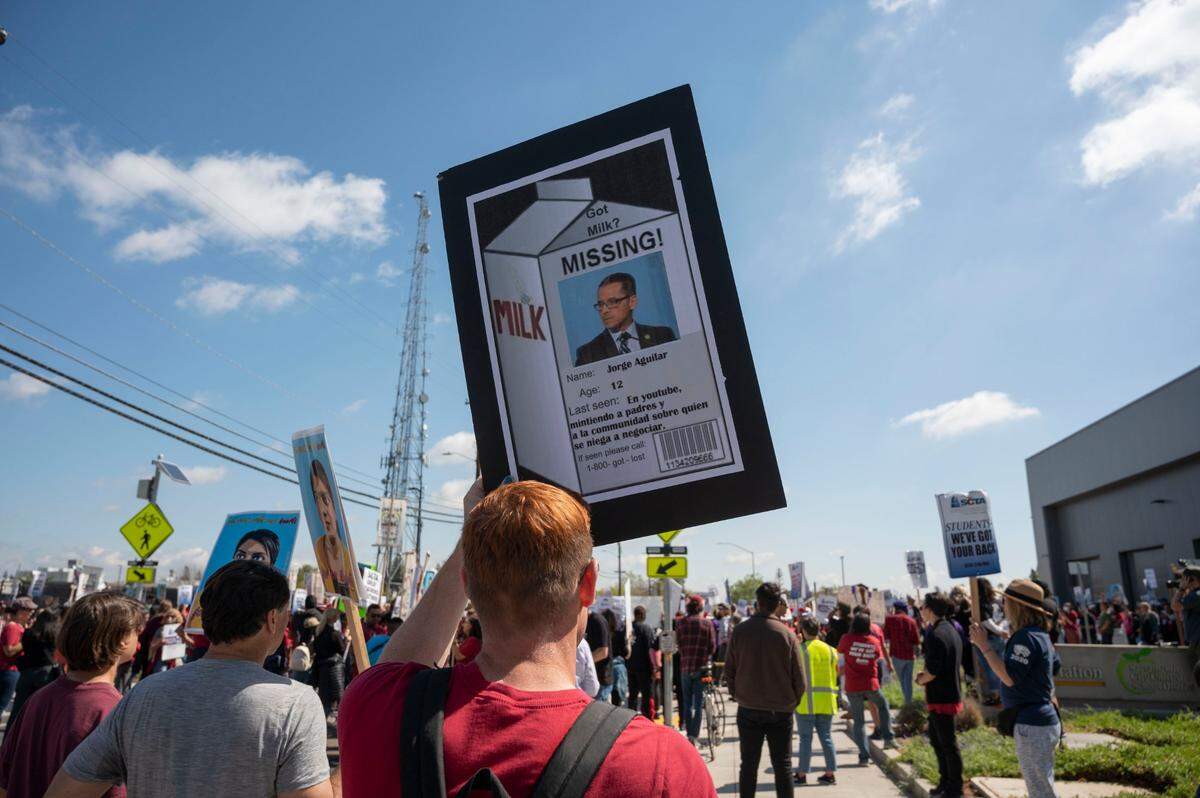
On Tuesday, schools remained closed across the city. The teachers union and SEIU Local 1021 held a rally together at the district bus depot and pledged to continue striking for better pay and working conditions.
A lifeline in COVID-19 pandemic
The infusion of federal money has been crucial to keeping the school system funded responsibly, Superintendent Jorge Aguilar told The Sacramento Bee.
“Without it we would have gone into insolvency,” he said.
Aguilar explained that the district is following recommendations from past auditors and others to put its budget on a more predictable, sustainable track. The federal money, Aguilar said, helps allow for a “soft landing” for a proposed transition to a different health care system, for instance.
The latest big chunk of federal money, $154.4 million, is due from last year’s American Rescue Plan, and most remains unspent.
Among the other sources of recent federal money: The district received $56 million from the March 2020, CARES Act., according to the education news organization EdSource.
And legislation to ease the economic impact of COVID-19 in December 2020 allocated $68.7 million, according to district school officials.
All the funds were aimed at helping state and local governments cope with helping combat COVID-19 and provide help with budget shortfalls.
In addition to the federal money, the school system received $33 million from state funds. The money has been used for several other programs, including help for foster and homeless youth.
The school district statement said the SCUSD Board “has taken responsible and fiscally sound steps toward correcting the district’s longstanding structural budget imbalances. The board approved a policy to not use one-time funds for ongoing expenditures. It also adopted a goal to maintain a prudent and fiscally sound reserve for contingencies.”
How can Sacramento schools use the money?
The federal government has said the money can be used in a variety of ways.
Bonuses to essential workers are allowed. Sacramento County, for instance, used a portion of its COVID-19 relief money to give special payments of $1,500 to public employees.
At least 20% of the total funds have to be used “to address learning loss through the implementation of evidence-based interventions and ensure that such interventions respond to students’ academic, social, and emotional needs.”
There’s a lengthy list in the district draft plan of ideas for how the money can be used, including “other activities that are necessary to maintain the operation of and continuity of services in (local schools) and continuing to employ existing staff of the local education association.”
Soon after the 2021 COVID-19 relief legislation known as the American Rescue Plan became law, the Sacramento district school board adopted a 33-page spending plan for the pandemic-related money that said that “teachers, principals, school leaders, other educators, school staff, and local bargaining units, as applicable” must be included in “meaningful consultation” with the community.
The plan lists three main priorities: Addressing mental health and trauma needs of students, families, and staff, addressing accelerated learning and “the safe return of all students in-person, full-time at the beginning of the 2021-22 school year.”
District officials have met routinely with community members, and with their input came up with plans to use the federal money. Among them has been hiring nurses, social workers, guidance counselors and school psychologists to help students cope with issues associated with the pandemic.
The city has until June 2024 to allocate the American Rescue Plan funds, and the nonpartisan Committee for a Responsible Federal Budget estimated that $15.5 million has been paid to the school district so far.
Where has the COVID-19 money gone?
Federal officials provided some detail of how the schools have spent some of the March 2020 pot of federal money.
According to U.S. government data, the biggest expense, about $20 million, went to “facilitate distance learning,” helping classes meet by Zoom and making other accommodations during the COVID pandemic.
The next largest amount, $8.9 million, went for “public health expenses.” The Treasury Department gave no further details.
The school system received $2.45 million to “improve telework capabilities of public employees,” $1.6 million for unspecified “administrative expenses,” and $1.45 million for personal protection equipment.
This story was originally published March 29, 2022 at 6:25 AM.
.jpg)