Sacramento schools crafted a plan after a racist test went viral. Why this teacher has doubt
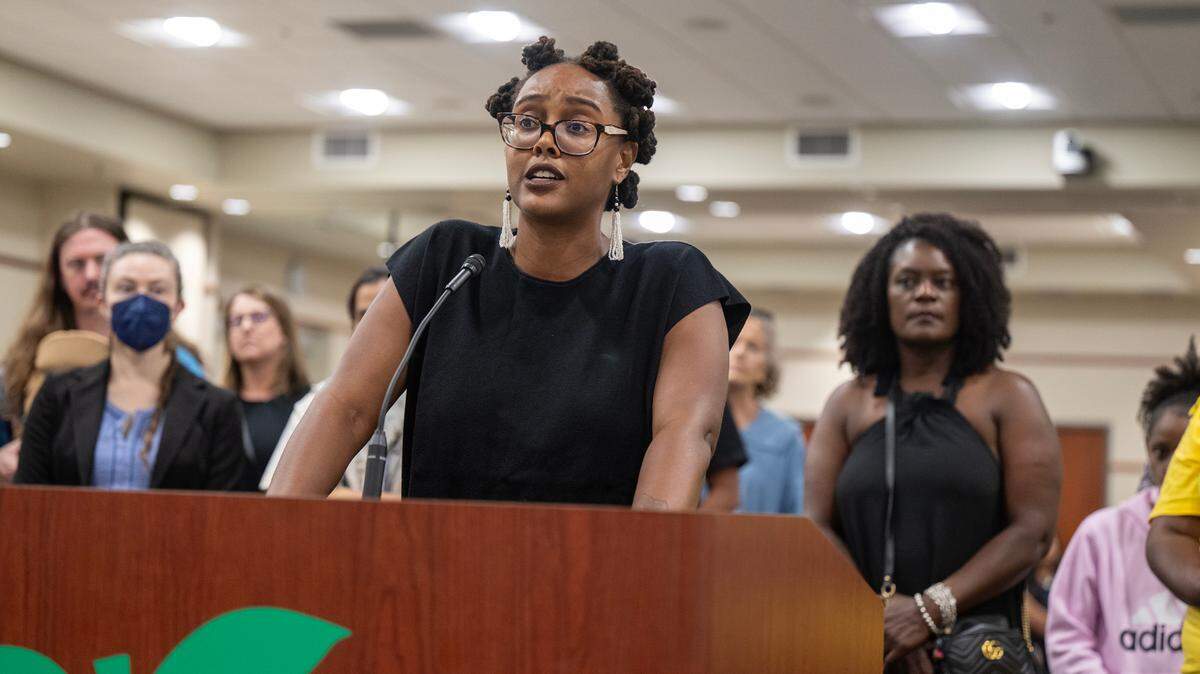
Luther Burbank High School teacher Erinn Leone has been looking for disciplinary reform in her school district since a fellow teacher launched into a racial slur-filled rant in her presence and she felt burdened with the responsibility of resolving the situation.
Then when her school received national attention after a biology teacher administered a final with racist questions targeting specific students, Leone felt it was time to share her story and push for change.
Since August, Leone and several colleagues have attended board meetings as the Alliance of Anti-Racist Educators at Sacramento City Unified School District, advocating for the district to institute a new policy to address racism among educators in the district. The draft is modeled after the principles of restorative justice, a framework within criminal justice that focuses on repairing the harm done to victims.
The board has not publicly discussed the policy proposal, but support for a a Restorative Justice committee gained traction this year as three recently elected board members took their seats and Trustee Jasjit Singh was elected board president. In response to the Alliance’s continued push for the policy, the board voted to establish the committee earlier this month. The new advisory committee will be one of several in the district that develop policy recommendations in different areas for the board to implement.
Singh appointed a civil rights attorney who works with the district to be the committee liaison. Each board member has been tasked with finding a community member from their district to join the committee alongside labor representatives from SEIU and the teachers association plus student representatives.
But as a trailblazer of disciplinary reform in the district, Leone has many questions — what are the goals of the committee? Will restorative justice experts be consulted? What will be the metrics of its success? Will she or any other members of the alliance be involved? Will her draft policy be considered?
“The fear is that this is just a performative committee that is going to continue to endlessly report to the board about things that are happening instead of focusing on creating an accountability framework,” she said. “And it doesn’t sound like the people who brought forth this proposal will be looped in.”
In the weeks since the board’s vote, Leone’s questions have gone largely unanswered, and she expressed the same fear that she did after first addressing the board last summer — that the creation of another district advisory committee (of which there are 11) could add unnecessary bureaucracy to the process of establishing the policy.
“While we welcome collaboration, we are demanding action and specific changes, not just more committees without real power,” she said.
The push for restorative justice
Leone came to The Sacramento Bee with her story over the summer after the newspaper reported that Luther Burbank High biology teacher Alex Nguyen administered a final exam with bigoted questions to his students.
She said that the test was one of many occurrences of racism on campus and shared her 2019 experience in which a fellow teacher used a racial slur in a staff meeting — a couple days following the event, the teacher was back in the classroom after a brief paid leave while Leone was tasked with creating a presentation about why the word was offensive.
Other teachers at the school argued that had her situation been appropriately dealt with at the time, Nguyen might not have felt emboldened to write what he did.
Leone said that The Bee’s coverage of Nguyen’s test and her allegations of racism within the school “shook the community.” She expected Luther Burbank administrators to finally address issues of racism on campus once they returned in August — but things were business as usual.
“It was a missed opportunity for learning and healing,” Leone said. “It wasn’t even addressed discretely, it was just ignored.”
Nguyen did not return to the classroom that fall but is still employed by the district, according to district spokesperson Al Goldberg. The school district can not permanently hire for his position while he is still employed, so substitutes taught the class until a biology teacher on a one year contract was hired in November.
Leone argues that having a restorative justice policy in place at the time of the incident would have allowed the school to more swiftly replace Nguyen and avoid a situation in which students had no consistent teacher for several months of the school year.
“There was additional harm being caused partly because we don’t have a system that allowed for him to be fully removed and hire for his position right away,” she said.
The proposed policy recommends creating a panel composed of representatives from the teachers union, the district, administrators, and community members to determine the appropriate response if a staff member is found to be at fault for professional misconduct. Then, that staff member would be provided with sensitivity training, which would “include the use of real experiences of systemic racism in our district to inform our practices.”
“This involves identifying and deconstructing how harm is perpetuated, not relying solely on hypothetical scenarios in an online training,” Leone said.
The committee would regularly check in and evaluate the educator, and if they are deemed unwilling to grow and repair the harm caused, they could be fired.
Visions for the committee
Leone is concerned that the established committee does not yet have any specific written goals, and that without clear goals, the committee could lose focus of its original intention. She also worries that the creation of the committee will be another performative action from the district that will not result in material change.
Members of district committees like the Community Advisory Committee for special education and the Black/African American Advisory Board have voiced concerns about the board’s willingness to act on their recommendations in the past. BAAAB chair Terrence Gladney refused to back down from the podium at a June meeting in part because of what he said was a deficient response to recommendations the committee made to the board at a prior meeting.
Singh recognizes that communication between the board and district committees has not always been effective in the past and that in his presidency he is pushing for committees to push forth fewer, more focused recommendations that the board can act on.
But Singh said that the board is not in the business of dictating those goals for a committee and entrusts the prospective members of the committee to establish those themselves. That said, the intention is for the committee to give policy recommendations that are supportive of restorative justice ideas.
“We can’t say ‘here’s the goal’ or ‘here’s not the goal,’” he said. “We want this to be community led so we can hear back from folks who have skin in the game and have true feelings about creating change.”
In terms of the Alliance’s initial policy proposal, Singh said that it would be a “helpful document” but that he hopes that what the committee establishes is “more encompassing and farther reaching” than what it includes.
“I think they’ve done their job, and if they hadn’t come forth with their idea then we wouldn’t be putting this idea forward as a board,” he said. “There are things in that policy document that warrant further discussion, especially around labor, but its helpful groundwork and now we have to put the people in place to make this a reality.”
Leone also expressed concern about attorney Mark Harris’ assignment to be the committee’s liaison. Harris was appointed by former Superintendent Jorge Aguilar to help the district address instances of racism and improve on equity, but Leone has described him as “absent” when trying to reach him about her experiences in the past couple years.
Harris did not respond to multiple requests for interviews. Leone said that he has not been responsive to her questions surrounding the committee.
Singh said that board members will begin the search for committee members in the coming weeks and that more details will be determined as they go. He said that there’s no desire to delay the process, but that it’s a busy time for educational agencies as they coordinate responses to new federal mandates.
This story was originally published February 25, 2025 at 5:00 AM.