Why Trump has Sacramento State, UC Davis students and faculty afraid for free speech
Following news of investigations into 60 universities and the detention of a Palestinian student activist in New York, Sacramento State students responded to a national call to protest the federal government’s “existential attacks” on the student movement against Zionism.
Around 40 people gathered in the library quad to chant and to condemn President Donald Trump’s crackdown on student activism, bearing signs that advocated for free speech and the liberation of Palestinians
Two days later, Sac State President Luke Wood sent a message to the campus community in response to the Department of Education Office of Civil Rights Title VI investigation into the university. After affirming his commitment to cooperating with the investigation, protecting Jewish students and protecting free speech, Wood referenced the protest.
“This week at a student protest on campus, groups were chanting offensive and hurtful messages that go against our values,” Wood wrote. “Though these messages are protected speech under the law, they fundamentally contradict the values we uphold as a community.”
Wood denied The Sacramento Bee’s request to share the statements he categorized as hurtful, saying that he wanted to be careful because “that’s what our Jewish community has asked us to do.”
“Sacramento State does not want to cause further harm by sharing the offensive and hurtful language chanted at the student protest,” spokesperson Lanaya Lewis said.
Representatives from Students for Justice in Palestine, the group that organized the walkout, believe that Wood is referring to their use of the phrase “from the river to the sea.” This battle cry by pro-Palestinian activists has been criticized by Jewish groups like the Anti-Defamation League as inherently anti-Jewish because it does not leave room for Israel, while the people who use the slogan say it is an aspirational call for peaceful coexistence, not destruction.
But representatives from SJP say that this is a conflation of political critique and antisemitism being leveraged to delegitimize their movement.
“The Trump administration, and anyone’s cooperation with it, is policing our language, abusing the idea of anti-semitism in the West to stifle speech in support of Palestinian rights, in the face of what is clearly a long-standing project of ethnic cleansing,” they said in response to Wood’s letter.
Sac State students and SJP board members Jack and Amal, who asked that their last names not be used out of fear of harassment, are among many local college students and faculty members who fear that Trump’s pressure on higher education institutions will threaten free speech, academic freedom and student safety — and that their schools will not do enough to fight back.
Crackdowns on campus free speech ‘a threat to all of us’
The Trump administration has not been shy about coming down on schools that it says allowed “illegal” protests on campus, characterizing the demonstrations as antisemitic and violent against Jewish students.
Last week Trump and Education Secretary Linda McMahon directed the Education Department’s Office of Civil Rights, which lost nearly half of its workers, to focus on investigating Title VI complaints related alleged antisemitism at pro-Palestinian campus demonstrations at 60 colleges across the country. Sacramento State and UC Davis are two of 10 California universities on the roster.
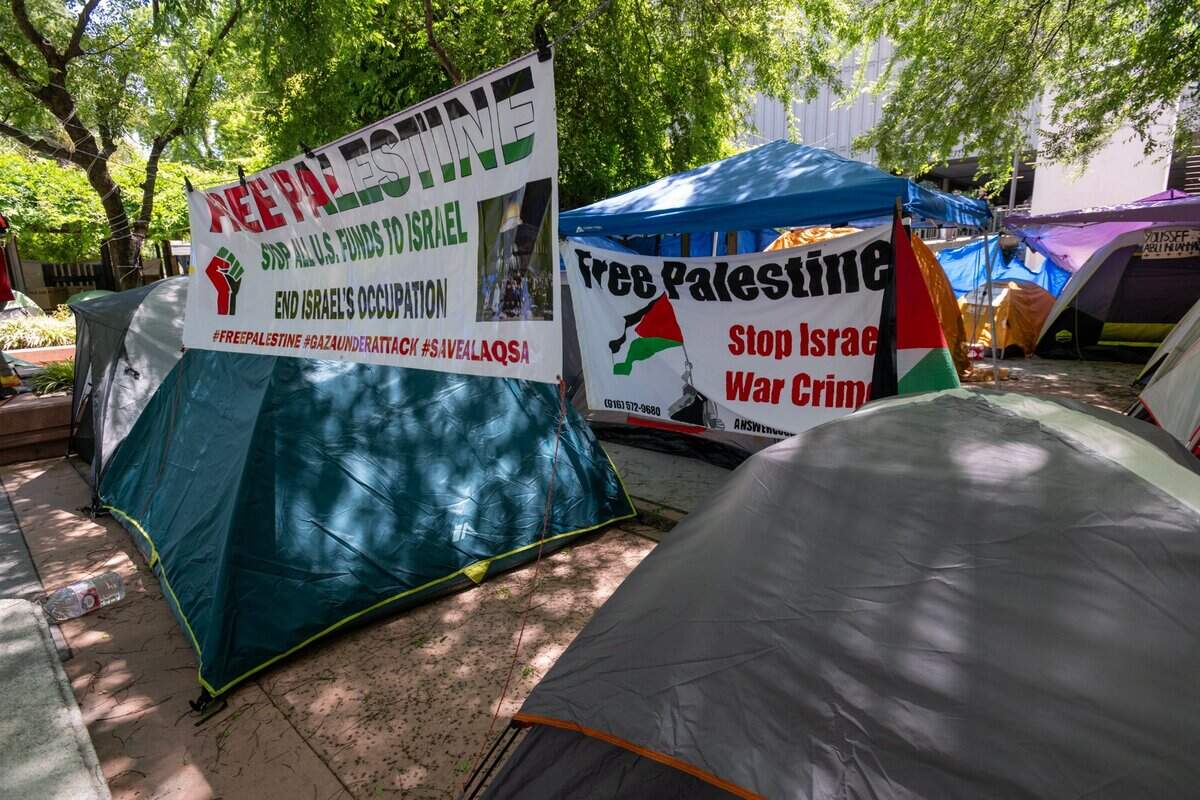
Activist groups at both universities erected controversial encampments in May 2024, calling for the higher education institutions to divest from Israel. Feds including Acting Assistant Secretary for Civil Rights Craig Trainor have called similar encampments “paralyzing” to campus life.
The Trump administration detained and attempted to deport Columbia University grad student and Palestinian activist Mahmoud Khalil for his role in a campus encampment and pulled $400 million in federal grants and contracts from Columbia, claiming the university failed to act against the “persistent harassment of Jewish students.”
The threat to federal funds comes in a year when both the University of California and California State University systems are facing a 8% budget cuts proposed by Gov. Gavin Newsom.
In anticipation of the loss of federal funding, UC announced a hiring freeze and the elimination of diversity statements in any hiring processes following direction from the federal Department of Education to end diversity, equity and inclusion programs.
But students and faculty at UCs and CSUs resist assertions that their criticism of the state of Israel and opposition to Zionism is antisemitic, saying that Trump’s crackdown on student activism is not an earnest attempt to protect Jewish students, but a threat to free speech.
Ahlam Muhtaseb, a Palestinian professor of media studies at California State University, San Bernardino, fears that should opposing forces be successful in shutting down critique of Israel, a precedent she worries will apply to myriad different issues in the future.
“Because when constitutional rights are taken from one group in a society, this could be extended to so many other groups,” she said. “This feels like a new manifestation of McCarthy-style repression of the 50s and 60s.”
The Davis Faculty Association staged a demonstration Wednesday in part to protest the Trump administration’s “assault” on higher education, calling for UC leadership to denounce the administration’s actions.
“The repression of Palestinian students and faculty is a blueprint for the repression of all of us … We are in an existential fight. We must defend the university, our students, and our right to a workplace free of repression,” the UC Davis Faculty Association wrote in a statement.
Are educators ‘preemptively complying?’
Muhtaseb believes that Trump and his allies are not earnestly interested in investigating claims of antisemitism, but are instead trying to further a political goal.
“They are just weaponizing the charges of antisemitism to silence us, those of us who research, teach or advocate on behalf of Palestinian human rights,” she said.
But the culture of fear is not just directed at university leadership. The Palestinian academic said that she has already been affected by educators “preemptively self-censoring” speech about the war.
Muhtaseb was scheduled to speak earlier this month at a UC Davis community Iftar, a gathering in which Muslim people break their Ramadan fast together. Two days before the event, a member of the Muslim Faculty and Staff Association informed her that she was no longer invited to the event.
Muhtaseb, whose multimedia work often centers Palestinian and Arab identity, said that she was told that her presence could make students and faculty members vulnerable to threats or doxing.
The Muslim Faculty and Staff Association told the Davis Enterprise that the decision to cancel Muhtaseb was not an effort to repress her speech, but “an effort to protect those present at the event, particularly those made most vulnerable by the current political climate.”
“We can’t be silencing ourselves,” Muhtaseb said. “It’s very dangerous. Our silence is not going to protect us.”
Instead of attending the Iftar, Muhtaseb spoke virtually at the UC Davis SJP-organized protest of Mahmoud Khalil’s detainment on March 11. She described it as a “beautiful scene.”
“It was honestly much better than having to do a mediocre Iftar because the students, I told them ‘your legacy is going to go down in history books. You are the heroes — not administrators who are engaging in preemptive politics of censorship,’” she said.
Sac State protesters reject claims of antisemitism at protests
In a March 10 letter to Sac State President Luke Wood, Trainor used Columbia to exemplify the Trump administration’s goal of “rooting out antisemitic harassment in schools and college campuses.”
Trainor does not specify the nature of the complaint that led Sac State, the only California State University, to be subject to investigation. Notably, Sac State is one of the few schools where school leadership and encampment occupants reached an agreement in which the university promised to set new standards for its investments to ensure they do not profit from “genocide, ethnic cleansing, and activities that violate fundamental human rights.”
Two representatives of the SJP at Sac State, which was responsible for last year’s weeklong encampment, deny issues of antisemitism within the encampment, saying that the accusations come from the “conflation of anti-Zionism and antisemitism.”
Amal said that Jewish Voices for Peace is one of their “most frequent allies and advocates.”
“The whole narrative has been shifted to paint us as antisemitic and put targets on our back to villainize and delegitimize our movement,” she said. “The reason we’re out protesting is because of the genocide in Gaza, not because of anything to do with Jewish people — it’s to do with the state of Israel.”
Jack said that the idea that the Trump administration cares at all about antisemitism is “laughable,” pointing to several Trump associates’ apparent use of Nazi salutes.
Ashutosh Bhagwat, a UC Davis law professor who specializes in free speech, said that while he would not go as far to say the Trump administration is seeking to silence political dissent, he does fear that the administration will conflate anti-Israel speech with harassment, which would present a First Amendment issue.
“Protesters have no right to harass Jewish people, of course. That’s not a question. But if they’re making public statements, say in support of Hamas, which I find utterly deplorable, that’s still free speech right?” he said. “But to convert that type of statement that is a part of public discourse into a claim of antisemitism, that’s a line I fear the administration might cross, and then there is a big free speech problem.”
Time, place and manner
Michael Lee Chang of Sac State’s Students for Quality Education is concerned that the Cal State University system has preemptively complied with what he fears is Trump’s attack on student political dissent by instituting an updated time, place and manner policy in September which banned encampments and the occupation of campus buildings.
He argues that the vague wording of the policy suppresses student speech and makes it clear that campus police can arrest at will, which creates a bigger threat for undocumented students.
“That policy, regardless of intention, will not only suppress student free speech but will actively aid in Trump’s efforts to oppress dissent and deport students,” he said.
Muhtaseb had similar criticisms of the policy, saying that it was a matter of preemptive compliance at CSU. The California Faculty Association, the union that represents 29,000 employees of CSU, condemned the policy, saying that they “believe they’re aimed at suppressing protests and future strike actions, all of which fundamentally undermine the civil liberties of faculty, students, and staff.”
Bhagwat said that time, place and manner policies are not themselves unconstitutional, and that universities have reason to institute them for sanitation or safety reasons. The policy could be problematic, he said, if it shuts down the possibility of protest or is selectively applied.
This story was originally published March 24, 2025 at 5:00 AM.