Sutter and its medical foundations to pay out $90 million to settle Medicare fraud suit
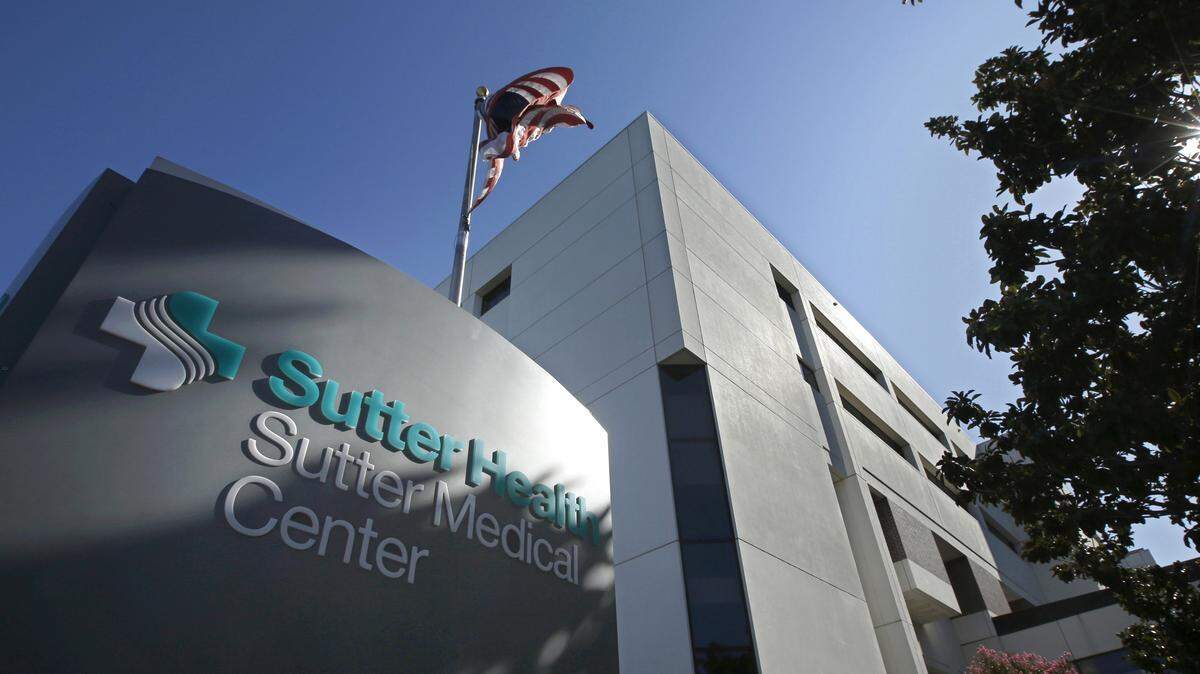
Sacramento-based Sutter Health will pay out $90 million to settle allegations that its staff and affiliated doctors lied to Medicare about the severity of patient conditions to jack up their payments, the U.S. Department of Justice announced Monday.
“Today’s settlement exemplifies our commitment to fighting fraud in the Medicare program,” said Acting U.S. Attorney Stephanie M. Hinds for the Northern District of California. “Health care providers who flout the law need to know that my office will hold accountable those who pad their bottom line at taxpayer expense.”
In a statement issued Monday, Sutter leaders said: “Today’s agreements bring closure to a long-running dispute, allowing Sutter to avoid the uncertainty and further expense of protracted litigation, and enabling a constructive relationship with the government.”
These types of Medicare fraud cases have exploded in the past few years as retired Americans have flocked to managed-care plans offered via Medicare contracts with big health care providers like Sutter.
The providers essentially operate health maintenance organizations under the Medicare Advantage umbrella, receiving a set monthly fee to care for each patient they serve. The Medicare Advantage plans also include pharmacy benefits, something retirees have to buy separately if they enroll in original Medicare.
Roughly 42% of Medicare beneficiaries are enrolled in a Medicare Advantage plan.
The set fee works out well if Medicare Advantage providers get a generally healthy population, but what if a provider ended up enrolling a sizable number of patients with complex chronic conditions?
Medicare’s leaders anticipated this possibility and devised a way to pay an additional fee for each complex case that providers treat. The agency has long assigned a billing code to each service or procedure.
By using those codes, Medicare is able to assign a risk score to each person enrolled in a Medicare Advantage plan and calculate what a provider should receive to care for beneficiaries who are in poorer-than-average health.
Within the past few years, however, whistleblowers at a number of companies are alleging that providers are making false claims on Medicare patient records in order to generate payments they have not earned. One such whistleblower is bill coding specialist Kathy Ormsby, who worked at a Sutter-affiliated physician group, Palo Alto Medical Foundation.
“Ms. Ormsby’s case is the latest in a string of risk adjustment fraud cases moving forward this summer, highlighting the government’s focus on ensuring Medicare Advantage plans do not fall prey to widespread fraud,” said Gordon Schnell, an attorney for Ormsby at Constantine Cannon. “Whistleblower laws exist to uncover such wrongdoing. Ms. Ormsby coming forward to report this alleged fraud meant risking her career to make sure that our healthcare system did what it is supposed to do — place patients before profits.”
In connection with the settlement, Sutter Health and two of its affiliates signed a five-year pact with the U.S. Department of Health and Human Services to pay for an auditor that will independently assess the accuracy of medical records for patients in Sutter’s Medicare Advantage plan. The company also will develop and maintain a compliance program for training and monitoring for Sutter and its affiliates.
The size of overpayments on Medicare Advantage contracts runs in the billions of dollars annually, according to audits by the U.S. Centers for Medicare & Medicaid Services. CMS estimated that, in fiscal year 2020 alone, it overpaid $8.4 billion in Medicare Advantage organizations as a result of unsupported diagnoses.
In 2015, Ormsby filed a complaint against her former employer and Sutter, saying she had audited records and discovered a high number of inaccuracies. Here’s a summary of her allegations:
Leaders of Palo Alto Medical Foundation pushed management in their bill coding unit to add the term “chronic” to conditions such as leukemia, asthma and bronchitis because it would result in payment increases.
The bill coding team was charged with going through medical records to ensure they were accurate, but Palo Alto Medical’s leaders “approved coders adding risk-adjusting diagnosis codes to patient medical records that physicians missed during their patient visits.”
One leader referred to it as a “pit crew plan” that would boost Sutter’s efforts, but others expressed concern that bill coders were making changes to a doctor’s notes.
Sutter told Palo Alto Medical and its other affiliates to make a push in late 2012 to schedule office visits for any Medicare Advantage patient who lacked diagnosis codes that would adjust risk scores, and then the health care giant tracked the progress in each affiliate, awarding a 1% annual bonus to those that reached 75% or more of such patients on their rolls.
Also in 2012, doctors at Palo Alto Medical were given “cheat sheets” with diagnosis codes for diabetes and other conditions it referred to as common, pressuring doctors add them to electronic medical records even when that was not the reason for a patient’s visit.
Palo Alto Medical also had no program to train doctors in how to code in compliance with Medicare Advantage guidelines when Ormsby arrived. She figured she could go to Sutter and get the blueprint for a companywide program, so she checked in with Julie Cheung, who ran Sutter’s program for risk-adjustment diagnosis scoring.
It was then that Ormsby learned that Sutter had no systemwide training program in place.
The news concerned Ormsby, and she quickly undertook a random audit of 42 patient visits in the first two quarters of 2013 to get a baseline read on coding accuracy at the practice group. Of the 62 diagnosis codes in these encounters, she found that 53 were false.
The codes already had been submitted to the Medicare agency, and Ormsby fully expected Sutter would be overpaid as a result. A month after she had done the audit, a health insurer sent a letter to Sutter noting that it was using one or two condition codes at a significantly higher rate than its peers. The carrier requested supporting documents and an independent medical chart review.
In anticipation of that audit, Ormsby asked for additional support and, based on her own audit results, wrote out a corrective action plan that included hiring certified coders to do audits and establishing a training and compliance program for those who would code medical records.
In a statement sent to The Bee, Kathleen R. Scanlan, an attorney with Keller Grover who represented Ormsby, said her client uncovered a systematic pattern of inaccurate patient coding in Sutter’s Medicare Advantage program and reported it to federal authorities as part of an anonymous whistleblower complaint allowed under the False Claims Act.
“Rather than help physicians record accurate information, Sutter took millions of dollars in improper payments from the government based on unsupported diagnoses,” Scanlan said. “This massive settlement will return nearly a hundred million dollars taken from this taxpayer-funded program. The False Claims Act is such an important tool in holding providers responsible, and whistleblowers are uniquely positioned to uncover the details of this kind of alleged misconduct.”
Leaders of the Palo Alto Medical Foundation hired five coders and began additional audits. They discovered hundreds of inaccurate codes for conditions such as heart attack, cancer and fractures and millions of dollars in overbilling.
Over a dozen or so pages in the legal complaint, Ormsby shared the problematic results of various audits and how often she brought them to management’s attention. Rather than addressing issues, however, the medical group’s management continued to encourage “aggressive diagnosis coding, resulting in the submission of false codes and inflated Medicare reimbursements.”
In late 2018, after reviewing Ormsby’s complaint, the U.S. Department of Justice decided to intervene in a portion of her suit, namely her allegations against Palo Alto Medical Foundation. In one court document, the U.S. attorney stated: “Before Ormsby’s arrival at PAMF in May 2013, Sutter and PAMF management recklessly disregarded and were deliberately indifferent to problems of false diagnosis coding, with few attempts made to audit or otherwise identify such problems even in the face of the high failure results of audits and chart reviews.”
Ormsby filed her whistleblower complaint under the False Claims Act, which makes it unlawful for any individual or organization to knowingly make a false record or file a false claim regarding any federal health care program.
Ormsby’s share of the settlement was not made public. Under the law, the whistleblower could receive 15% to 25% of any penalties that government prosecutors secure or 25% to 30% of whatever penalties the whistleblower’s legal team wins.
This current settlement includes $30 million that Sutter had agreed to pay in April 2019 to reimburse Medicare for overpayments made to Sutter, Sutter East Bay Medical Foundation, Sutter Pacific Medical Foundation, Sutter Gould Medical Foundation and Sutter Medical Foundation. These foundations contract on Sutter’s behalf with the multi-specialty physician practices that serve Sutter patients.
Ormsby’s attorneys said that their client’s court filing also brought these overpayments to light. Ormsby’s team at Keller Grover, Constantine Cannon and Kleiman/Rajaram worked with the DOJ in settling the case against Sutter and Palo Alto Medical Foundation even as they continued to pursue claims against the other Sutter affiliates.
This story was originally published August 30, 2021 at 2:40 PM.