You should probably check to see if your yard is a paradise for mosquito larvae
A sign outside the front door welcomed people to grandma and grandpa’s house (“admission – one hug each”), a happy beehive thrummed in the trunk of the big camphor tree, and the whole tranquil scene was once a breeding ground for killers.
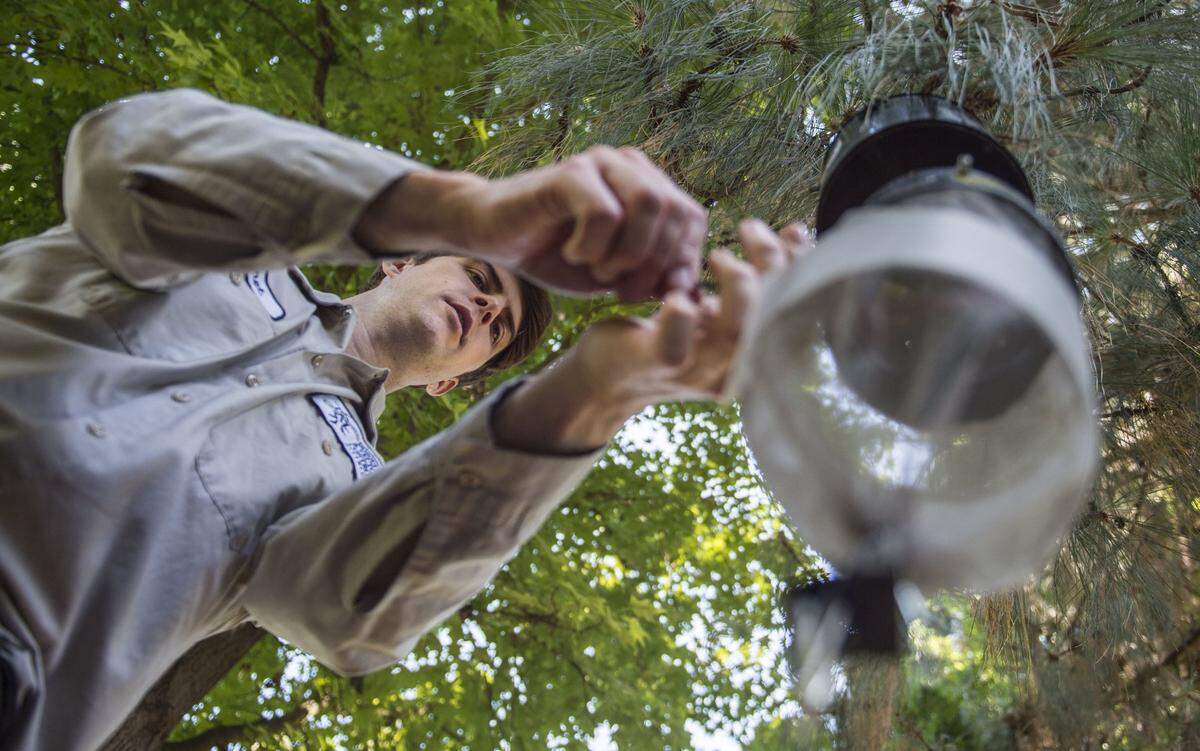
Hiding behind the hydrangeas at the Elk Grove home were two big government-issued mosquito traps, one of them wafting out small puffs of carbon and pheromones to trick mosquitoes into thinking a person full of blood was breathing in the bushes — the carbon mimics an exhale and the pheromones smell like human skin.
John Snell, the invasive Aedes field operations supervisor for the Sacramento-Yolo Mosquito and Vector Control District, had set this unsettling trap last summer as disease-spreading insects feasted on residents in Elk Grove and Arden Arcade.
“When we go into the backyard,” he said, “that’s when you’ll find out why I chose this house.”
Dee Madruga, 84, who has seven grandchildren and three great-grandchildren, is a gardening maximalist who planted bulbs and seeds in an old iron bed frame and cheerfully called it her “flower bed.” To an ordinary person, her garden looks inviting: You could sit under the awning and admire the bird baths and countless potted plants; you could wait for a neighborhood cat to saunter by and take a drink from a metal dish pan.
Snell looks at that vibrant garden and sees an incubator for the next generation of invasive mosquitoes. He knows the lethal threat these eggs and larvae can pose. To hatch and mature, they need standing water, and when he poked around last summer, there was standing water everywhere his eyes fell.
The cat dish was the first thing he noticed when Madruga invited him to see her property last year.
“As soon as I walked up to this container,” he said, “I could tell that there were larvae in here.”
Closer, he saw about 500 wriggling baby mosquitoes, just in that one metal cat trough. All invasive. Dozens of plant saucers in the yard had standing water, he said, and 40 of the saucers had larvae.
Once the larvae grew up, the females were capable of transmitting deadly or debilitating diseases such as Zika and yellow fever from an infected person to someone else (mosquitoes largely feed on plants, but before they lay eggs, female mosquitoes drink blood). The cat trough, he said, had been there for years.
An easy fix existed all along: Dump out the water at least once every three to five days, so any larvae will dry out and perish before they turn into young adults, which takes as little as a week. But Madruga didn’t know that until the “very polite young man,” Snell, showed up in the summer of 2021. At that point, the dish was a beautiful home for Aedes aegypti, the scientific name for the species of mosquito whose bite is a primary source of yellow fever.
The mosquito species has become an unwelcome transplant from Southern California.
Aedes mosquitoes spread disease globally
A. aegypti is a snazzy-looking striped mosquito. According to the Centers for Disease Control and Prevention, it’s also one of the deadliest creatures in the world. In addition to yellow fever, the species can spread dengue fever and Zika, among many other diseases. First detected in Sacramento County in 2019, the mosquito species has gained a spindly foothold in the capital region, with current infestation hotspots in Arden Arcade and Elk Grove.
They prefer human blood to all other types of blood, and while most mosquitoes common in California hunt at dawn or dusk, these mosquitoes also hunt during the day. If the expectant mother mosquito eats a big enough blood meal, she can spread 200 eggs over multiple locations, in the hopes that her offspring will survive. Her white eggs will soon turn a shiny black and can survive without water for over a year, waiting for the perfect conditions to hatch.
“They’re rapidly spreading,” said Luz Maria Robles, the public information officer for the Sacramento-Yolo Mosquito and Vector Control District. “Invasive mosquitoes are a public health threat.”
The eggs or larvae often travel from one place to another in containers (notably, the eggs can travel in dry containers). Robles pointed out that A. aegypti are, unlike many mosquito species, content to live indoors; she said the district got a call for help from a woman bitten inside her house. A field worker discovered the mosquitoes multiplying in a gift from an out-of-town friend — a bamboo plant that had harbored stowaways.
“That,” Robles said, “would be an unlucky bamboo.”
And although several of the most frightening diseases these insects can spread are not common in the capital region (especially: yellow fever, Zika and chikungunya), their presence still multiplies the risk to locals. If someone gets infected somewhere else, travels to Sacramento, then is bitten by a Sacramento invasive mosquito, that mosquito could transmit the disease and lead to wider spread here.
This threat doesn’t exactly keep Snell up at night. But it has given him a really, really strong aversion to plant saucers. If you absolutely must have a saucer under your potted plant, he said, “We ask that they dump them out completely every two to three days, just to make sure we don’t have any larvae going on.”
You can imagine that your life depends on it.
People can mitigate mosquitoes
Snell had stopped by Madruga’s Elk Grove house in early July, a week before he met Bee reporters there, to set up a perfect nursery for bouncing baby larvae. He filled six large buckets from the side yard that had water lines in them already — A. aegypti often lay eggs in dry containers with a water line, anticipating that more water in the future will bring the eggs to life. Snell set the buckets out in the shade and left them undisturbed.
When he returned with reporters, he was sure the buckets would be teeming with larvae because he had made such an appealing place for a bloodsucker to grow up.
But Madruga’s diligence in getting rid of standing water in other parts of the yard had made the whole garden, to some degree, mosquito-repellent: No little wormy things wriggled in the still water.
A year ago, Snell said, those six plastic buckets would have been teeming with larvae.
Snell was a little disappointed — he wanted to show off his creepy crawly foes. But he was also proud of Madruga, who had changed her ways and made sure to never let water be still in her yard for long enough for larvae to grow into teens and adults (they grow up fast, becoming pupae in five days).
Check standing water
The Sacramento-Yolo Mosquito and Vector Control District was formed as a “Mosquito Abatement District” in the 1940s, part of an ongoing effort to fight mosquitoes in California. Originally focused on, of course, mosquitoes, they also work to control other vectors (disease-spreading organisms).
The district operates a large-scale monitoring program, setting up traps like the two behind the hydrangeas in Elk Grove. Field technicians bring captured mosquitoes back to their lab once a week, where scientists test them for diseases. When invasive or infected mosquitoes are detected by their monitoring program, they fan out with more traps within a 500-foot radius of the offending bug’s location. They go door-to-door in neighborhoods with invasives, which is how Snell originally found himself staring down that cat dish full of larvae.
And, Robles and Snell said, they want the public to help them. When a district worker knocks on a front door wearing a long-sleeved shirt embroidered with a mosquito, they aren’t selling traps or bug spray or anything at all, though they might try to talk you into destroying your plant saucers.
“Tax dollars have already paid for us to be out here doing this,” Snell said. “There’s no charge for what we’re doing.”
What’s more, they’re not there to report you if you live in an area that prohibits growing marijuana in your backyard and you’ve decided to flout the local regulations.
“It’s so critical that they let us in,” Robles said. “If we go into your yard, we’re not there to see if you’re growing pot, growing whatever. We’re there to look for mosquito breeding sources, so ultimately, we’re there to make sure that residents are staying healthy.”
Robles, for her part, begs residents to check their yards for standing water.
“If everybody could, at least once a week, look around their yard, dump out any stagnant water,” she said, “eliminate the sources — that will definitely go a long way to control mosquitoes.”
Because as Snell knows, some people don’t go into their yards much at all, and the results can be frightening. He’s seen yards with 300 buckets with varying amounts of water collected in them, “all just filled with larvae.”
At the least, he said, turn your abandoned buckets upside down. And consider calling the district for help.
This story was originally published August 5, 2022 at 5:00 AM with the headline "You should probably check to see if your yard is a paradise for mosquito larvae."