Sacramento clears highly-visible homeless camp on Fair Oaks Boulevard. Was it legal?
Under pressure from Sacramento County law enforcement agencies, the city of Sacramento on Monday cleared a highly-visible homeless encampment that had been present for more than a year — a move activists say could have been illegal.
A tight-knit camp of about 30 people was located on a well-lighted one-acre grassy lot at Fair Oaks Boulevard and Howe Avenue. The land is public, owned by the city, meaning crews could not clear the camp without offering all individuals shelter beds or housing, according to the 2018 decision by the 9th Circuit Court of Appeals known as Martin vs. Boise.
But the land is adjacent to the border of the county, which has caused tension.
In January the Sheriff’s Office sent surveys to business and home owners in the area asking them to document crimes taking place at the camp. One of the questions read, “Are you willing to sign a written declaration prepared by the District Attorney’s Office to be filed with the Superior Court?”
Who’s leasing the parcel?
The city last week signed a lease with a group called the Howe/Fair Oaks Property Owners Association for $250 a month. The lease will end when the city sells the property, or on March 24, 2024, whichever comes first. The 16-page lease does not mention the homeless camp, but it does mention “improving the property” so the city can sell it.
“Leasing of the premises to tenant serves a public purpose because a well-maintained property will attract customers to nearby businesses and thereby improve the overall economic outlook in the city,” the lease reads. “Such lease will also improve the condition of the property and increase city’s chances of selling the property quickly.”
Before the group will take control of the property, the city agreed to install a 6-foot high iron fence with locks on the property, according to the agreement, which did not go to the City Council for approval because it was under $250,000.
The lease was signed by Hector Barron, assistant city manager; Gerald Hicks, supervising deputy city attorney; and Dave Mercer, president of the Howe/Fair Oaks Property Owners Association. Attorney Charles Trainor was listed as the agent on paperwork the association filed with the state. The group was formed in February, according to the Secretary of State’s Office.
The group of more than a dozen property owners will not allow the homeless back on the property, said Doug Elmets, a spokesman for the association.
“The property owners association intends to improve the property, thereby improving the visitor experience to the nearby businesses,” Elmets said in an email.
The city will still own the land, even while it’s being leased, however. The Boise decision does not mention leases, and so it is unclear if the sweep was legal.
The Sacramento Homeless Union believes it was illegal.
“Martin vs. Boise state that no municipality may criminalize an unhoused individual when no adequate shelter is available,” said Crystal Sanchez, president of the Sacramento Homeless Union, which has sued the city for sweeps in the past. “These people were not given realistic resources and their belongings were taken.
“The city and the county need to deal with our homeless crisis and focus attention on solutions and solving the crisis versus finding ways to circumvent Martin vs. Boise and enforce on people who the system repeatedly traumatizes and fails.”
‘They haven’t offered us anything’
In the last few months, city and county workers were able to get some of the people living on the parcel into housing, including the encampment’s unofficial spokeswoman Joy Gonzalez. Many still did not have housing or services to go to.
On Monday morning, after she had to leave her campsite, Shelley Sanders tried to figure out where she was going to go. Like many unhoused women, she’s been a victim of sexual assault, which is more common when she is out on her own versus in the camp.
“We are a big family,” Sanders, 32, said. “We look out for each other.”
Behind her, a yellow bulldozer scooped up items. Her brown pitbull, Boogie, hid under a purple blanket.
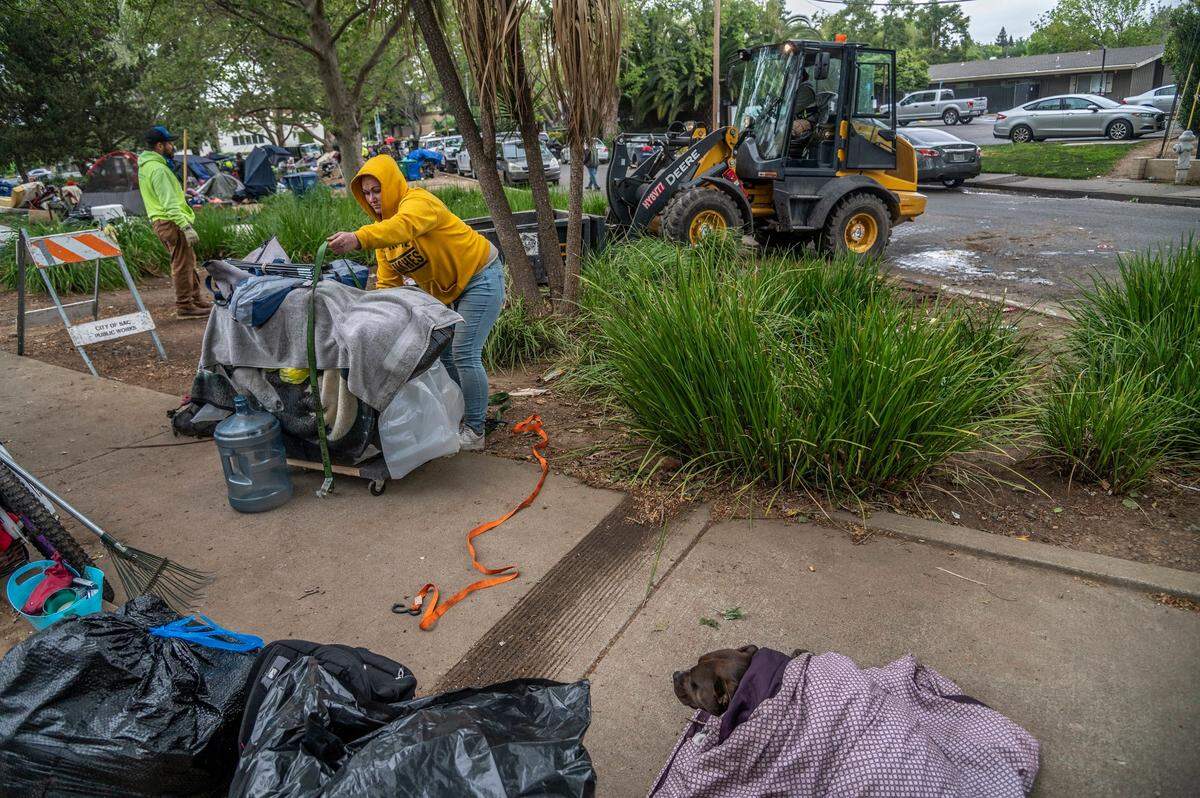
An employee from the city’s Department of Community Response sat down with a small computer to try to help Sanders. But with all the city’s roughly 1,100 shelter spaces full on any given night, she was not able to find anywhere she could go immediately. The department’s staff visited the camp 60 times in recent months, according to a city blog post. But they often do not have beds or housing available to offer, Bridgette Dean, the department director, has said.
Sanders’ hunt for shelter or housing is even harder because she has Boogie for protection.
Others like Lisa Louise Cook, who gave up her dog to find housing, are still unhoused. Cook was sobbing Monday as she realized her flower and herb garden, nestled under a tree in the middle of the camp, would soon be destroyed. She also lost her only photograph of her son.
“They haven’t offered us anything,” Cook cried. “They killed my plants.”
Mattresses, wheelchairs, tarps, chairs, paintings, a squeaky duck toy, and a neon green ‘Jesus Loves You’ sign sat in piles to be thrown away.
Dena Vickroy, 37, sat on the curb of Fair Oaks Boulevard with all her belongings including her cattle dog puppy, Sparkles. She said a man from the county named Justin had told her he would get her into housing that day, she said, but she hadn’t gotten a call. She left him a voicemail as she stayed on side of the road, cars whizzing by and rain sprinkles falling on the former encampment.
“He said he’d get us in somewhere today, but we’re still waiting,” Vickroy said.
This story was originally published April 11, 2022 at 2:48 PM.
CORRECTION: This story was updated at 3 p.m. on April 12 to clarify that Sacramento County law enforcement agencies appeared to be preparing legal action related to the Fair Oaks Boulevard homeless encampment.