
Is Sacramento’s new economy recession-proof? These are the jobs driving the region’s boom
Check out all of our stories in the Tipping Point series. Click here
***
Barely a decade ago, if you wanted to be where the economic action was in Sacramento, you probably worked in real estate. You were working construction, selling houses, developing shopping centers or writing mortgage loans. It was the mid-2000s, before the housing bubble burst and the economy collapsed, and real estate was Sacramento’s growth engine.
Nowadays, in the new Sacramento economy, you’re more likely to find yourself working in a hospital. Or a medical clinic.
Or at a company like Blossom Ridge Home Health Hospice. The 7-year-old Sacramento company deploys a growing army of 200 nurses, therapists, health care aides and other workers to patients’ homes across Northern California. Business at Blossom Ridge is up 30 percent this year.
“We’ve been growing very rapidly,” said Rick Lunsford, co-founder and chief executive of Blossom Ridge. “Our population’s getting older and the hospital systems are being set up to get people in and out quickly .... They get out of the hospital and they still need help.”
With a microscopic unemployment rate of 3.1 percent, greater Sacramento’s economy is booming. Perhaps more importantly, it’s evolving.
State government remains a mainstay employer, and government in all forms — including federal, local and schools — accounts for 23 percent of the region’s workforce, more than any other sector of the economy. But other industries are emerging as major drivers of the economy: Health care, in particular, which surpassed the state as an employment source in 2003, not counting higher education, is threatening to leave everyone in the dust. Health care and social assistance payrolls have mushroomed 26 percent in the past five years and now make up 15 percent of all jobs.
Tech is having its moment, too. While a major tech sector remains an elusive goal in Sacramento, companies and talent are emerging — some homegrown, some migrating east from the costly and overgrown Bay Area.
“There are tech jobs to be had,” said Dave Sanders of WorldBridge Partners, a headhunting firm with offices in Sacramento. “We’re finally at that tipping point where word is getting out that Sacramento’s a good place to do business.”
Construction and real estate have hardly been forgotten. The twin sectors are growing, and the construction of the Major League Soccer stadium will usher in a new era of development in the city’s historic railyard.
Yet the region isn’t nearly as reliant on the notoriously cyclical real estate market as it used to be — Sacramento still employs fewer construction workers than it did in 2005, when the market began softening.
“There’s a little bit of this, a little bit of that, there’s been growth spread around. It’s remarkably broad based,” said economist Jeff Michael of the University of the Pacific.
Michael said the increased diversification of the economy translates into steadier, more sustainable performance. “There continues to be solid growth, solid incremental growth — I think that’s a good outcome.”
That should help Sacramento weather the next recession, whenever it occurs, better than the last one. Another factor in Sacramento’s favor: The state has built up a rainy day fund that’s expected to total $18 billion by 2021. That should soften the blow on the state treasury and Sacramento’s economy when the downturn arrives.
But even with the rainy day fund, a major slump in the stock market will likely erase billions in state tax revenue. That will put a squeeze on a community where state government excluding universities employs 92,400 workers, or 9 percent of the total workforce — many of whom can remember the three times-a-month unpaid “Furlough Fridays” that plagued Sacramento during much of 2009 and 2010.
“The state budget is very healthy now but it’s structured in a way that the revenue could be more volatile going forward,” Michael said. “It may be tested if you get a big national recession.”
In the meantime, Sacramento’s economic evolution is far from complete. The low unemployment numbers mask the fact that 73,000 residents of greater Sacramento commute outside the area for work, according to a Sacramento Bee analysis of census data. About half of those commuters work in the Bay Area.
Barry Broome, who runs the Greater Sacramento Economic Council, said the region has to do more to draw businesses to the area and reduce dependence on government.
“We need a better economy than government,” Broome said.
Thousands of health insurance jobs
The sun was shining, the mayor was smiling — and Sacramento had landed one of its single biggest economic development fish in 20 years.
Last February, on a 68-acre tract near abandoned Sleep Train Arena, the city held a “cornerstone unveiling ceremony” for Centene Corp., a Fortune 500 health insurer from St. Louis. Centene is building a 5,000-employee West Coast headquarters, bringing together 3,000 employees who already work for Centene in the suburbs with another 2,000 who will be hired.
It was a huge win. Sacramento beat Austin and Phoenix for Centene, thanks in part to millions of dollars worth of state and city financial incentives. Centene will hire nurses, care and case-load managers, information technology specialists, accountants and more, likely beginning sometime in 2020. Under the incentive deal with the city, the new jobs must carry a median salary of at least $61,515.
Despite community leaders’ efforts to erase Sacramento’s government town image, Centene’s arrival demonstrates the enduring economic might of the state. Centene primarily operates Medicare and Medicaid plans, and its chief executive said the company wants to rub shoulders with government officials.
“We like being visible in the capital,” CEO Michael Neidorff told the assembled dignitaries. “We like it when government officials see how well we are doing it.”
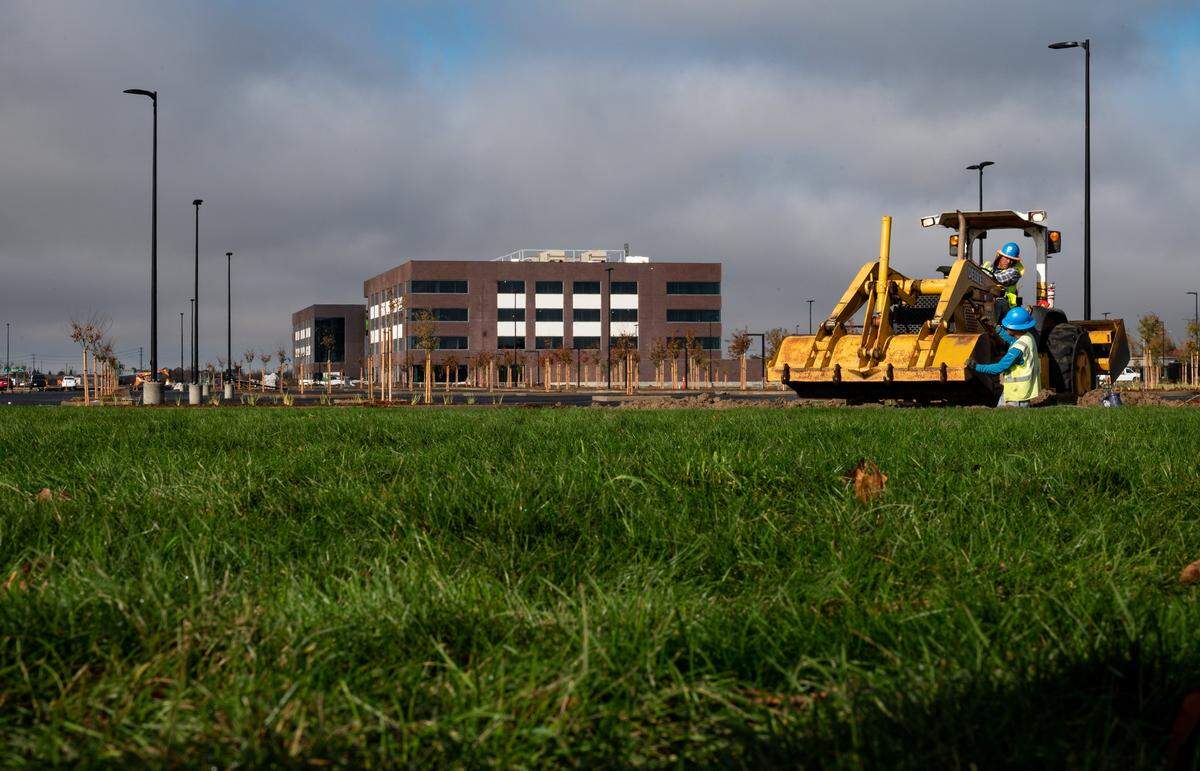
Although insurance company jobs are counted under the financial services sector in payroll and unemployment statistics, Centene is largely a company of nurses, pharmacists and other professionals who oversee health plans. The fledgling Natomas campus illustrates the rising power of health care in the region’s economy.
“The big change in the past decade has been health care and health care-related industries,” Michael said.
Promising young companies like MDstaffers are helping drive the trend, too. A company that connects doctors with hospital chains, MDstaffers was launched in Berkeley by a pair of Sacramento natives and relocated a few years ago to Rancho Cordova. It employs 24 workers and has doubled in size in the past year, ranking 49th on Inc. magazine’s annual roster of America’s fastest-growing privately-held companies.
“I think that we’re already onto something big,” said Ryan Larkin, chief operating officer. He said MDstaffers left the Bay Area to reduce costs but has found that being in the Sacramento area isn’t a handicap.
“There’s a lot of talent here,” he said. “I don’t find ... we’re losing out on (job) candidates to the Bay Area.”
The big hospital chains continue to do well in the Sacramento area. Sutter Health has added nearly 3,000 jobs since 2015, to a total of 18,315 in an eight-county area surrounding Sacramento.
But much of the employment growth takes place outside the hospitals. Glenn Melnick, a health care economist at USC, said supporting roles are becoming more important to the economy: therapists, home health care aides and so on.
BEHIND THE STORY
MOREAbout this story
The Sacramento region’s economy is booming and has evolved from a decade ago, when jobs linked to real estate and housing dominated the landscape. Today, the region’s economy is more diverse, with jobs in the health care and technology sectors helping to the lead way.
Economists think those job sectors may help the Sacramento weather the next recession. But will it be enough to avoid another catastrophic downturn?
Tipping Point
This story is part of Tipping Point, our new project focused on telling the stories of the Sacramento region’s evolution. We have formed a team of reporters and editors who are writing weekly stories focused on the challenges and opportunities in the region.
We’ve brought you stories about the threats facing our beloved tree canopy, the viability of downtown’s restaurant scene and the growing number of students at local colleges who are homeless.
Stay in the loop and subscribe to our Local News newsletter here: https://bit.ly/2KMNh2i
At Rx Healthcare Services in Sacramento, which dispatches those kinds of workers to patients convalescing at home, business has improved sharply along with the economy. Chief Executive Ken Erman said a lower unemployment rate means more Sacramento workers are undergoing elective procedures like hip or knee replacements.
“More people have benefits so people are having things done,” he said. His payroll, which had dipped to as low as 125 workers during the recession, has risen to 180.
Salaries for health care support jobs vary considerably. An occupational therapist in California averages $95,000 a year, according to the federal Bureau of Labor Statistics. An occupational therapy aide makes $35,000.
Will the boom ever end? The health care industry mostly sailed through the last recession, and Melnick thinks the industry can keep growing for another five or 10 years. But he said state governments are increasingly anxious to curb health care spending and that will likely affect hiring eventually.
“At some point there has to be a slowdown,” he said.
From real estate to high-tech
Sanders, the headhunter, remembers driving down Douglas Boulevard in Roseville during the mid-2000s and marveling at all the loan origination and title insurance companies that had set up shop. He wondered what the people buying all those new homes did for a living.
It turned out that real estate had become its own dynamic force. With an assist from lax lending standards, real estate dominated greater Sacramento’s economy during the mid-2000s boom. A Sacramento Bee analysis of Employment Development Department data showed that construction, real estate and related industries accounted for about 46 percent of the jobs created in a two-year period.
The market crash and recession sent Sacramento’s unemployment rate to a peak of 12.8 percent in early 2011. The recovery has seen little of the economic excess that marked the mid-2000s boom.
Although the construction industry is growing fast again, the region employs 6,000 fewer construction workers than it did in 2005. The financial industry, which includes mortgage loan officers, has 8,900 fewer workers in Sacramento than it did back then.
“The good news is we’re not very real estate dependent,” said Broome, head of the Sacramento economic council, the area’s main business recruiter.
Yet Broome said the relatively sluggish recovery in the real estate sector carries a downside. He believes Sacramento developers haven’t built enough office parks or other spaces that he says could house more companies like Centene. That’s hindered the community’s ability to diversify its economy beyond government, he said.
Broome said he knows of three pharmaceutical companies that considered bringing manufacturing jobs to the area this year but “we couldn’t deliver a single building that came close to meeting their requirements.” He wouldn’t identify them.
That said, Broome and others said the region is making considerable — if quiet — progress at bringing young tech companies to Sacramento.
While some of the region’s earliest technology titans have faded — Hewlett Packard Enterprise employs just 1,300 workers in Roseville, down from more than 6,000 a generation ago — smaller companies are flexing their muscles.
With relatively little fanfare, for example, computer gamer Electronic Arts Inc. is building a major development center in the Ice Blocks complex on the edge of downtown Sacramento. A small ag-biotech company called Biome Makers has set up shop in a West Sacramento incubator operated by Bayer CropScience.
“There’s more happening underneath the radar,” Sanders said. “We’re seeing a big influx from the Bay.”
And some up-and-comers are homegrown.
Three years ago, a laid-off Hewlett Packard employee named Manvir Sandhu was working from his Roseville home on a startup called Zennify — a tech consulting firm that specializes in banks and insurance companies.
The company was at the point that it needed an actual office. Sandhu and his partners considered Dallas, Phoenix and Salt Lake City but then stumbled onto a pipeline of topnotch software developers from an unexpected source: Sacramento State.
These were people who Sandhu originally thought were in short supply in Sacramento. “There is a gem right here, under my eyes, for whatever reason it’s been untapped. Maybe we lose them to the Bay Area as they chase the big dot-com money.”
Zennify is now happily based in a South Natomas office building. It employs 50 workers and expects to bring that figure to 120 by 2021.
He said employers are starting to wake up to Sacramento’s potential, but it’s a slow process.
“There is a general lack of knowledge about Sacramento and a perception about Sacramento,” Sandhu said. “I don’t think it gets perceived as an area that has this robust workforce that’s available and college educated.”
This story was originally published December 5, 2019 at 5:00 AM.