
Solar panels now required on new California homes. Why that’s so controversial in Sacramento
Check out all of our stories in the Tipping Point series. Click here.
***
Pacific Gas & Electric, now notorious for wildfires, blackouts and bankruptcy, isn’t the only major Northern California utility suddenly facing criticism and an uncertain financial future.
Sacramento County’s own electricity provider, the Sacramento Municipal Utility District, finds itself heading into the new year locked in a fight with much of the state’s solar energy industry over a controversial new state policy that could dramatically alter residents’ relationships with their utility companies.
The focus of the fight: Whether new houses in Sacramento and the rest of the state will automatically include solar panels on their roofs when constructed.
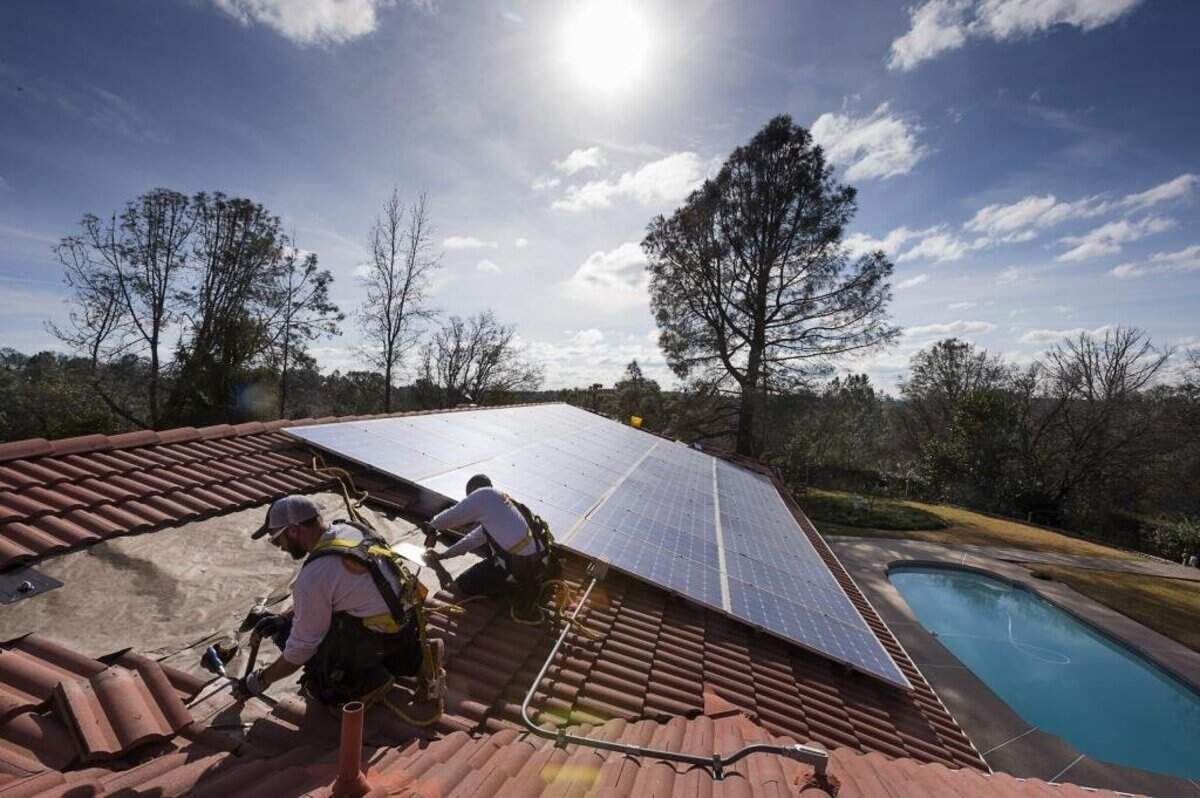
As of now, the answer is yes. Starting Wednesday, a new California home energy efficiency rule requires builders of most houses and low-rise apartments to put solar panels on rooftops.
The rule represents a major step in California’s decade-long effort to replace fossil fuels, like coal and gas, with renewable energy, like sun and wind power. And it brings California a big step closer to the day new houses will generate their own electricity, then store it in a garage battery and use it at night, thus avoiding the higher evening rates utilities charge for electricity that comes from the grid.
This potential new generation of “resilient” homes is suddenly more relevant than ever, said Bernadette Del Chiaro of the California Solar and Storage Association, after an October of massive blackouts instituted by PG&E during high winds to avoid grid failures that might cause wildfires.
“Think of it from the consumer’s point of view,” Del Chiaro said, “having the ability to black-out-proof their home and their business.”
Turning homes into self-sufficient mini power plants won’t come cheap, though.
Cost of solar panels on new CA homes
Rooftop solar will add an average of $9,500 to California’s already sky-high home construction costs, an increase that will likely get passed to new home buyers. State energy officials say homeowners will recoup the cost over time with increased energy efficiency and lower utility bills.
Another added cost will add even more to home prices. Solar batteries are not part of the state’s new Jan. 1 solar mandate, but the state is pushing for them eventually to be included when new homes are constructed. For now, the cost of batteries is prohibitive: $10,000 to $20,000. Officials say those prices ultimately will come down.
The new regulations are setting up a battleground in Sacramento. As the regulations are about to go into effect, SMUD is pushing hard for a carve-out that would allow some new or perhaps many new homes and apartments to avoid putting solar panels on roofs.
SMUD is asking the California Energy Commission to allow it to offer residential builders and buyers an alternative it calls a Neighborhood SolarShares Program. SMUD would sign a 20-year deal with individual builders to sell them power from SMUD’s solar farms. SMUD would send that power to residences the old-school way, via the existing grid of electrical transmission lines.
SMUD officials point out it is infeasible to put solar on some roofs, including houses and apartments shaded by Sacramento’s many tall trees, as well as tight urban infill apartments where roof space is limited.
SMUD is the first of the state’s major utilities to request an alternative to roof-top solar. Simultaneously, it is launching an effort to revamp its fee structure in a way that could cost future residential roof-top solar owners more money. The utility says its current fee structure has created an imbalance in which non-rooftop solar customers are subsidizing solar users. That needs to be fixed, SMUD officials say.
BEHIND THE STORY
MOREAbout this story
Solar panels are now required on many new homes built in the state of California. But in Sacramento, that’s causing some controversy, as the county’s electrical provider seeks a carve out from the new policy.
And then there’s the question prospective home buyers will ask: how much more will a new home cost now that solar panels must be part of the plan?
Tipping Point
This story is part of Tipping Point, our new project focused on telling the stories of the Sacramento region’s evolution. We have formed a team of reporters and editors who are writing weekly stories focused on the challenges and opportunities in the region.
We’ve brought you stories about the threats facing our beloved tree canopy, the viability of downtown’s restaurant scene and the growing number of students at local colleges who are homeless.
Stay in the loop and subscribe to our Local News newsletter here: https://bit.ly/2KMNh2i
In an email to The Sacramento Bee, SMUD General Manager Arlen Orchard said the proposed solar share program and the potential fee changes are part of the utility’s efforts to provide fair prices and feasible options for customers.
“We need to balance affordability and reliability,” he wrote. “This will require equitable rate structures that reflect our cost of service and enable us to make necessary investments in our distribution grid ... Our program is about providing developers and home builders with options to best meet the objectives of their project while still supporting the State’s carbon goals. As a community-owned, not-for-profit utility we carefully craft our programs to reflect the costs of providing services so that one set of customers does not subsidize another.”
That includes, he said, looking out for people who “rent their homes, live in tree-canopied neighborhoods, or cannot afford to install solar or purchase a new home.”
SMUD expanding solar power
SMUD has a 10- to 12-megawatt solar farm at its old Rancho Seco nuclear site. SMUD plans a major expansion of that solar farm in the next three years. It is finishing up building another solar farm in Natomas. SMUD also buys solar power from private solar farms around Sacramento, and it runs a large farm near Fresno.
The solar industry has cried foul, however, accusing SMUD of using a loophole to try to set a statewide precedent that would undermine California’s clean power efforts, and hinder homeowners from becoming more independent of the suddenly troublesome grid.
The state’s new solar rooftop requirement does allow for creation of community solar share programs, such as the one SMUD is asking the state to approve, with the understanding that rooftop panels will not be feasible for all new housing. But state regulators did not define what they meant by “community” solar, and critics say SMUD is pushing the concept too far.
Solar industry representatives say they believe shipping solar via transmission lines from Fresno, or even from Rancho Seco in the southeast corner of Sacramento County, shouldn’t qualify as a community-based solar share program. The industry contends community solar should be defined as an array of solar panels somewhere on the housing development property or near it,such as on an adjacent parking garage.
“SMUD’s proposal will set a dangerous precedent in California,” Sierra Club policy advocate Lauren Cullum wrote last month. “This proposal will pave the way for other utilities to submit similar proposals leading to a complete upheaval of the rooftop solar mandate. The plan would end up blocking the development of new community solar and storage to the local grid at a time when our state needs it.”
For its part, PG&E has not proposed a community share alternative, but it signaled its likely intent to do so: It wrote a public letter asking the state Energy Commission to approve SMUD’s plan.
The Energy Commission, however, last month postponed approval or denial of SMUD’s plan after a several-hour hearing and intense debate. Instead, commissioner Andrew McAllister suggested SMUD consider scaling its solar share program concept back a bit. And he suggested his commission staff come up with a definition of what it means by “community” solar.
The energy commission is expected to consider a revised SMUD proposal in the first few months of the new year.
SMUD chief Orchard wrote a letter to the state last month saying he was “extremely disappointed” by the lack of approval in November, pointing out the new law is going into effect and that is leaving builders in limbo, not knowing if they need to design their projects to include rooftop solar or if they will be able to buy solar from SMUD.
“It is troubling that the commission is contemplating rewriting the rules at the 13th hour,” Orchard wrote.
Orchard, however, has offered to make some concessions. SMUD agreed not to include energy from the Fresno solar farm in its solar share program. SMUD also will build new solar farms locally, and use that new solar energy for the program, in keeping with the spirit of increasing the state’s solar capacity.
California solar requirement first in U.S.
The Energy Commission rooftop solar requirement for most new houses represents a first for a state nationally.
California currently accounts for half of the nation’s rooftop solar installations. The state hit one million recently, most of it on residential rooftops. That represents a foothold, about 8 percent, in a state with 13 million housing rooftops. In SMUD’s coverage area, mainly Sacramento County, the solar percentage is smaller. Some 25,000 customers out of 630,000 have rooftop solar, or about 4 percent.
The state’s new regulations and SMUD’s solar share proposal have exposed philosophical differences in the alternative fuels community among those pushing for roof-top systems and those who envision more utility use of large and small solar farms connected to the electric transmission line grid already in place.
Energy economist James Bushnell of UC Davis believes the state is over-reaching and being dogmatic in imposing the rooftop mandate. “I’m not a fan,” he said. He backs SMUD’s argument that people with rooftop solar are not paying their share of the costs of building, operating and maintaining the state’s massive grid system of electrical transmission and distribution lines.
The California chapter of the National Electrical Contractors Association also supports a SMUD solar share program, and says it can coexist with the state’s rooftop mandate.
“NECA believes there is a place for both types of projects to meet the commission’s greenhouse gas reduction goals,” association officials wrote to the Energy Commission. “Builders should have the choice of selecting the most cost-effective method to meet the solar energy mandates.”
Bob Raymer of the California Building Industry Association said he thinks the SMUD program would not undermine the state’s efforts because it would be more of a niche program used by builders of multi-unit apartments and condos in tightly packed infill areas of downtown Sacramento. Many suburban builders have already been putting solar on new subdivisoin rooftops for the past year in preparation for the new rules.
“I think we’ll just agree to disagree that an approval of the SMUD program is going to create a tidal wave,” Raymer said. “ I don’t see that happening at all. That’s my understanding of where our builders are thinking right now.”
As the clock ticked toward the new year, one local project, phase four of The Mill at Broadway, an 84-unit apartment infill project near downtown Sacramento, sat in limbo, its developer uncertain whether he must put panels on the roof or buy from SMUD’s solar farms.
“I am already digging in the ground out here and they haven’t figured it out,” developer Kevin Smith lamented. “I don’t know what the rules are at this point. It’s discouraging.”