
Legacy of racist ‘redlining’ lingers in Sacramento neighborhoods. How this costs the city
Check out more our stories in the Tipping Point series. Click here.
• • •
The long and ugly history of banks, white-only community groups and developers “redlining” people of color out of desirable neighborhoods was outlawed in 1968.
Although there has been a steady increase in minority home ownership and integration throughout the country, particularly in Sacramento, the effects of redlining nevertheless remain. Fifty years later, many black families are left behind when it comes to getting home loans across the country.
And now, new research shows some Sacramento communities that were redlined in the past remain haunted by poor health as well.
Many Sacramento neighborhoods officially shaded red and “hazardous” on an official map after the Great Depression remain home to people who are more likely to frequent an emergency room for asthma. And they are less likely to have a hardy tree canopy overhead, exposing them to harsher conditions that can impact their health.
Recently published studies have found a noteworthy relationship between the location of redlined communities, their exposure to extreme heat, and the rate of hospital visits for asthma that is likely due to poorer air quality.
The redlined neighborhoods were targeted for “urban renewal” projects in the 1950s, which often meant a highway system would be built on top of it, or through it. Sacramento’s network of busy elevated freeways is now the conduit for ozone and particle pollution. A highway has the greatest impact on the people who live near them.
In Sacramento, the land surface temperature in A-rated communities such as Land Park was nearly 2 degrees cooler than in D-rated communities in other parts of the city, according to one study published in the journal Climate. Similarly, another examination of eight cities in California concluded that as a neighborhood’s letter grade declines, the rate of hospital visits for asthma increases.
That means residents of Mansion Flats, Southside Park and segments of Oak Park have higher rates of emergency room visits for asthma — upwards of 77 for every 10,000 residents, according to the study published in the Lancet Planetary Health. The study suggests the historical policy could be contributing to one of the most distinct health disparities in the country.
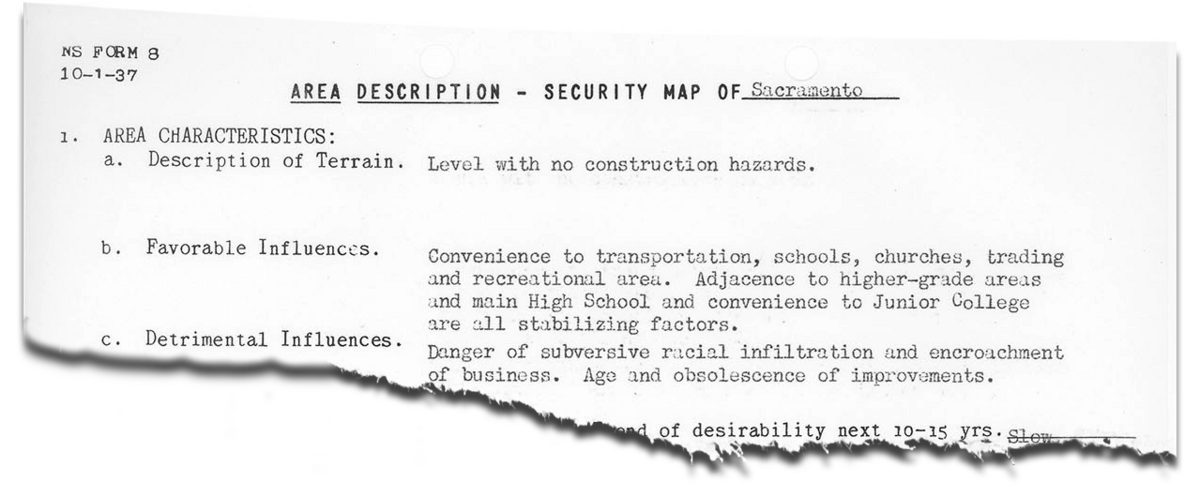
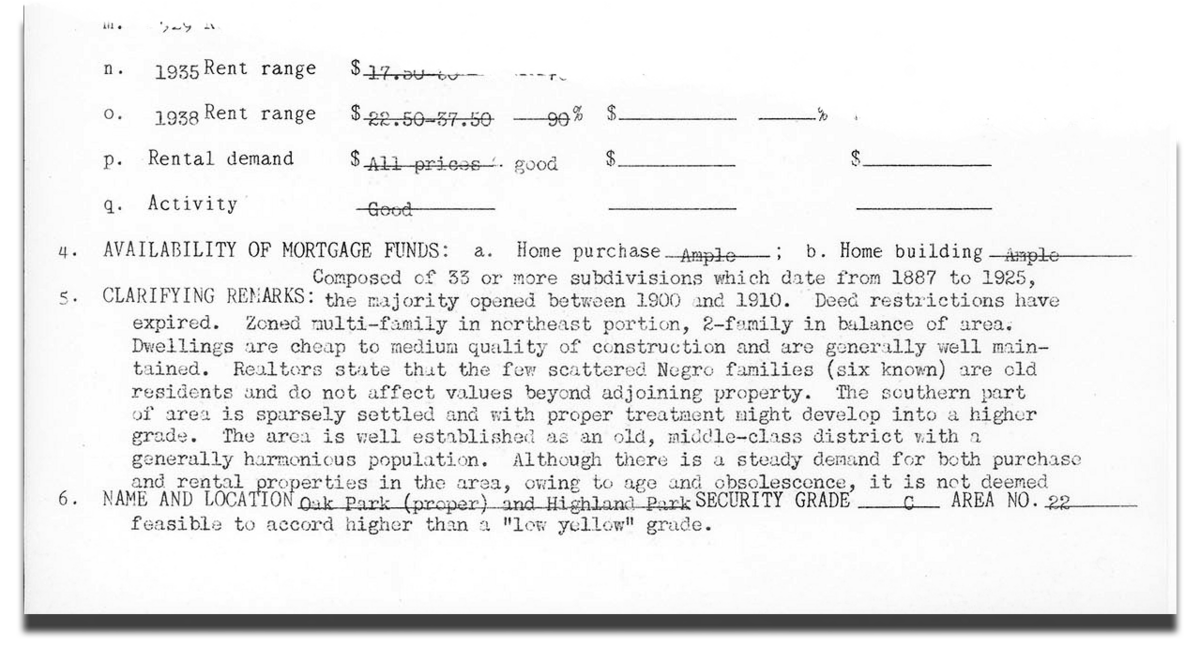
Those letter-grade ratings come from the old Home Owners Loan Corporation, a government-backed entity that once rated communities to determine eligibility for federal support. The so-called HOLC grades were once synonymous with community desirability.
Completed in 1937, the last rating map for Sacramento illustrates a striking division between neighborhoods that more or less conforms with the places we see today. East Sacramento, Curtis Park and Land Park were each considered more desirable; and Southside Park, Mansion Flats, Old Sacramento and Downtown Sacramento were not.
Researchers mapped the HOLC grades onto census tracts in Fresno, Los Angeles, Oakland, Sacramento, San Diego, San Jose, San Francisco and Stockton. Then they measured race, ethnicity, poverty, diesel emissions and asthma-related visits to the emergency room.
Anthony Nardone, a lead author of the Lancet study and a medical student in the UC Berkeley-UC San Francisco Joint Medical program, found that in the eight cities he studied, the number of asthma visits were more than two times higher in redlined tracts compared to those that fell in the lowest rating group.
“We expected to see a relationship; we didn’t expect it to be that dramatic,” Nardone said.
The study concluded that as the security grade worsened in those places, the share of the black and Latino population increased along with poverty and particle emissions from diesel exhaust. Nardone said community change is a potentially significant caveat.
“There is gentrification happening in many cities and many of the redlined neighborhoods,” he said. “It’s hard to say how a process like that might affect this relationship that we observed.”
Barriers to response
Local experts and advocates say the findings show how racist policies still shape the world today. However, they cautioned against a uniform interpretation since each city, including Sacramento, has a unique history that influences the effects.
A highway system was built through Latino communities set between W and X streets; the same was done to barrios that were once near the waterfront. And the “melting pot” HOLC surveyors described as downtown Sacramento is only a faint memory now that government buildings dominate.
“The most important part of this is the message that this is an institutionalized form of racism and classism. Therefore, institutions are responsible for engaging in redressing the problem,” said Robin Datel, an expert in urban geography and professor at Sacramento State, who reviewed both works.
“It’s not individual animus or prejudice or discrimination. It’s (the) government as well as (the) business sector that’s been involved in this.”
The studies also dovetail on a story published last year by The Sacramento Bee which concluded Sacramento’s unofficial title as the so-called “city of trees” does not extend to all neighborhoods. The Bee found that wealthier neighborhoods like Land Park, East Sacramento and River Park often enjoyed more tree cover than less affluent places, a fact that improves air quality, shields people from extreme heat and boosts property values.
The red markings on the maps produced for the Home Owners Loan Corporation often meant those communities did not get resources and were usually the places governments decided to build highways that now carry air-polluting chemicals.
Exposure to traffic pollution increases the chance a child will develop asthma and makes symptoms worse; decreases lung function; and increases the likelihood of death from cardiovascular disease, according to the Centers for disease Control and Prevention.
“The downstream effects of that have been higher disease burdens in a number of areas,” said Chet Hewitt, president and CEO of the Sierra Health Foundation, which managed asthma intervention programs in the past.
There are two barriers to correcting the issue, Hewitt said. First, there’s a lack of will to acknowledge the relationship and then the desire to devote resources to correct it.
“That’s what makes these types of studies really important because otherwise we devolve to (blaming) the people there, their motivation, will or their culture and behavior — and that’s simply not the case,” Hewitt said.
Sacramento’s redlining history
Many of the studies do not account for communities outside of the central city since the rating maps were created in the 1930s and 40s — long before Sacramento spanned the 100-square miles it covers today. Therefore, the research is limited in what it says about the city. Datel and others said ongoing gentrification in places like Oak Park and displacement of minorities in Southside Park has already reshaped those places.
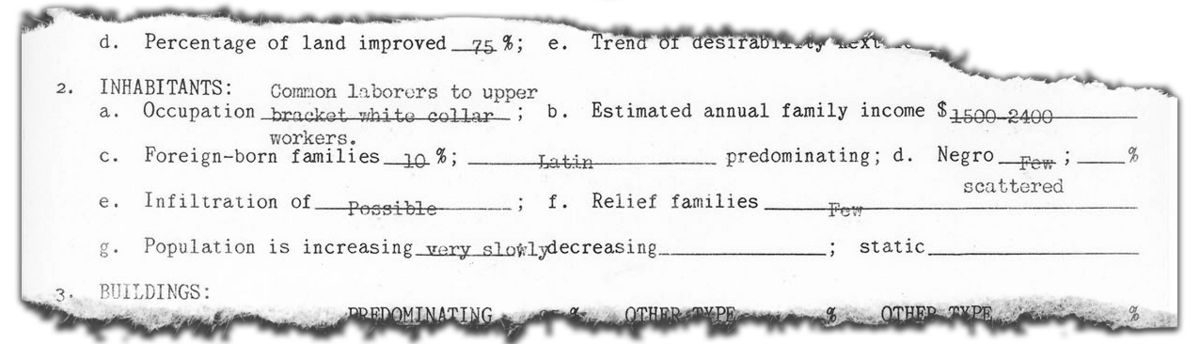
What’s more, race covenants — a formalized restriction on who could buy and rent property — also limited people to certain parts of the city, said Jesus Hernandez, an urban sociologist who has studied redlining in Sacramento. Jewish, Latino, Asian and black people were sometimes cut out of certain neighborhoods until the practice was banned in 1948. Then other practices of exclusion picked up.
“The maps aren’t the best way to go because a lot of the incentives to use the race covenants took place after the maps. It’s only a snapshot of 1938,” Hernandez said. “In Sacramento, you saw the boom of the post-World War II in the 1940s and 50s when everybody was using the GI bill and Federal Housing Administration loans.”
Over time, those areas with no race restrictions became pockets of disparity, particularly in north and south Sacramento. He said the imbalance extends beyond health and wealth.
“You can map any social ill over that geography,” Hernandez said.
The research underscores another growing concern about climate change and how it could give rise to another disadvantage. More extreme swings in weather, including hotter days, could add to the hardship.
Jeremy Hoffmann, a researcher in Virginia who led the nationwide study of land surface temperatures in cities, said he was trying to tie the historical policy to the environment and he was surprised to see how uniform the results were. Out of 108 urban areas that were redlined, 94 percent of them showed an increase in temperature as you go towards a worse HOLC grade or more hazardous HOLC grade, he said.
“This seems to be related to the relative dominance in impervious surfaces — things like streets, buildings, interstates — compared to the availability of tree canopy in those same areas,” Hoffman said.
“In the face of a changing climate, which is making heat waves more intense, more frequent and longer in duration, these places (are) in a heightened state of precarity.”
BEHIND THE STORY
MOREWhat is Tipping Point?
This is Tipping Point, our new initiative focused on telling the stories of the Sacramento region’s evolution. We have formed a team of reporters and editors who will write weekly stories focused on the challenges and opportunities in the region. We have more in the works.
Another team of journalists are organizing community forums to open a conversation about how we avoid the mistakes of San Francisco and Seattle, where progress for a few came at the expense of so many.
We will also remain rooted in our commitment to holding the powerful accountable.
To support our work telling the stories of the Sacramento region, please consider a subscription to The Bee to support work like this and local journalism. Subscribe here.
This story was originally published February 27, 2020 at 4:50 AM.