The coronavirus crisis has crushed Sacramento arts and charity groups. Here’s how you can help
Check out more our stories in the Tipping Point series. Click here.
• • •
This was supposed to be the summer of “Annie” and “Carousel” and “Kinky Boots,” delighting audiences at Sacramento’s fabled Music Circus.
Instead, the coronavirus pandemic has halted the music and left Richard Lewis, the leader of Music Circus’ parent organization, with a darkened theater, a $2 million deficit and a feeling of urgency. The chief executive of Broadway Sacramento spends his days working the phones, wrangling with producers in New York and his overworked accountant, trying to script a happy ending.
“This is show business, right?” he said. “We’ll do whatever it takes.”
The show-must-go-on routine only goes so far, however. The other day Lewis wrote subscribers and corporate donors a no-nonsense email laying out the stakes: “Without any programming in the coming months, Broadway Sacramento needs your help to pay the rent, keep the lights on, and plan our return.”
The sad song is playing out all over greater Sacramento. From animal rescue organizations to battered women’s shelters to community centers for at-risk youth, nonprofits and charities are being plunged into financial crisis by COVID-19.
They’ve had to cancel performances and fundraisers. The demands for their services, whether it’s food giveaways or childcare, are rising. They’re worried about donations drying up as the economy plunges into recession.
Breakthrough Sacramento, which runs a college-prep program for students trapped in underachieving schools, had to cancel its big fundraising dinner, featuring a quiz-show theme, scheduled for Thursday night at Turn Verein hall in East Sacramento. The annual gala probably would have brought in $50,000 – enough to run Breakthrough’s tutoring classes and other programs for two months.
“I’m definitely on a knife’s edge,” said Breakthrough’s executive director, Faith Galati.
As they try to stave off economic ruin, Galati and other nonprofit executives are looking toward a potential lifeline: the Big Day of Giving, the region’s annual online fundraising extravaganza.
Last year’s Big Day brought in $8.4 million for local nonprofits. Organizers and beneficiaries alike hope this year’s event, set for May 7, will do even better and help more than 600 participating nonprofits recoup at least some of their losses.
“A number of nonprofits are looking at the Big Day as a bigger part of their pie this year, those who had to cancel their spring fundraising events,” said Linda Beech Cutler, organizer of the event and CEO of the Sacramento Region Community Foundation, a leadership and advocacy organization for hundreds of nonprofits.
Cutler said a survey of about 250 area nonprofits showed 75 percent believe the shutdown will have a severe, very severe or extremely severe impact on their finances.
The Community Foundation has been able to help with some stopgap funding, awarding $420,000 in recent weeks to 57 nonprofits that provide urgent social services, like childcare for the families of essential workers.
“There (already) has been so much generosity shown since the whole crisis has started,” Cutler said.
Can the arts, theater survive coronavirus?
Broadway Sacramento began in 1951, when Lewis’ father pitched an enormous tent downtown and launched the summer theater series known as Music Circus. Lewis worked the concession stands as a kid and today presides over Music Circus and its sister program, the Broadway on Tour series – which, of course, has been canceled as well.
Lewis has been able to stabilize the organization’s finances a little; he secured a Paycheck Protection Program loan from the Small Business Administration. But he’s had to furlough “hundreds of full-time and seasonal employees – actors, musicians, stagehands, box office representatives, and lifelong members of the organization’s management team,” as he put it in his fundraising letter. The effort has left him drained.
“I’m kind of numb,” he said in an interview. “I’m sad. I’m disappointed.”
At the other end of the spectrum, far removed from the floodlights of Music Circus, sit a seemingly endless array of lesser-known arts groups that have been affected by the coronavirus, from the Big Idea Theatre, which operates out of a tiny space on Del Paso Boulevard in north Sacramento, to Capitol Ballet, which stages performances by young dancers.
“We’re month-to-month,” said James Wheatley, president of Celebration Arts, a 34-year-old theater company for young African American performers. “It’s scary.”
Celebration Arts, which occupies part of the old B Street Theatre complex in midtown, was staging “The Bluest Eye,” a drama about an African American pre-teen in 1940s Ohio, when the shutdown came.
“We had a major source of income cut off,” said Wheatley, who operates the theater on $150,000 a year. “We can’t do anything right now.”
Neither can CLARA – the E. Claire Raley Studios for the Performing Arts, a kind of multi-cultural landlord in midtown. It rents space at low rates to eight different groups, ranging from the Brazilian Center for Cultural Exchange to the McKeever School of Irish Dance. All of them are suffering without a fresh influx of donations, said CLARA’s executive director Megan Wygant.
“Our building normally buzzes with creative energy,” Wygant said in a video fundraising message she posted the other day. “But right now, due to the COVID-19 pandemic, our halls are silent.
“For $10,000, or $10 per child, we can bring the arts to an additional thousand students in the next year,” Wygant continued. “Can you help us?”
.JPG "IMG_RCB_20160406_Arts_04_2_1_MM7OEN6L_L211028342 (1).JPG")
Mayor Darrell Steinberg wants to help as many as possible.
In 2018, Steinberg persuaded voters to approve Measure U, which increased the city’s sales tax by a half-percent to fund a variety of programs, including what he calls the “creative economy” – an elevation of Sacramento’s cultural scene.
Now, Measure U money will go toward patching the estimated $90 million hole that the economic shutdown has drilled in the city’s budget over the next year-plus.
However, Steinberg is eyeing another pot of money for propping up the creative economy: a one-time $89 million grant the city received from the federal stimulus package.
Congress appropriated the money for local governments with strings attached – it has to be used to fix specific projects that have been affected by COVID-19. Steinberg thinks some of the federal money can go to the arts.
“Some arts organizations were having trouble before COVID-19 hit,” the mayor said. “I am absolutely committed to using some of this $89 million to restore and advance the creative economy in Sacramento.”
Demand high for Sacramento social services
Peggy Delgado Fava realized just how dire things were getting when her organization, Bridge Network, decided to offer a new service when the pandemic started.
Bridge operates a drop-in center in Max Baer Park in south Sacramento for troubled teens. When the economy collapsed, Fava decided Bridge needed to offer a once-a-week food distribution program. The first time, the results were astounding.
“We gave away a lot of stuff in a 45-minute period,” she said. “We depleted everything we had.”
Other needs are increasing. Bridge is trying to obtain WiFi service and computer equipment for kids whose schools have closed. It’s scrambling to find jobs for teens who’ve lost jobs in an economy that’s screeched to a halt.
Many of Bridge’s clients have gang affiliations and “aren’t easy-to-hire youths,” Fava said. “Everybody is struggling but our community is going to feel it that much more. They are at the bottom of the barrel, so to speak.”
Social service providers are feeling the effects of the coronavirus perhaps more than other nonprofits. Demand for their services has risen just as the flow of donor dollars has been curtailed.
My Sister’s House, which operates a shelter for Asian and Pacific Islander women, has seen two significant income sources dry up. It had to scrap two major fundraisers that were expected to reap $100,000 total, and it closed its restaurant near the Capitol, My Sister’s Cafe. The cafe alone pulls in $20,000 a month.
Nilda Valmores, the organization’s executive director, said she’s been able to secure donations to reopen the cafe and serve lunches to victims of domestic violence. Perhaps in July, if the shutdown orders are eased, state workers will return to downtown Sacramento and she’ll be able to serve meals to the general public.
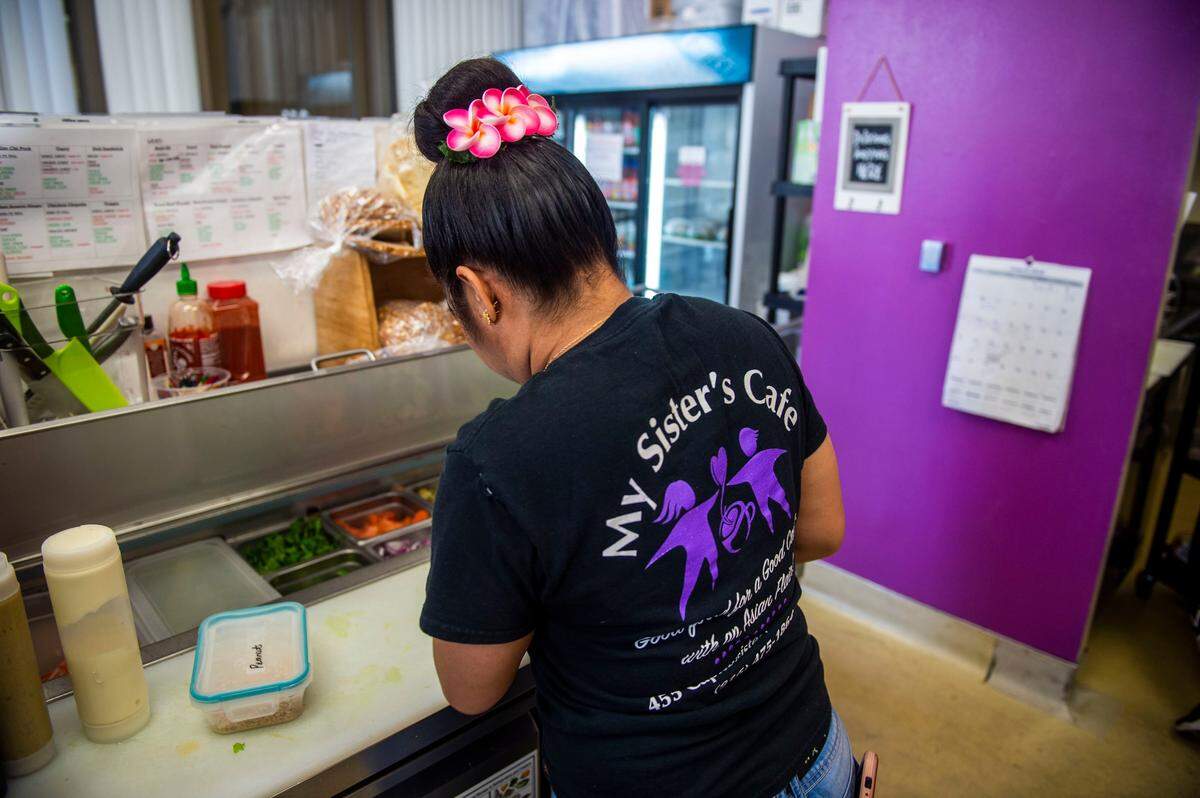
In the meantime, Valmores is hoping to raise $20,000 during the Big Day of Giving. The money would go toward developing a sorely-needed transitional housing facility for women who are ready to leave My Sister’s emergency shelter.
Meeting that financial goal “is vital to us,” she said. “It will help us avoid having to make painful decisions.”
‘Donor fatigue’ for Sacramento nonprofits
Wellspring Women’s Center, which runs a drop-in facility for low-income women, is among those needing extra dollars.
Its free breakfasts and lunches now have to be packaged for takeout, adding to Wellspring’s costs. It’s spending more on janitorial services. It lost $25,000 when a fundraising dinner was canceled.
Some of its financial backers have been extra generous lately, but executive director Genelle Smith is realistic about the ability to raise funds in the coming weeks and months.
“There could be an issue of donor fatigue,” she said.
Many other nonprofits worry as well that a prolonged economic shutdown will take a toll on contributions – if not right away, then eventually.
“People have been donating but I think it’s going to wear out if people don’t get back to work,” said Bridge Network’s Fava.
Sacramento Area Congregations Together, a coalition of religious organizations that lobbies on social justice issues, also fears that its benefactors might be wearing down.
ACT has been hitting up its donors relentlessly in recent weeks, said executive director Gabby Trejo. The group raised $67,000 to help struggling families pay rent.
Asking contributors to kick in another $10,000 on the Big Day of Giving – the group’s official goal for the event – might be pushing things a little.
“But who knows?” Trejo said. “Miracles can happen.”
This story was originally published April 30, 2020 at 5:00 AM.