Sacramento has an affordable housing crisis. This is City Hall’s plan to finally solve it
Check out more our stories in the Tipping Point series. Click here.
• • •
Sacramento has failed for a decade to build affordable housing for low-income workers. In that time, rents in the capital region have soared, pushing some people to move out of state and forcing others to the streets. Now, the economic carnage of COVID-19 is placing others at risk of eviction.
Can the city turn that unhealthy scenario around this year? City leaders say they have a plan.
Following a promise made when voters passed the 2018 Measure U sales tax hike, the Sacramento City Council last week agreed to take the unusual step of putting up $31.5 million as a carrot to private developers to get them to build an estimated 200 to 300 apartments reserved for people who have very low incomes or who are subsisting on fixed incomes.
Rents in many cases would be less than half the city rent average and in some cases possibly lower than $500 a month.
That effort to reseed livability in the capital city likely will subsidize builders of apartments in old, neglected commercial corridors such as Stockton Boulevard, Del Paso Boulevard, Northgate Boulevard, Florin Road and Franklin Boulevard.
Mayor Darrell Steinberg, who championed Measure U, calls the $31.5 million putting city skin in the game, and says it is one of the most important things the city can do with the additional sales tax revenue it has been collecting from the measure. The city has previously invested annual Measure U revenues on youth programs and plans to spend more on other economic and civic investments in coming years.
“Given what we are dealing with in our city around housing and homeless ... whether it is Stockton Boulevard or any other area of the city, especially on these commercial corridors, we will build with the private sector some great, great projects that will house a lot of people and that is our priority,” Steinberg said. ”I assert that is our priority.”
The city may take its Measure U-infused affordable housing initiative even further.
At the City Council’s request, the city treasurer is conducting an analysis to see if the city’s annual operating budget, which pays for police, streets, parks and other basics, is robust enough to back a bond sale that would increase that $31.5 million to $100 million, a housing investment number that has long been Steinberg’s goal.
City officials say they want to move quickly this year to line up projects and get construction started. City housing policy manager Danielle Foster said the city has put together a list of developers who have projects in mind and who have expressed interest in getting some of the city investment money.
“We have over 20 potential sites,” Foster said. “We have enough projects to get that money spent quickly.”
The move is similar to large investment efforts Los Angeles and San Francisco are trying, California municipal finance expert Michael Coleman said. “Cities are scrapping for resources to deal with affordable housing,” he said. “This is a big step.”
Focus on low-income workers
That unusual effort, which essentially would turn the city into a mini-redevelopment agency, is focused mainly on people earning minimum wage and others on fixed-income government checks.
The city is struggling simultaneously to get some of its growing numbers of homeless people off the streets. That dire situation was highlighted recently when violent storms hit, leaving homeless with little protection.
The affordable housing and homeless housing efforts are linked. Boosting the number of affordable apartments for workers and people on fixed incomes could keep some from ending up homeless, housing advocates and city officials say. Adding more lower-rent housing stock in the city also could provide an easier path for some currently homeless people to make their way toward permanent housing.
Adding 300 low-rent apartments to the city housing stock is only a step though toward improving livability in a growing city with rising costs.
The city intends to air several other complicated affordable housing measures this spring and summer as part of a broader effort to rewrite the city’s housing rules. That includes discussing whether to charge market-rate housing developers higher fees that would be put into the city’s “housing trust fund,” boosting funds the city can use to subsidize affordable housing.
Councilwoman Katie Valenzuela said she wants that discussion to include reviewing an ordinance the city discarded years ago that would require housing developers to devote a percentage, say 15%, of housing units in a new subdivision or apartment building for low-income residents.
“We’ve been digging ourselves into a deficit on (the) number of units for a decade now,” Valenzuela said. “We need to look at every tool at our disposal. We can’t afford to lose our workers. We can’t afford to lose our seniors. We can’t afford for people to keep ending up on the street.”
Critics of the fees and inclusionary housing concept, notably housing builders, say such moves would stifle construction rather than propel more affordable housing construction.
Affordable housing failure
This year brings with it a particular sense of urgency with the COVID-19 pandemic putting renters at risk, and with growing numbers of homeless on the streets. But the problem has been building for years since the Great Recession essentially killed housing construction in the region between 2007 and 2011.
That housing-stock deficit, particularly apartments, caused rents in the city to soar. At one point around 2015, Sacramento saw the highest rent increases of any major city in the country with double-digit increases. Despite the COVID-19 pandemic last year, rents in the city of Sacramento went up 4.4.%, according to Apartment List, a real estate analyst.
The city saw an increase in new apartment construction in 2019 and 2020, but builders are focused on housing for median and upper-income workers, often charging rents of more than $2,000 a month and essentially pushing the market’s average rental rates even higher.
New single family housing construction is also more robust than it has been in a decade, but average prices have crept beyond $400,000 and toward $500,000. New central city condominiums are going for $700,000. That may be affordable for many Bay Area emigrees moving to the Sacramento region, but not for typical Sacramento family budgets.
Data provided by the city show that the construction of apartments affordable for baristas, entry-level state workers, service industry workers and others has been close to non-existent for a decade.
In 2018, an estimated 1,894 housing units were built in the city of Sacramento, a low number by historical standards. (That number actually represents the total building permits issued, which typically marks the launch of construction.)
Of those, city data show that only 11 units were listed as affordable for very low-income wage earners who make less than 50% of the region’s median income. And only 69 units were built for low-income earners; those people earn 50% to 80% of the regional median income.
In 2019, affordable housing construction was arguably less robust. The number of new housing units permitted for construction was 3,076, a sign that building companies were becoming more bullish on Sacramento, particularly downtown apartment buildings and new single-family homes in Natomas.
But of those, just 47 units were affordable for very low-income earners and another 59 units for people in the low income category.
That means in 2019, only 3.5% of newly permitted housing units in the city were affordable to a family of four that earned $67,000 or less.
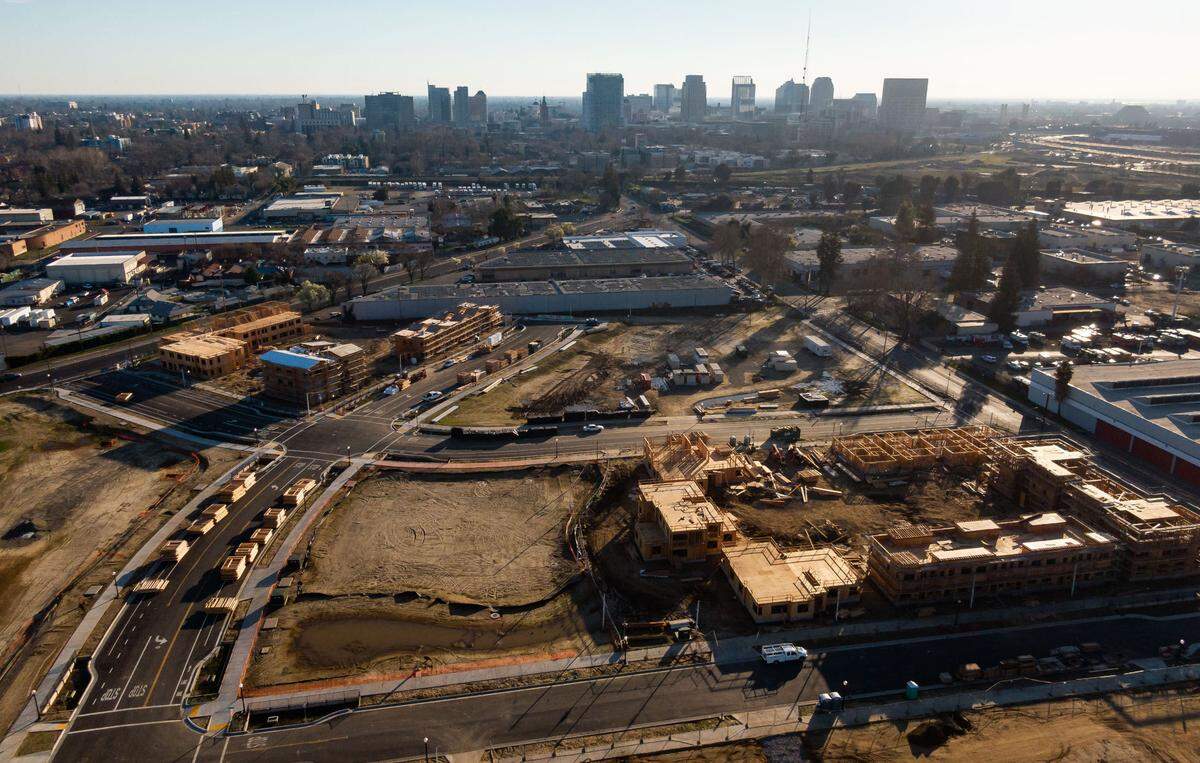
New housing numbers for 2020, due out in April, are likely to show a slight improvement, given the launch of a few key projects aimed at lower-income people. Those include Lavender Courtyard in downtown and Mirasol Village, under construction in the River District just north of downtown near Richards Boulevard.
Tough new housing benchmarks
Housing advocates are demanding better from the city this year.
Kendra Lewis of the Sacramento Housing Alliance says a city that found a way to help pay to build Golden 1 Center and is investing in development of the downtown Railyards should also be able to invest in a big way to create affordable housing.
Lewis is critical of the city, but also said she thinks Steinberg and other council members, notably newcomers Valenzuela and Mai Vang, have the desire to improve housing affordability.
“COVID has exposed the affordability problem at a new level,” Lewis said. “It can’t get more desperate than this. City Council members have to be fearless. It’s going to be tough.”
How tough? Affordable housing unit numbers would have to skyrocket to match the amount of housing that Sacramento is expected to need over the next decade of all kinds, based on new regional growth projections.
Those projections, listed in the latest state-mandated Regional Housing Needs Allotment (RHNA), suggest a growth rate that many current residents would say is too much, given the burden it could also put on transportation systems and other local infrastructure.
Under the new RHNA, Sacramento is being told to set up zoning and other housing rules to pave the way for 45,580 new units between 2021 and 2029. Here is the breakdown of how many units the city should make room for during that span under the RHNA:
- Very low income - 10,463 (households that make less than 50% of the area median income)
- Low income - 6,306 (households that make 50-80% of area median income)
- Moderate income - 8,545
- Above moderate income – 20,266
“It’s a daunting prospect,” said city planner Matt Hertel. “For us to meet this new goal coming up we’d have to issue permits for 5,581 housing units. Last year (2019) was a good year. We had 3,000. (But) it doesn’t meet the demand.”
The city is not legally on the hook if those numbers aren’t met. The city is only required to create a path for developers to build that many units, via zoning enough lots for housing.
Practically speaking, though, Steinberg and other city leaders say they believe housing stock variety is necessary for a balanced economy. More housing at the lower end can help stabilize rents, and provide businesses with access to a broader workforce.
It takes money to build in California
The affordable housing problem in Sacramento and California has been long-standing, but took a turn for worse a decade ago.
California cities used to be able to help subsidize that kind of housing via the state’s now defunct redevelopment law, which allowed cities to funnel local property taxes into blighted areas. That law was eliminated in 2012 when state officials were struggling, post-recession, to balance the state budget.
The last redevelopment-funded affordable housing project in the city opened a few years ago downtown — The Hardin apartments, years in the making, opened at Eighth and K streets with several dozen apartments available for $700 a month.
The city meantime was struggling to get any housing built. Desperate to meet soaring demand for new housing, the city in 2015 relaxed a requirement that builders set aside 15% of new developments for low-income residents.
The city also waived “housing trust fund” fees for some housing developers to encourage them to build any housing, but mainly higher-end apartments and town homes.
Now, some officials say, it is time to rethink those decisions and perhaps raise those fees. The city recently conducted a ”nexis study” to set legal parameters for potential new or increased development fees. That possibility will be debated this year as part of the city’s current rewrite of its housing policy.
The idea already has fierce opposition. In a statement to The Sacramento Bee, the North State Building Industry Association, which represents most housing builders in the area, said it is adamantly opposed to a reinstated inclusionary housing ordinance and to increasing fees on builders.
“The North State BIA is deeply alarmed by the call for the examination of enacting a citywide inclusionary zoning policy at a recent City of Sacramento City Council meeting,” BIA president Michael Strech wrote. “We ... believe this type of zoning discourages housing production and jobs from being created in our own community.
“Housing and jobs are critically needed more now than ever as the Sacramento region seeks to rebuild from the COVID 19 economic downturn.”
Instead, his organization wants the city to reduce builder fees and costs to reduce the cost of housing, making homes more affordable for hard-pressed buyers.
“The BIA strongly urges the city to enact bold pro-housing policies ... (including) streamlined land use approvals and permitting, fee eliminations and long-term deferrals, zoning reform and density bonuses if they meet density and design guidelines. Burdensome regulations and excessive impact fees should be reviewed and immediately eliminated.”
Other ideas for new housing
The upcoming moves aren’t the first the city will take this year to increase housing.
The city took an initial and controversial step forward last month — hailed as groundbreaking in California — by agreeing to allow duplexes and larger residential units in what have been until now single family only residential neighborhoods.
The city also is inviting residents to offer opinions as part of what could be a major rewrite of its it guiding document for housing policy -the Housing Element of the city’s General Plan. The concept for the Housing Element is available on the city website for resident comments.
Also under discussion in the proposed General Plan housing update:
- Unused city property should be made available for affordable housing and homeless shelters, and the city should encourage others (such as Regional Transit) to do the same.
- Find local money to boost affordable housing (Measure U).
- Encourage builders to construct housing that allows families to live with multiple generations under one roof.
- Explore ways to make it easier for people to build Accessory Dwelling Units. That includes special low-interest loans to residents who build ADUs to rent out to lower-income households.
- Consider changing codes to allow “tiny homes on wheels” to be considered ADUs.
- Focus new affordable housing in areas that have stores, services, transit and other “resources.”
- Work more with non-English speaking areas.
- Protect residents against displacement as their neighborhood changes.
- Reduce time and expenses for builders to get permits.
- Focus on turning old commercial areas and parking garages into new mixed-use areas of housing and stores.
- Design more units for older people and people with disabilities.
This story was originally published February 11, 2021 at 5:00 AM.