
Spite. Vitriol. And the background to suburban life. How I remember Rush Limbaugh
Editor’s note: This story is part an ongoing series of journalism produced as part a collaboration between The Sacramento Bee, Sol Collective and other community organizations called the “Community to Newsroom Pipeline.” To learn more or to contribute, email us at voices@sacbee.com.
***
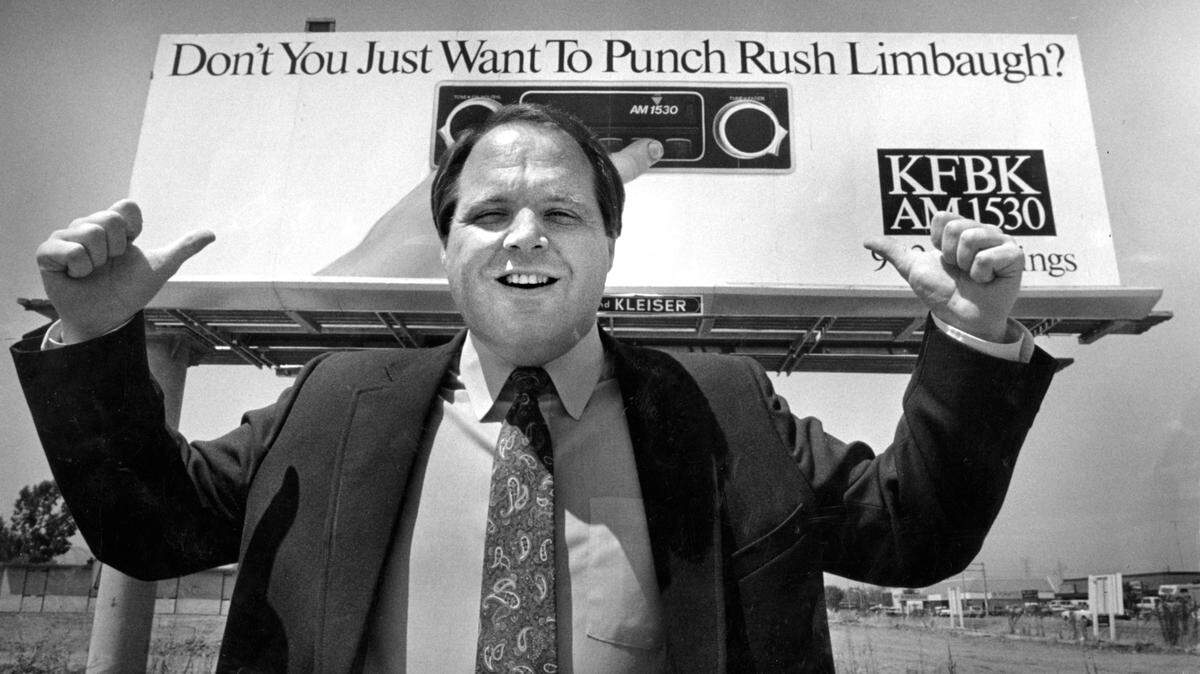
As a kid growing up in Sacramento, I had a few friends I liked, but dreaded going to their houses to play. I suggested riding bikes, playing tag or hide and seek — anything to avoid their homes. I avoided their houses because their families usually had the radio tuned to KFBK, listening to a guy who was always furious about nothing, as though he was pleasant background noise — elevator music for single family, one story homes in the suburbs.
To my young ears, there was an uncanny vibe about his voice. He sounded like Santa Claus if Santa swallowed another Santa whole, but that Santa got stuck in his throat. Boots, beard, and furry coat, all jammed against his larynx as he croaked on and on, complaining about “illegal” elf workers wanting fair pay, health care and for him to stop grabbing their tiny butts.
My friends’ “nice” families had him on, all the time, stinking up their homes with hate the way others baked to make homes smell like cookies.
I wondered what that did to us, constantly breathing in his vitriol — for non-white people, for women, for gay people, especially if they were richer, smarter or more powerful than him. I wondered what he’d think of me, what they all think me — a Black kid with a working mom and absent dad — skin so light it sometimes camouflaged me from their sight.
All that passive listening groomed us for his targeting of a child – the cherubic Chelsea Clinton. He routinely roasted her, from the time she was 12 years old, for failing to meet his personal standard of attractiveness. It now reminds of a bad open mic comic trying to roast audience members, except adult audience members implicitly consent to a comedy show. At the time, Chelsea Clinton wasn’t an adult, could not consent, and couldn’t leave the venue to escape persecution.
The families whose children I played with, who I thought were decent because they smiled at me and remembered my name, were there for those hateful words daily. Some snickered, some belly laughed, some doubled over and slapped their knees at how funny it was to them. Most just kept doing whatever they were doing — eating meals, watching TV and talking about hard days at work, as the background shock jock assaulted the First Daughter in front of us.
It doesn’t just say something about the people who listened to him as the soundtrack to their lives, marinating their brains in his spite, 10 pounds of meat in bitter salty brine. It says something about a culture — that it was “normal.”
A grown man taking to the radio, punctuating his sentences by popping pills, as millions listened to him obsessively bully a child for not being someone he could fantasize about, was “normal.” It says something about his impact on the character and trajectory of media in the U.S., and the people who consume it.
Over the span of his remarkably successful career, this utterly mediocre man said countless terrible things, inspired so much hate, and made a vast amount of money for his employers. He made them so much money, that even the slices of profit he was given still made him rich. The power he wielded in his field was so great that he could’ve chosen to speak in any way, about anything.
For years, he made a living putting down a child for her appearance, continuing when she was a young woman, and inviting millions of people onboard for so-called harmless fun. Then he was awarded the Presidential Medal of Freedom for his daily radio war, waged daily against his fellow Americans.
At the news of his death, that is what I remembered Rush Limbaugh for.