
Cause of light rail crash that injured two dozen Sacramento riders detailed in NTSB report
Sacramento Regional Transit’s “weak administrative controls” was the likely cause of the light rail crash that injured more than two dozen people, federal investigators concluded.
In its final report, the National Transportation Safety Board found the collision between a two-car passenger train and a one-car maintenance train Aug. 22, 2019, occurred because senior RT management failed “to assess a transportation supervisor’s competency in the combined role as both the controller and dispatcher on the evening shift.”
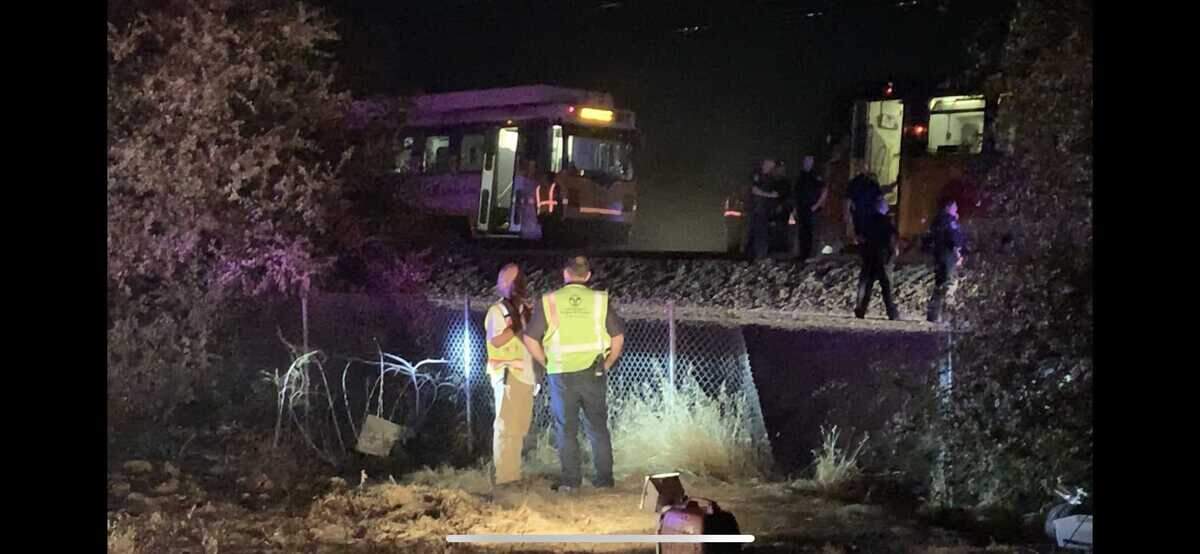
The crash occurred about 9:38 p.m. on a remote stretch of the Blue Line near North Sacramento’s Hagginwood neighborhood when an RT train with 24 occupants collided head-on at 32 mph with a stopped test train with three occupants.
Neither train derailed, but all 27 people suffered minor injuries; 13 were transported to hospitals. The transit agency estimated the damage cost more than $242,000.
“SacRT continues to extend deepest sympathies to all of the individuals and families who were affected and is very grateful that there were no major or life-threatening injuries as a result of this collision,” the agency said in a statement Friday.
Investigators found that the RT transportation supervisor did not adhere to procedures when he allowed the test train to enter the mainline track without knowing the location of the passenger train or alerting the passenger train’s operator of the test train’s presence.
Clear warning signs or devices placed on the main track before the test train began its final run “would have alerted the operator of the passenger train of the ongoing testing,” according to the report, which was issued last week.
In addition, investigators said a transmission-based train control system “could have applied the brakes of the passenger train and stopped it before it collided with the test train,” one of several recommendations the NTSB made in the report.
RT said it implemented several safety measures, such as requiring derails and stop signs on either end of the track when testing. Transportation supervisors now have to issue a radio bulletin when test trains head out to the mainline, and all train operators working must acknowledge the bulletins as radio read-backs.
“SacRT has gone above and beyond to put laser focus on improving its safety program,” the agency told The Sacramento Bee.
Supervisor had prior ‘competency’ issues
The safety board did not name the transportation supervisor on duty during the crash. According to investigators, he was hired in January 2018, and had worked for five years prior as a train dispatcher for Canadian Pacific Railway.
In the supervisor’s first performance evaluation, conducted eight months before the crash, a transportation superintendent had noted that the supervisor’s “radio control duties still needs to improve.”
“At times misses radio calls. Be more aware of the activity on the line. Slow decision making at times. At times no clear and concise directions,” the superintendent wrote, according to federal investigators.
The supervisor did not make significant improvements and was ultimately put on a 90-day performance improvement plan in April 2019. A senior RT employee oversaw the supervisor’s work for a few weeks, but changed shifts in June 2019, ending the monitoring.
“SacRT missed an opportunity to monitor how the transportation supervisor, who was continuing to develop and refine his skills, performed with these combined task demands,” investigators wrote. “By choosing to terminate his PIP and to not continue monitoring the transportation supervisor, SacRT had no reliable means of determining if the transportation supervisor performed his duties at an acceptable level.”
The NTSB investigation does not state whether the supervisor was disciplined after the crash, and an RT statement also did not include any action against the supervisor.
One last test, and a missed radio procedure
In interviews with RT staff and a review of radio calls, investigators pieced together what led up to the crash.
That night, an operator finishing maintenance on a test train wanted to test its propulsion system. The plan was to run a high-speed test on the primary Blue Line track near the Marconi/Arcade Station — a common practice, investigators said, that takes about 10 minutes.
Fifteen minutes before the collision, the test operator made a phone call to the transportation supervisor at RT’s Metro Control to ask if he could conduct the final test.
The operator told investigators that the supervisor cleared him to go ahead. The supervisor told the NTSB that he had instructed the test operator to wait until a passenger train had passed, then to radio for formal permission. There was no recording of the phone call and the test operator told the board the passenger train was not discussed.
Protocol required the transportation supervisor issue an advisory by radio to all trains on the mainline that a test train was entering. Guidelines said a radio conversation should have taken place between the supervisor and the closest passenger train operator — neither of which the supervisor did.
The supervisor told investigators “the test train operator called him, ‘ten things were going on at once,’ including a situation involving an unruly passenger on another revenue train.”
At 9:31 p.m., the test operator radioed to get the OK to enter the mainline. The two did not discuss the passenger train, according to the recorded radio call. A minute later, the test train entered the mainline and headed north from the maintenance facility toward the Grand Avenue overcrossing.
After running the trials, the test train operator switched directions, heading south toward the maintenance facility, which is just south of the Marconi/Arcade Station.
That’s when he noticed a headlight about 400 yards ahead, partially obscured by trees and vegetation.
A minute before the crash, Train 9 left Marconi/Arcade Station with a “yellow signal,” which allows an operator to proceed with caution but remain aware the next signal could be red.
As Train 9 crossed Arcade Creek, its operator saw the signal ahead change multiple times. The operator slowed the train as he saw the signal turn from yellow to red, yellow and red again, then back to yellow, according to investigators.
When the train exited a curve, the Train 9’s operator saw the headlight of the test train but “but was unable to immediately determine” if it was on the mainline, investigators said.
Traveling at 48 mph and about 65 yards from the test train, the passenger train operator realized he was heading toward a collision. At 9:38 p.m., he hit the emergency brakes, activated the dead man’s switch and braced for impact.