Sacramento is working on a new bridge across the American River. Should it ban cars?
An advisory body has urged the Sacramento City Council to consider making a new bridge across the American River car-free, citing the capital’s climate goals and the potential cost savings as well as the high rate of cyclist and pedestrian deaths on city streets.
Nine of 10 members of the Active Transportation Commission voted at their Thursday meeting to ask the council to demand that the Department of Public Works study a car-free Truxel Bridge; the 10th member abstained. Public works officials presented four alternatives for the planned bridge, which would connect the River District with South Natomas and provide a crossing for a future Sacramento Regional light-rail line to the airport.
There was no car-free alternative in the plan.
The project’s planner, Fedolia “Sparky” Harris, explained that when a report was prepared 12 years ago, a bridge that accommodated only pedestrians, cyclists and transit was rejected. Because of that policy decision from 2013 as well as other planning documents, Harris said, the department could only consider building the bridge with cars.
“You talk about documents that say ‘we have to prioritize other things,’ or plans that say ‘this is in compliance,’” said Active Transportation Commission Vice Chair Isaac Gonzalez from the dais. “There are many documents that have been created for decades that result in built environments that are dangerous for people. ... We have to be brave enough to abandon a rationale that says ‘because a piece of paper says we shouldn’t, we shouldn’t.’”
Thursday’s Active Transportation meeting drew unusually large audience, largely because of the bridge project. Sixteen people made public comments, and 15 criticized cars on the bridge.
The city has said that one point of the Truxel project would be to increase the number of emergency evacuation routes over the American River in the event of a flood. In 2013 documents, two potential goals of the bridge were to provide an alternative to the bridges carrying Highway 160 and Interstate 5; the nearby Jibboom Street Bridge, for example, is subject to flooding.
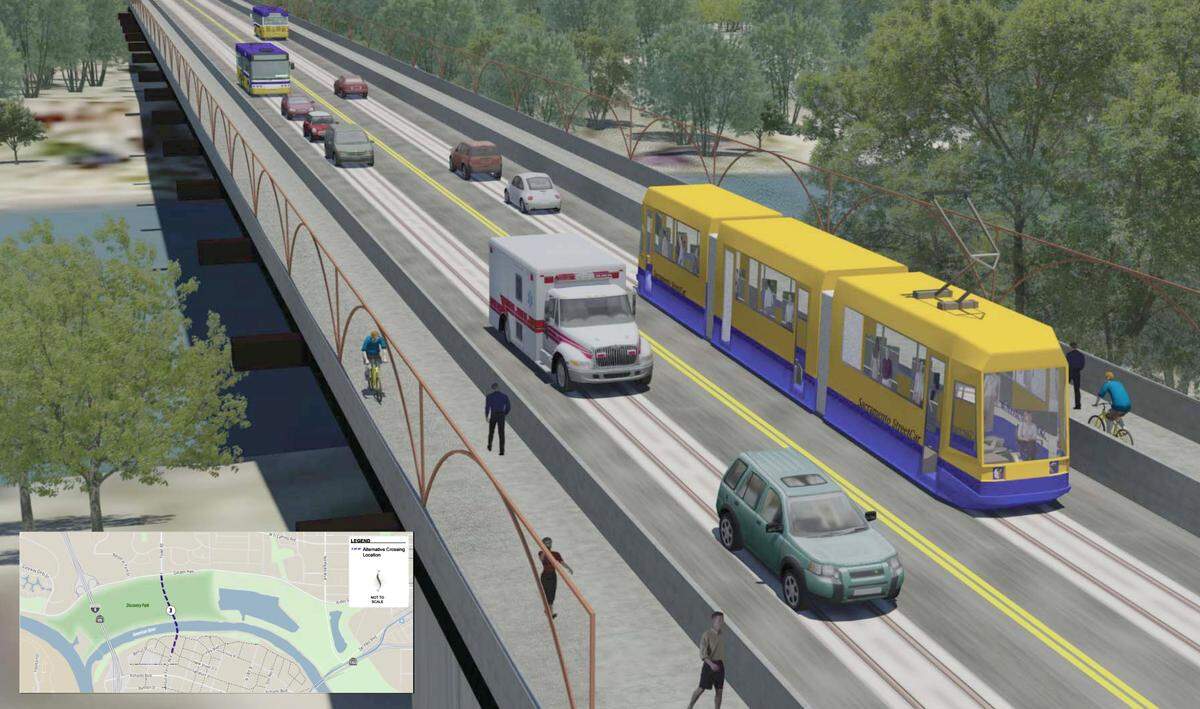
The city now intends to build the bridge about half a mile from the onramp to I-5.
“Car access is already abundant near the project, with Interstate 5 having 10 car travel lanes,” wrote Don Gibson, a member of the Active Transportation Commission, in a draft letter to the council. “Adding more car lanes only further accommodates personal vehicle travel as the primary and often the only form of transportation, going against many of the city’s plans.”
Since the initial Truxel Bridge plan was adopted in 2013, Sacramento leaders declared a climate emergency; finalized the 2040 General Plan that prioritized pedestrians, cyclists and transit riders over personal vehicle users; and set a “Vision Zero” goal to eliminate all traffic fatalities and severe injuries by 2027. Commissioners said the bridge would undermine all three plans.
Do any other bridges ban drivers?
A bridge that accommodated multiple modes of transportation but barred personal vehicle traffic is not unprecedented in the U.S. In 2015, Tilikum Crossing opened in Portland, Oregon, a span over the Willamette River that does not include space for drivers. The transit agency, TriMet, says that the project came in under budget, and the city built electricity-generating wind turbines on the bridge using the extra money.
Dave Unsworth, a TriMet director at the time who oversaw the project, told The Oregonian newspaper in 2011 that the agency considered having cars on the bridge but dismissed the idea, in part because it would create more traffic on feeder streets (Harris said at the Thursday meeting that the Truxel bridge would generally create more traffic on feeder streets, too).
Unsworth said that if cars were using the space as well, the Portland bridge would have needed to be about twice as big. A slimmer, auto-free bridge was cheaper and quicker to build.
Guenevere Millius, who served on an advisory commission for the Portland bridge for several years, said this month that the project did not meet much opposition over its lack of space for personal vehicles. The bridge, she said, is in line with the car-free “wave of the future.”
Harris said that “under the most favorable circumstances,” the planned Sacramento bridge would begin construction in about a decade.
The bridge would go from Sequoia Pacific Boulevard on the south side of the river to Truxel Road in South Natomas. I-5 is currently the closest nearby route for vehicle traffic between the city center and neighborhoods in Natomas. Two options in the feasibility study included bike and pedestrian lanes that were separated from car traffic with physical barriers; one option only separated cyclists from cars with paint. City staff recommend the option that places light rail trains, as well as a physical barrier, between cars and people walking and biking.
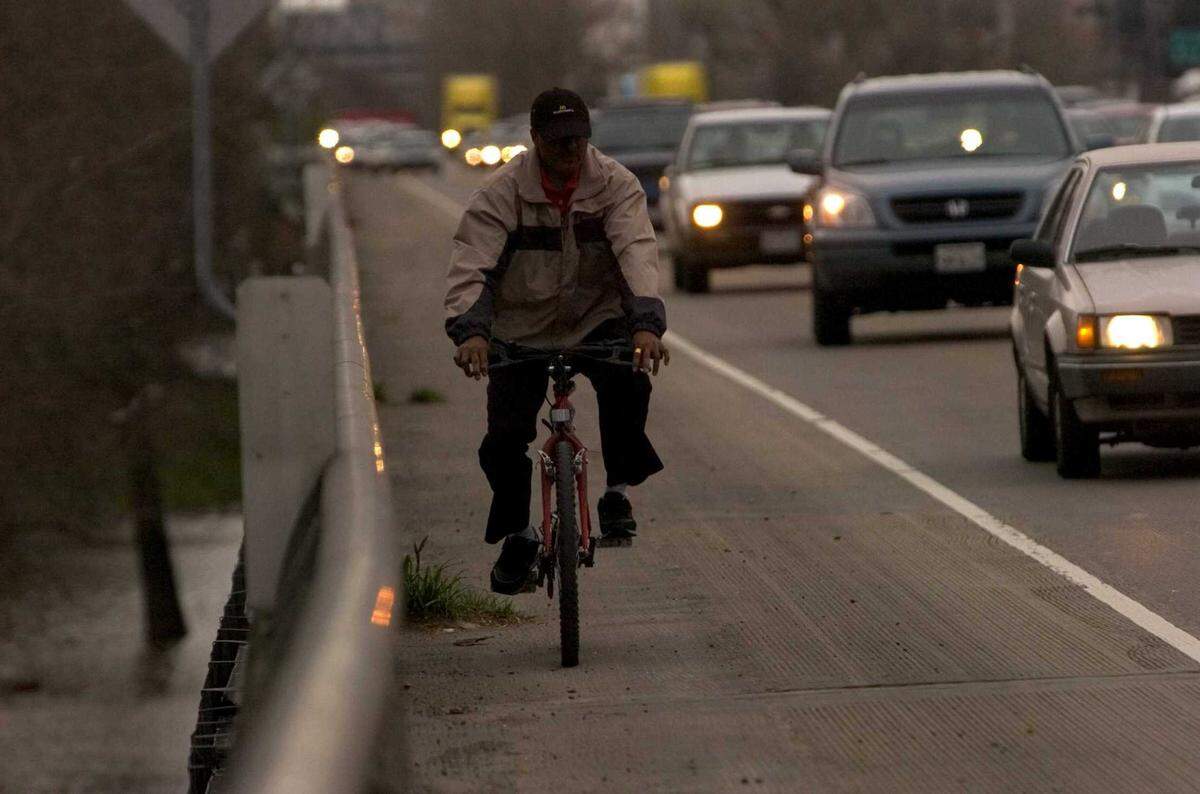
Current options for pedestrians and cyclists crossing the river are limited. The Sacramento Northern Bikeway offers a car-free passage that lines up with North 18th Street in the River District and lets out near Del Paso Boulevard. To the west, the Jibboom Street Bridge just west of I-5 is open to vehicle traffic as well as pedestrians and cyclists. The Truxel Road Bridge would be situated a half-mile upstream from the freeway and cut through Discovery Park.
In 2024, 20 cyclists and pedestrians were fatally struck by drivers on Sacramento city streets; two young women were killed while riding electric scooters. Gibson pointed out that Truxel Road is on the city’s high-injury network — those city streets where the highest numbers of fatal and severe crashes occur. He argued that the bridge would prompt more people to drive — a phenomenon called “induced demand” that has been verified by decades of research — and thus increase dangers to pedestrians and cyclists.
The Truxel proposals will next go before City Council — along with the commission’s recommendation to at least consider a bridge without cars — though a date for discussion has not been set.