
Broadway has some of Sacramento’s worst car crashes. The city wants to fix it
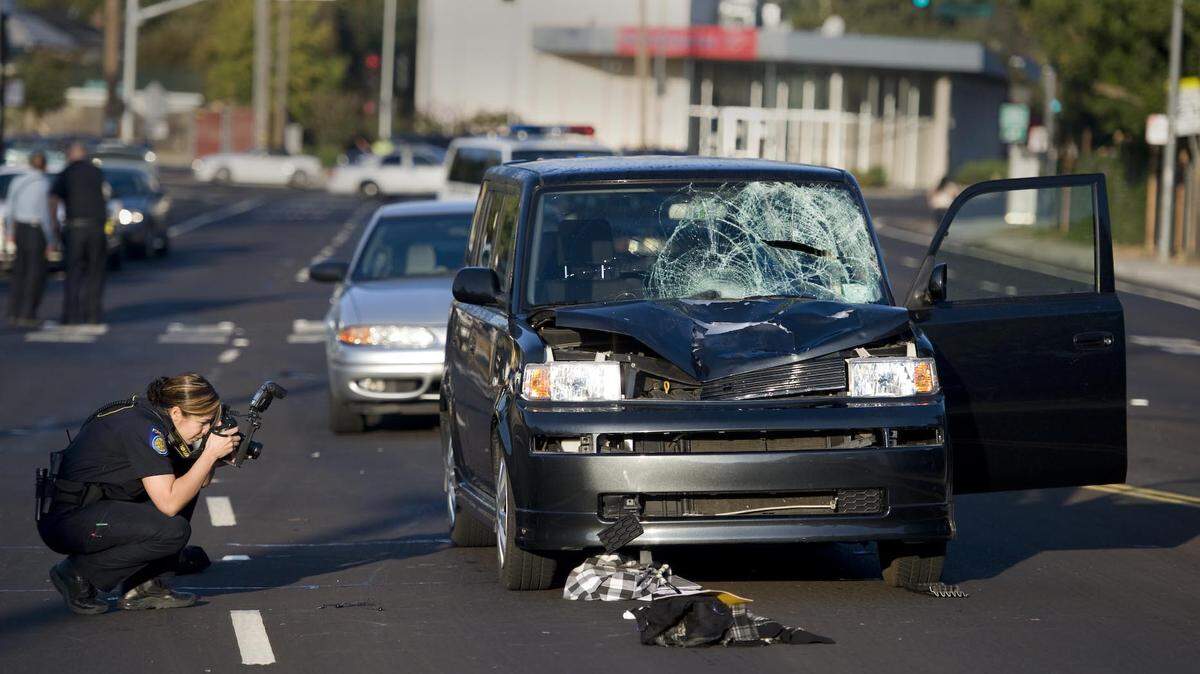
Sacramento’s City Council approved a preliminary plan Tuesday to overhaul Broadway in Oak Park, one of the city’s most dangerous corridors.
“These complete streets projects literally change lives and save lives,” Councilmember Caity Maple, who represents Oak Park, said at Tuesday’s meeting. “I’m so excited that we’re taking our next step.”
Under the plan, lanes will be removed on Broadway between Martin Luther King Jr. and Stockton boulevards, narrowing the road to two general travel lanes and a center lane. With the lanes eliminated, the space that’s freed up will be turned into continuous bike lanes, mirroring safety improvements that have already been made on Broadway west of Freeport Boulevard. Between MLK and Stockton, the city intends to install plastic posts to buffer the new bike lanes from vehicles.
Officials have identified Broadway as one of the “top five” corridors in the city with the greatest numbers of car crashes that severely injure or kill people. The newly approved plans include the installation of better pedestrian crossing infrastructure and bus stop enhancements to better accommodate people with disabilities. The Department of Public Works has earmarked $1.3 million to finalize the engineering and planning phase. Construction may begin next summer, with an expected price tag of $4.4 million.
The city has three safety projects on Broadway, which “represent a coordinated investment in safety and livability,” said Gabby Miller, a spokesperson for the Department of Public Works. “Once completed, Broadway will offer a continuous, bikeable and walkable connection from Interstate 5 to Stockton Boulevard.”
These projects are part of a larger effort. In 2017, the council made a “Vision Zero” pledge to eliminate all traffic fatalities and serious injuries by 2027, largely through changes to infrastructure.
The city approved a “quick-build” safety program earlier this year to rapidly install safety improvements, a major shift in its approach to the roadway fatality crisis in the California capital. Nonetheless, Sacramento is not on track to meet its goal to end traffic deaths by 2027. Since officials made that commitment, more than 300 people have died in collisions on city streets, including at least 17 people this year: Najah Islam, 30; Jonathon T. Slaugh, 62; Adrienne Keyana Johnson, 33; Cornelius Jesse, 59; Vuong Van Nguyen, 47; Zachery Ryan Taylor, 20; Natalia Regina Sanchez, 50; William Andrew Akens, 26; Ernesto Torres, 58; Zhen Cheng Kuang, 76; Thongthai Xanaxay, 55; Kaleb Josiah Green, 22; Duc Nguyen, 30; Robert Michael Pineschi Jr., 39; Kimberly Lynn Pickett, 60; Parris Shauntel Windham, 41; and Michael Driskell, 78.
Of the dead, 14 were pedestrians or cyclists. The remaining three were motorists.
As the city acknowledged with its Vision Zero pledge, the vast majority of serious crashes are preventable with changes to infrastructure and policy. Such collisions tend to follow identifiable patterns. In Sacramento, a disproportionate amount of them occur on just 14% of the city’s roads, dubbed the “high-injury network.”
Broadway bike lanes could make roads safer for everyone
Because Broadway is considered one of the worst corridors for severe crashes, part of a larger safety improvement project has already been installed west of Freeport Boulevard, where the city has removed travel lanes to slow drivers down and lessen the severity of crashes that do occur. In the space that lanes designed just for cars used to occupy, the city has painted wide unprotected bike lanes.
Safer and more comfortable bike infrastructure leads to more people biking. A study published in Nature Cities in June found that protected bike lanes attract about twice as many cyclists as unprotected bike lanes. Additionally, better bike lanes reduce risks for everyone on the road.
“Separated bikeways result in increased safety for all street users — not just folks walking or biking: That’s including people driving,” Jeff Jelsma, an associate planner in the Department of Public Works, recently told the Active Transportation Commission. Referencing research published in the Journal of Transport & Health, he said, “A study that analyzed crash data over the last 13-year period found that areas with separated bike lanes on city streets resulted in 44% fewer deaths and 50% fewer serious injuries.”
This story was originally published July 30, 2025 at 2:08 PM.