California I-80 tolls will cost you at rush hour. An algorithm decides the price
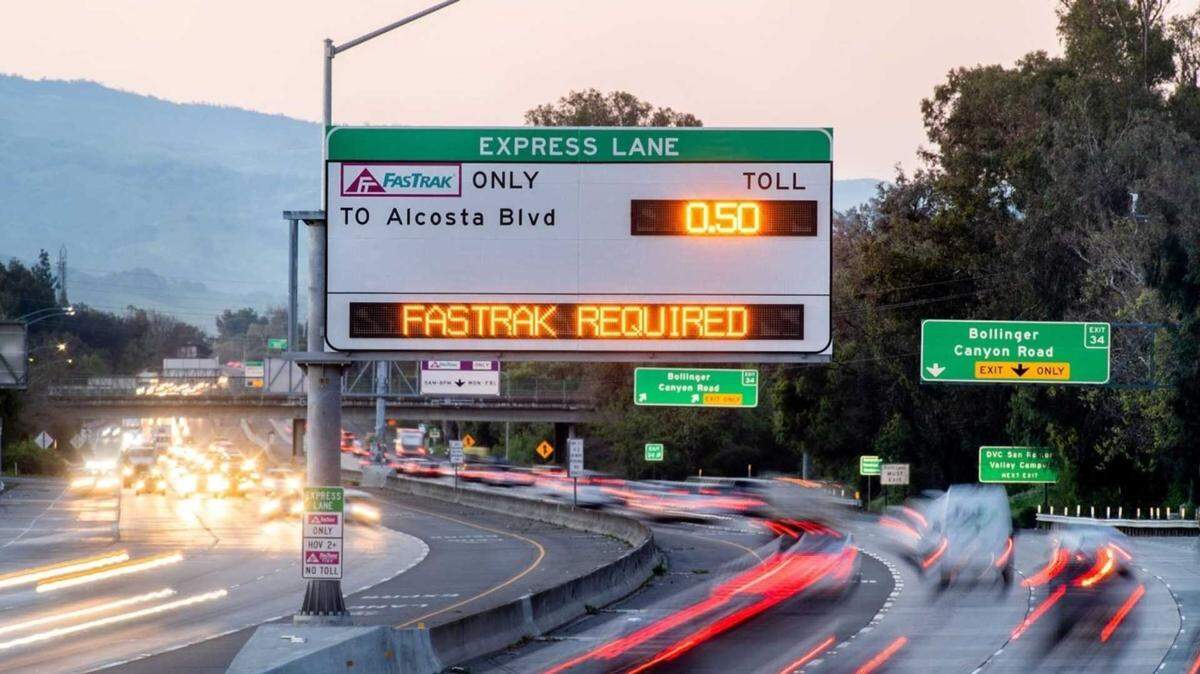
Interstate 80 congestion-based toll express lanes between Fairfield and Vacaville are set to open Dec. 16 — and the tolls, technically, have no cap.
The Bay Area’s Metropolitan Transportation Commission announced in a news release that the 18 miles of express lanes will operate seven days a week from 5 a.m. to 8 p.m. Drivers must have a FasTrak toll tag. The tolls — which vary based on current traffic conditions — will be displayed on overhead signs.
The minimum price is $0.75, but the maximum is up to an algorithm whose goal is to keep traffic in the express lane moving.
“We are obliged under federal law to keep (the tolled express lanes) moving at an average speed of 45 mph or faster at least 90% of the time,” said John Goodwin, a spokesperson for the commission. “That’s par, if you will, for this course: We need to price it in such a way that we ensure the traffic is moving at least 45 mph or faster at least 90% of the time.”
There are four segments marked as “zones” in the eastbound and the westbound Solano County express lanes, and a separate toll applies to each zone. The cost per zone of Bay Area express lanes rises at peak traffic times; the more drivers on the road, the higher the cost to enter the express lane. The higher prices are meant to discourage many people from using the lane and, therefore, make it worth the money to some motorists.
What are the costs and benefits?
Goodwin said that the agency looked at congestion-based tolls on Interstate 680 in Contra Costa County as a comparison. In the second quarter of 2025, the average toll for all times was $4.40 per zone. The average northbound toll peaked at $9.40 at 4 p.m., and the average southbound toll peaked at $6.40 at 8 a.m.
“If the data from 680 in Contra Costa County is a reliable proxy for what the results will be on 80 in Solano County, which is a completely untested theory,” Goodwin said, “the average toll would be about $4.”
For the project, Caltrans built new lanes between Fairfield and Vacaville. It also converted existing I-80 carpool lanes into tolled express lanes southwest of Fairfield. The project, the agency said, cost $244 million.
There are toll exemptions for carpools with three or more people, vanpools, buses and motorcycles, but the commission said these drivers must still have a FasTrak flex toll tag set to “3+.” A vehicle with two people gets half-off the toll, setting the flex toll tag to “2.”
The commission said the Dec. 16 opening date of the express lanes could change due to weather or technical issues.
A more transformative type of congestion-based toll debuted in New York City in January. Drivers in lower Manhattan’s “Congestion Relief Zone” now pay to enter the area. The effort has been a huge success: New York’s Metropolitan Transportation Authority says about 60,000 fewer vehicles enter lower Manhattan each day and that 311 complaints about honking in the area are down 70%.