In eco-friendly California, lawmakers still cling to wider highways, bill shows
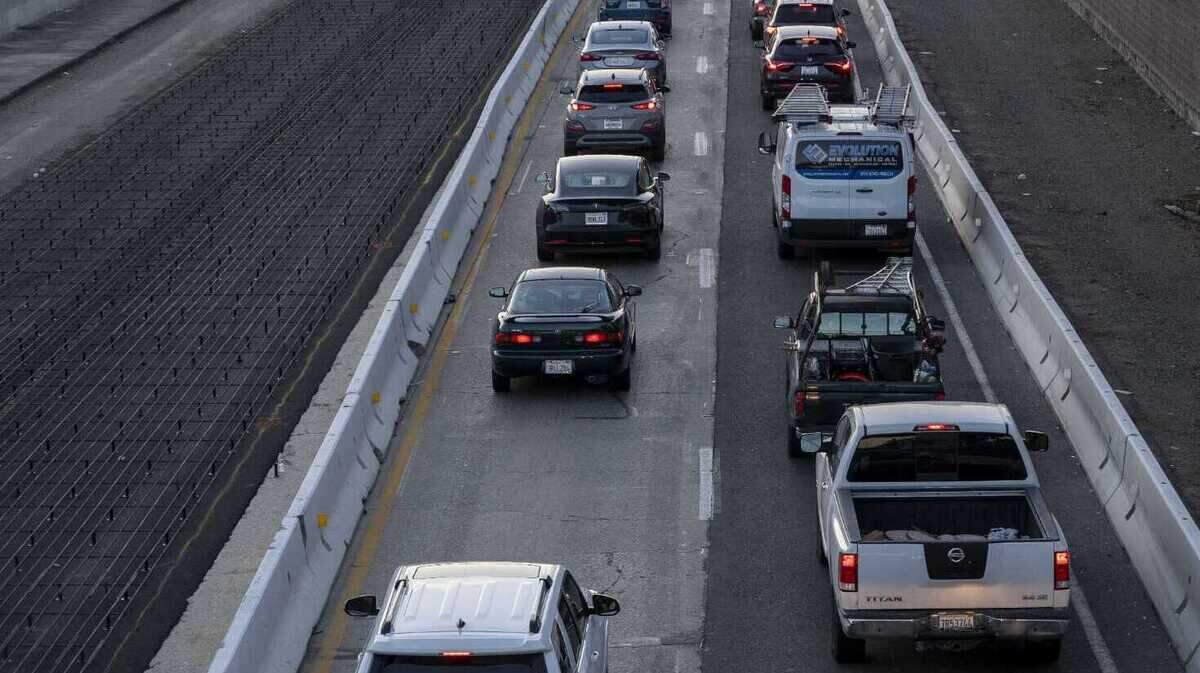
An effort by California lawmakers to require transportation agencies to “consider alternatives” to widening highways was thwarted recently after special interest groups fought to preserve more freedom to build bigger freeways.
Assembly Bill 2560, authored by Assemblymember Nick Schultz, D-Burbank, seeks to codify some of the goals in the state’s Climate Action Plan for Transportation Infrastructure, or the CAPTI.
To get the bill setting certain climate goals out of the California Assembly Committee on Transportation, however, Schultz said he had to cut the highway requirement — despite decades of research demonstrating conclusively that widening highways worsens traffic.
When asked about changing the language in the bill, he said, “I’ll be very candid: It’s not something that I wanted to do.”
But he said that without those changes, the proposed law would have died in committee.
“It may not include everything we set out to do, but I still think it’s a good foundational step,” Schultz said. When a state has important environmental values, he said, “We should enshrine them in law.”
Currently, CAPTI — a plan from the California State Transportation Agency originally adopted in 2021 — is based on goals were generated in response to executive orders by Gov. Gavin Newsom — and as result, they could be significantly changed or removed by a future governor.
Legislators have previously attempted to get CalSTA’s climate goals into state law. Newsom vetoed the similar AB 2438 in 2022, saying it was “unnecessary,”
With that history in mind, for AB 2560, Schultz weakened the language around highway widening and removed a requirement to weigh alternatives in an effort to ensure the bill’s passage through the legislature.
Beyond taking out the discouraging language on new lanes, the revised bill removed all references to using a “fix-it-first approach” when considering projects the state should pursue. Under that framework, maintenance and rehabilitation projects would be prioritized over big construction overhauls. Schultz also removed language that connected CAPTI goals to several transportation funding programs.
After making those edits, the bill passed out of the Assembly Committee on Transportation and was approved by the Senate Committee on Transportation Tuesday.
The current version of AB 2560 still encourages agencies to pursue projects that do not significantly increase car travel. But it no longer directly states that widening highways makes congestion worse, and it has been edited to add language saying “that highway expansion projects serve different purposes and as a result assessing the impacts of each project will vary based on context and project-specific analysis.”
CalSTA’s own guidelines say, “(R)esearch over the past several decades has demonstrated that highway capacity expansion has not resulted in long-term congestion relief and in some cases has worsened congestion, particularly in urbanized regions. … As a result, we cannot continue the same pattern of highway expansion investment in California and expect different results.”
Despite the CAPTI guidance, some lawmakers continue to advocate for pet freeway projects.
Why make climate goals for transportation?
The state has set climate goals around transportation and cars because the transportation sector is responsible for the largest share of greenhouse gas emissions.. The California Air Resources Board has said transportation is responsible for about 38% of these emissions, while the next-most-polluting sector, industrial sources, is responsible for 22% of emissions.
Hana Creger has analyzed highway widening policy as the associate director of climate equity at the Greenlining Institute, which supports AB 2560. She said that she saw the importance of enshrining the climate action plan in statute.
“Without codifying it,” she said, “nothing actually changes.”
And while Creger still thought the bill was positive, she was disappointed to see the weakened language around adding lanes to highways.
“This softening of the highway piece is indicative of how the state of California continues to prioritize funding highway expansion at the cost of communities,” she said. That cost to residents “can be measured in the number of demolished homes, worse air quality, the number of unsafe streets near highways.”
It can also be measured in taxpayer dollars: California spends vast sums of money on adding lanes to highways. In the Sacramento region alone, the “Fix 50” project that has ensnared drivers in construction jams for five years will ultimately cost about half a billion dollars.
Expensive highway widening projects such as Fix 50 are often aimed at reducing traffic congestion, but they have repeatedly failed to deliver that result, said UC Davis professor Susan Handy, who studies transportation.
“We have a lot of very robust evidence that is very consistent in showing that when highway capacity is expanded, the vehicle miles of travel also expands,” Handy previously told The Sacramento Bee. She explained that when people see there’s less traffic, they start driving more, which creates traffic in a phenomenon called “induced demand.” Adding lanes, she said, “doesn’t work because of human behavior. Because when the conditions in the roadway system change, we as individuals start to make different choices about our daily travel.”
“We invest billions of dollars,” Creger said, in highway projects that lead to air pollution, worse traffic and a lower quality of life.
“When you look at what we are getting for that investment,” Creger said, “it should really piss Californians off.”
What changed about transportation bill’s highway goal?
In the version filed in February, AB 2560 said one of the goals of the CAPTI was to promote “projects that do not significantly increase passenger vehicle travel, particularly in congested urbanized settings where other mobility options can be provided and where projects are shown to induce significant auto travel.”
Projects, the bill’s language went on to say, “should generally aim to reduce vehicle miles traveled and not induce significant vehicle miles traveled growth. When addressing congestion, consider alternatives to highway capacity expansion.” The bill made suggestions, including charging a flexible toll that increases during periods of higher traffic, a strategy known as congestion pricing that has successfully reduced traffic in Manhattan.
In the version that passed out of the Assembly and moved to the California Senate, however, Schultz edited out the vast majority of the bill’s original language, including the references to induced demand. The bill says the state should promote projects that do not significantly increase car travel, but there is no longer a requirement to “generally aim to reduce” driving or to avoid generating more car travel. And the bill does not tell agencies to consider alternatives to adding lanes.
The new wording gives widening projects — particularly those in rural areas — more leeway.
What did lobbyists say about climate bill?
Schultz said he received opposition from committee leadership and from lobbyist groups. The Sacramento Bee requested the lobbyist position letters for the first two iterations of the climate bill.
In total, 24 letters were released. The writers fell into three camps: organizations that opposed the law on behalf of development and construction industry groups, including unions and trade associations; a group of governmental regional planning organizations; and a group of public health and environmental organizations expressing enthusiastic support for the legislation.
Groups opposing the bill complained that AB 2560 imposed “a one-size-fits-all” approach to transportation planning that did not account for differing regional needs. Though most of the opposition didn’t directly mention highway widening, induced demand or vehicle miles traveled, many did cite the need for “flexibility” in project planning.
Five of the opposition letters did address highway expansion. Two made the same complaint: that the bill, as the Nevada County Transportation Commission put it, would “fail to reflect rural transportation realities.”
The Tulare County Association of Governments, another regional planning organization, made the same argument, writing that the focus on reducing vehicle miles traveled would disproportionately disadvantage a rural area. In Tulare County, the letter said, residents have to travel longer distances for jobs and essential services, and alternatives such as transit, biking or walking are much less feasible.
The California Chamber of Commerce, the California Manufacturers and Technology Association and the California Trucking Association jointly wrote that the bill “promotes a framework that discourages projects that increase vehicle travel and directs agencies to consider alternatives to highway capacity expansion. While multimodal investments are important, a one-size-fits-all emphasis on reducing vehicle miles traveled does not reflect the operational realities of California’s diverse regions.”
Both the Tulare County Association of Governments and the Nevada County Transportation Commission later removed their opposition to the bill after Schultz amended it.