
How Sacramento is trying to stop car commuters from overwhelming neighborhoods
Twenty-five years ago, Sacramento made a pivotal decision at the urging of beleaguered residents: Cars would no longer be undisputed kings of central city streets.
The city would revamp the central street grid to slow commute traffic, disperse it, and even block car drivers from using some residential streets. The long-term goal was to swing the pendulum from a car-centric central city to a calmer and more livable series of neighborhoods where pedestrians and bicyclists feel safe, and where walkable business districts could thrive.
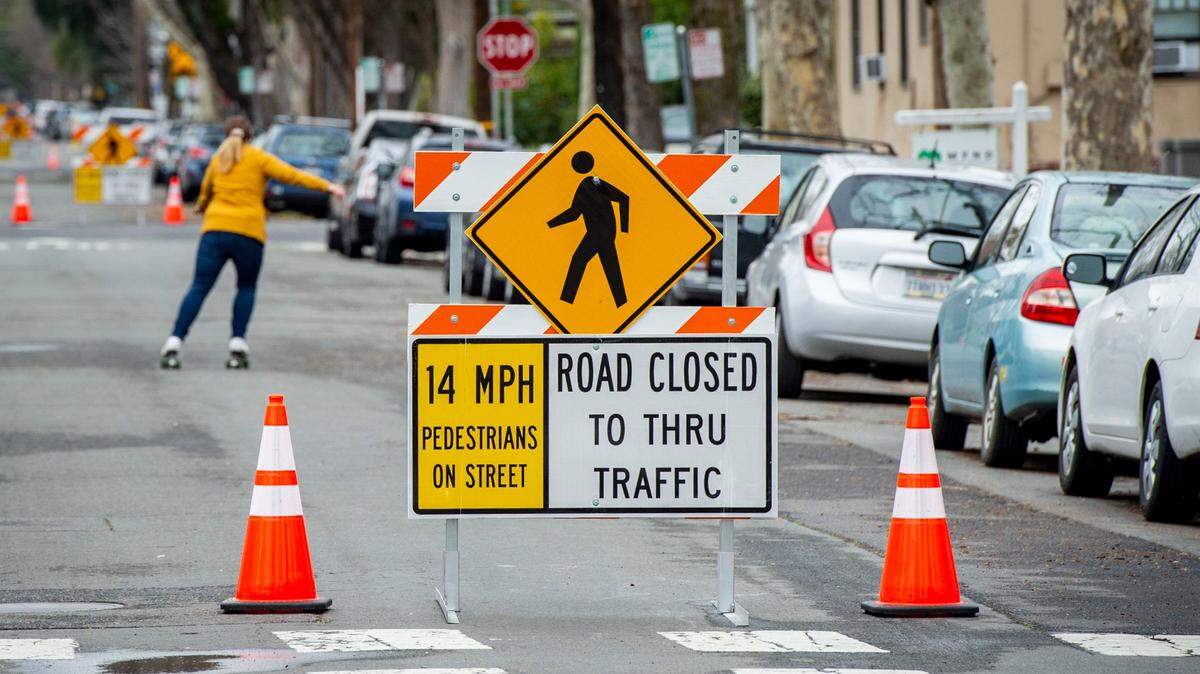
That ambitious effort is ongoing today, and took what could be a notable step forward last week when the city partially closed 1.6 miles of residential streets in midtown to through traffic.
The closures, on 26th Street from K to V streets, on O Street between 22nd and 26th streets, and V Street between 21st and 26th streets, are an experiment, with temporary signage.
The experiment comes during a period of relative commute calm in downtown due to pandemic-related office closures. The city will observe in the coming months to see how it works.
But officials say they already are willing to try it out in other neighborhoods if residents want it and if the street situation makes sense, city transportation planning manager Jennifer Donlon Wyant said.
The move has triggered immediate debate and some confusion.
Some applauded the idea, saying it makes residential neighborhoods tranquil and friendly. Others complain the city is wrong to force drivers out of their way, especially given that pedestrians already have sidewalks, and cyclists can use the street anyway.
And some just question the viability: There are signs up, but the streets are not entirely blocked, so what’s to stop any and all drivers from heading down the street anyway?
The idea appears to have solid support in the neighborhood, though. The area’s City Council representative, Katie Valenzuela, calls the closures an amenity that could help improve mental and physical health during the COVID-19 pandemic.
Emel Wadhwani, a 26th Street resident, was walking her dog last week on the first day of closures. She was on the sidewalk, but said she supports the closure experiment as a way to knit the neighborhood together. “And,” since the street isn’t fully closed, “we can still park on our street.”
Started as a way to salvage neighborhood livability, the city’s “traffic calming” program has broader context now, given the city’s efforts to take local-level steps to reverse climate change, Mayor Darrell Steinberg said.
”Being a leader on climate requires we take the big steps and do all of the smaller steps to ensure that we are not leaving any strategy to the side,” he said. “This is not a small step. It is a very tangible step that says Sacramento aspires to be and in many ways is already a walkable and a bikeable community.”
Part of a ‘healthy community’ plan
It’s been a long, slow evolution. In 1996, it seemed revolutionary.
Decades earlier, the city had turned a number of central city streets into high-speed, one-way, three-lane commute corridors to push cars from freeways and outer communities quickly and in big numbers to downtown work sites.
Typically, the city teamed up two streets, similar to opposite sides of a freeway – one street to funnel commuters inbound in the morning, an adjacent street to funnel them out in the afternoon.
But, in the 1990s, residents in northern midtown’s tree-lined neighborhoods of bungalows, Victorians, small apartment buildings and corner markets complained that they were under siege from speeding traffic on G and H streets. Both at the time were three-lane, one-way streets. Residents didn’t feel safe crossing their own street, they said.
City officials themselves had come to realize they had sacrificed core-area residents’ interests for those of commuters coming in from outside the city. They responded by converting G and H streets back to two-way with just one lane in each direction. That slowed and dispersed commute traffic.
That fix caused another issue that required an even more hotly-debated change: To stop diverted traffic from inundating other quiet nearby streets, the city constructed half-street closures on some nearby residential streets – concrete curbs and planters that blocked commuters from going down certain blocks.
More than the street conversions, the lane blockages sent a message to commuters: It’s about residential livability now, not about shaving minutes off commute times.
Ken Grehm was the city’s traffic official in charge of the transformation. He recalls the anger and indignation it created among commuters.
“People were afraid the car commuter was being thrown over the cliff,” he recalled. “But we found ways for commuters to get to work. Maybe it takes an extra two minutes, but that is not too much to liberate these neighborhoods.”
Sacramento street diets, traffic circles
The multi-decade effort since then has included putting other major streets on lane-reduction “diets,” returning some streets to two-way and adding bike lanes here and there.
Sometime later this year or next year, another section of I Street between 15th and 21st streets is scheduled to be transitioned to two-way from one-way.
The city also has built traffic circles in some intersections, replacing stop signs. Officials said too many drivers blew through those stop signs, endangering pedestrians and risking crashes. The circles forced cars to slow down and eliminated broadside crashes.
The most controversial change in recent years, transportation manager Donlon Wyant says, was narrowing J Street to two lanes from three, and sliding the right-side parking lane out into what had been the third travel lane, making room for a “parking protected” bike lane next to the right curb.
Commuters worried about traffic jams in the afternoon headed to the Capital City Freeway. Traffic models, though, “showed it wasn’t going to be the end of the world,” Donlon Wyant said. It has made it easier, she said, for shoppers and diners or Saturday Farmers’ Market visitors to cross J Street safely.
More recently, when the COVID-19 pandemic hit, the city went further by allowing some restaurants and brew pubs to spill out into the street, such as 20th Street between J and K streets. Places put tables, tents and service areas in what once were traffic lanes.
The moves have generally been well received after the initial shock. But they continue to prompt criticisms from two very different viewpoints.
Some car drives complain the changes are complicated, confusing and entirely too focused on cyclists and pedestrians when most people still need to drive cars to get to the store or work. Others complain the city isn’t going far enough fast enough in suppressing car travel or encouraging alternate modes.
Sacramento, for instance, still has not made good on its plan to create safe and separate commuter bike routes into downtown from the north, south, east and west, nor has it created enough bike lanes in downtown.
The city also has been stymied so far on its decade-long effort to build a streetcar line that would have allowed more people to travel through downtown and midtown without using cars. Sacramento Regional Transit remains less than the robust service it wants to be. And the COVID-19 pandemic has shrunk what was a growing electric bike and electric scooter rental movement in Sacramento.
Yet the desire by the city and residents to reduce car travel in the core area appears to be stronger than ever.
The city has repeatedly changed its parking program in recent years to allow more businesses, such as restaurants, to open without providing on-site parking.
New apartments in some denser areas of the city are now only required to build one parking spot for every two apartment units, a decrease from the previous minimum of three parking spots for every two apartment units.
The city has pushed, meantime, to open private parking garages for use at night, such as around the Golden 1 Center arena, tapping existing unused capacity. That allows the city and developers to avoid building more garages.
In 2018, the city eliminated parking requirements for any development within a ¼ mile of a light rail station anywhere in the city.
More people, fewer cars
Growing density, both in the central city and potentially along older commercial corridors, will reduce the need for cars, at least for local trips, city Public Works Director Ryan Moore said.
In the next 10 years, the city could have 10,000 new dwelling units pop up in the central core, but it will not have new roads or car lanes to serve those people, except in a few places, such as the downtown Railyards development.
Given that, “we have to responsibly offer alternative modes,” Moore said. That includes more robust bus, light rail, and shared shuttles after the pandemic.
Despite that focus, “our intent is not to shun the car user,” said Emily Baime Michaels, head of the Midtown Association, which promotes central city vibrancy.
The city notably allowed cars back onto the former pedestrian K Street Mall downtown to encourage businesses by bringing more potential patrons in.
Instead, it’s about continuing to reshape the core area as a place you go to, not go through, Baime Michaels said. “The real tipping point for midtown vitality is you get to the point where there are so many residents living here that it can self-sustain while still being a welcoming place for visitors.”
City officials say the COVID-19 pandemic and the arrival of the Biden administration could open new avenues to add transit and turn more streets into shared facilities.
The pandemic’s longer-term effect could be fewer car commuters on city streets, if many office workers stick with partial teleworking-from-home schedules.
The Biden administration hasn’t spoken in detail about transportation plans, but is expected to invest more in transportation than the Trump administration with a focus on holistic projects, such as the “complete streets,” where roads are designed for different types of users. That includes making it safer and easier for children to walk and bike to school.
City officials plan more bikeways in the next year on streets in neighborhoods throughout the city, some of them separated from moving cars.
The newest concept in metropolitan areas is called “the 15-Minute City,” and means that people in any neighborhood should be able to get to most places – schools, stores, restaurants and jobs – within 15 minutes without having to use a car.
The city also is planning a remake of Broadway, changing the street from four lanes to two and creating a streetscape that will attract business investment. The goal is to make Broadway feel similar to the recently refashioned R Street Corridor in midtown and downtown, where the sidewalks are dotted with fresco dining and where drivers will be pushed to travel at lower speeds.
The signs that went up on O and V and 26th streets last week symbolize that. Cars aren’t banned. But motorists are asked to drive on those streets at 14 miles per hour.
This story was originally published February 21, 2021 at 5:00 AM.