
'Lava bomb' from Kilauea shatters a Hawaii man's leg. What is this magma spatter?
.JPG "In this Saturday, May 19, 2018, photo released by the U.S. Geological Survey, lava flows from fissures near Pahoa, Hawaii. Kilauea volcano began erupting more than two weeks ago and has burned dozens of homes, forced people to flee and shot up plumes of steam from its summit that led officials to distribute face masks to protect against ash particles.")
A Hawaii man standing on his third-floor balcony was hurt Saturday when he was hit by lava spatter, becoming the first person injured by the Kilauea eruption.
The man's leg was shattered from shin to foot as a result of the impact, according to Reuters. He has been identified as a homeowner on Noni Farms Road, but no additional information was immediately available.
“I heard the injury was quite bad, serious to his leg,” Hawaii County Civil Defense Administrator Talmadge Magno told the Honolulu Star-Advertiser.
Lava spatters “can weigh as much as a refrigerator and even small pieces of spatter can kill,” Janet Snyder, a spokeswoman for the Office of the Mayor, County of Hawaii, told Reuters.
Lava spatter occurs when expanding gases fling blobs of still-molten lava through the air from a vent or fissure, according to Oregon State University.
When some of the lava falls back to earth around the vent, it can form a spatter cone. Also called “lava bombs,” spatters can reach sizes of up to 1 ½ feet and fly up to 80 feet high, according to WorldLandforms.com.
And there are more concerns as the volcano eruptions continue to intensify.
The Star-Advertiser reported Sunday morning that sulfur dioxide levels have tripled due to two lava flows entering the ocean. Another worry is laze, a mix of hydrochloric acid, steam and volcanic glass particles, which is created when hot lava mixes with ocean water. Laze can lead to lung damage as well as eye and skin irritation, according to The Associated Press.
The laze plumes can travel with the wind and change direction at any time, Hawaii County Civil Defense advised. The agency urged everyone to be aware of the hazard and stay away from laze plumes.
Hawaii County Civil Defense said late Saturday night thatmore Hawaii residents living near the volcano had been evacuated, though details were not available regarding the number of people.
.JPG "Hawaii Volcano (1).JPG")
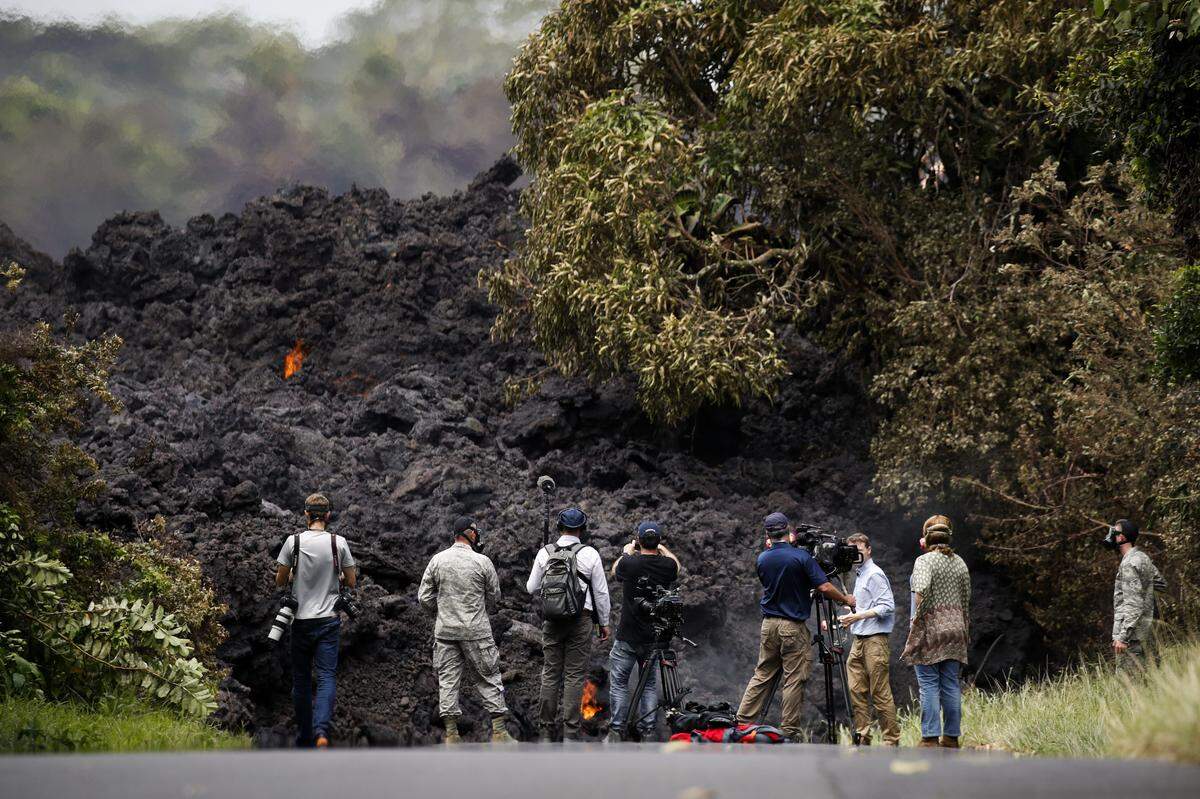
According to The Associated Press, some people trying to leave were temporarily trapped when a flow crossed the road, and they had to be airlifted to safety.
So far, the volcano has opened more than 20 vents — four of which have merged into one large crack — gushed lava into the sky and sent lava toward the ocean at a speed of 300 yards per hour, The Associated Press reported. It's unclear just how long the eruption will last.
"Here's nature reminding us again who's boss," Joseph Kekedi, an orchid grower who lives near the spot where lava is flowing into the sea, told The Associated Press.
Kilauea is located on the Big Island of Hawaii. The island is about 4,000 square miles, and the volcano has not affected the majority of the island.
Flights to Hawaii, even on the Big Island, haven't been affected by the eruption, and most businesses and tourist activities are still open and available, according to The Associated Press.
This story was originally published May 20, 2018 at 7:25 PM with the headline "'Lava bomb' from Kilauea shatters a Hawaii man's leg. What is this magma spatter?."