
Coronavirus death toll in Washington state climbs to 9; one died last week
The News Tribune and McClatchy news sites have lifted the paywall on this developing story, providing critical information to readers. To support vital reporting such as this, please consider a digital subscription.
Nine people have died of coronavirus in Washington state, the Department of Health reported, eight in King County and one in Snohomish County.
Four of the fatal cases stemmed from Life Care, a nursing facility in Kirkland. All the Washington deaths have occurred at EvergreenHealth Hospital in Kirkland.
One of the deaths was from a reported case of COVID-19 reported last week at Harborview Medical Center in Seattle.
According to Harborview spokeswoman Susan Gregg in a statement released Tuesday morning: “We have received notice from Public Health — Seattle & King County that a presumptive positive coronavirus case has been detected in a patient who was admitted to Harborview Medical Center in Seattle on Feb. 24 and died Feb. 26.
“This patient, with underlying medical conditions, had been transferred to Harborview from Life Care Center of Kirkland.”
According to Gregg, potentially exposed staff are now being monitored.
“We have determined that some staff may have been exposed while working in an intensive care unit where the patient had been treated. We don’t believe that other patients were potentially exposed,” she said.
“Potentially exposed staff have been contacted by our Employee Health team and are being monitored and screened daily. “
Another death blamed on the virus also was reported on Tuesday. Seattle and King County on Tuesday reported seven additional confirmed cases of COVID-19 in King County, bringing the total of confirmed cases to 21, along with eight deaths.
One death has also been reported in Snohomish County, along with six confirmed cases.
TESTING IN WHATCOM COUNTY
A second Whatcom County resident is being tested for the new coronavirus.
A sample was sent Tuesday, March 3, to the Washington State Department of Health lab in Shoreline, according to Melissa Morin, spokeswoman for the Whatcom County Public Health Department.
No additional details were available about the person being tested.
One other person has been tested in Whatcom County. That was in January and that test was negative.
Symptoms of the illness, also called COVID-19, include fever, cough and shortness of breath.
The Whatcom County resident is being tested under the current, expanded guidelines from the Centers for Disease Control and Prevention to include those who have symptoms but haven’t recently come into contact with someone known to be ill with COVID-19 or traveled to countries affected by the outbreak.
Those countries are China, Japan, Italy, Iran and South Korea.
As of Tuesday morning, March 3, no one has tested positive for COVID-19 in Whatcom County.
Schools should stay open and large public events should continue for now, the Whatcom County Health Department said Tuesday amid growing concerns about the spread of the new coronavirus in Washington state.
No schools in Whatcom County, including colleges and universities, have announced that they’re going to close. A petition has been launched on Change.org to get WWU to close, although it doesn’t have much traction.
“There are currently no plans to cancel classes or close the university due to the fact that no members of the WWU community have been diagnosed, and there are no cases reported in Whatcom County,” university spokesman Paul Cocke said to The Bellingham Herald in an email.
He said the university was working closely with the Whatcom County Department of Health and was monitoring updates and guidance from the Centers for Disease Control and Prevention as well as the state Department of Health.
—Kie Relyea and staff, The Bellingham Herald
SHELTON SCHOOL CLOSES FOR CLEANING
Mountain View Elementary School in Shelton was closed Tuesday for deep cleaning after school officials learned a staff member’s spouse was a first responder at a COVID-19 outbreak at a long-term care facility in Kirkland, the school says.
The staff member’s spouse responded to the Life Care Center of Kirkland near Seattle, where The Seattle Times reports there have been five resident deaths. The first responder has been directed to be quarantined at home, according to a school announcement.
Mountain View got the news Monday, then shared the information with the Mason County Public Health Department, which recommended the staff member stay home for 14 days, the school says.
The spouse and staff member aren’t known to have the virus and aren’t displaying symptoms, according to the school.
— Sara Gentzler, The Olympian
LIVESTREAM PLANNED FOR TACOMA STATE OF CITY ADDRESS
The city of Tacoma is moving its annual State of City address to a virtual platform amid coronavirus concerns.
Out of “an abundance of caution, as well as concerns expressed by the community,” the 2020 State of the City Address will now be streamed online and on TV at 6:30 p.m. Wednesday, the city announced in a press release on Tuesday.
The event was originally going to be held at the Mount Tahoma High School Auditorium in Tacoma.
Those interested can watch at facebook.com/cityoftacoma and tvtacoma.com. TV Tacoma can be viewed on both the Click! and Comcast Cable systems.
Elsewhere in the city, as of Tuesday, there have been two event cancellations for the convention center, according to a representative for Travel Tacoma – MT. RAINIER Tourism and Sports.
“We’ve had cancellations from one health care provider and one military group, both of which understandably wanted to prioritize the readiness of their staffs,” said Matt Wakefield, media representative for the agency.
— Allison Needles and Debbie Cockrell, The News Tribune
STORES FEELING THE STRAIN
If you were looking for toilet paper at Fred Meyer in Gig Harbor Tuesday morning, you were out of luck.
Also, if you were looking for bleach, throat lozenges, and hydrogen peroxide, all were also out of stock or in very limited supply.
Justin Lopez, store manager, told The News Tribune that their truck with restocking supplies would arrive later in the day.
“Come back tonight,” he recommended. “We should be back in stock with everything tonight.”
Hand sanitizer, though, was still in short supply system-wide, he said.
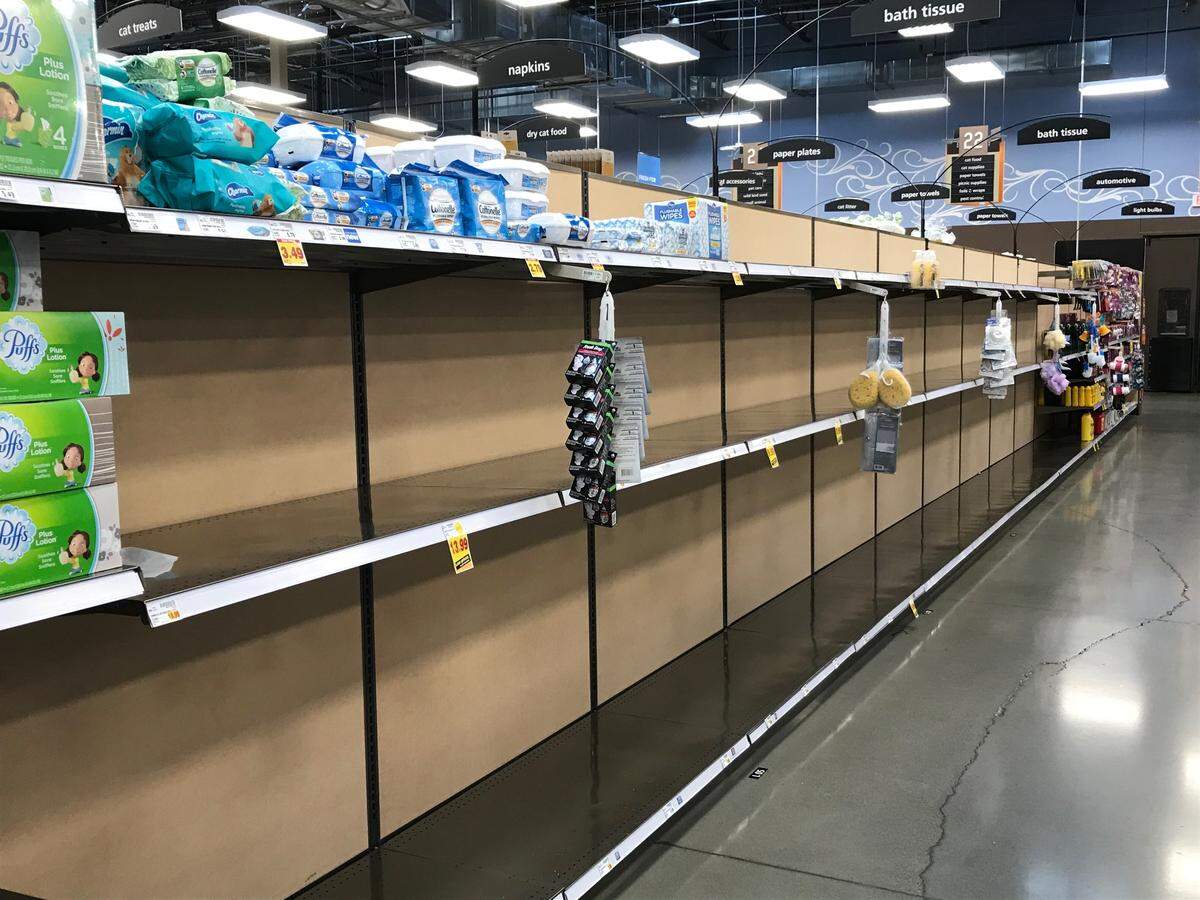
After a weekend of frenzied shopping driven by coronavirus fears, stores still showed shortages of different items. While Gig Harbor’s Safeway had toilet paper, paper towels and bleach as of Tuesday morning, it was still running low on antibacterial cleaning wipes for surfaces and Lysol.
A customer at the Fred Meyer gasped when seeing the hydrogen peroxide bin empty.
“I saw the frenzy over the weekend online and decided to wait until today to go to Costco,” she said. “I hope I’m not too late.”
Another shopper was seen wearing a face mask. Health officials up to and including the nation’s Surgeon General have discouraged people buying face masks unless they are sick, to ease the current shortage.
Bartell Drugs issued a statement Monday that it was rapidly restocking its stores: “Bartell’s is shipping more over-the-counter products to stores after experiencing high demand due to concerns relative to COVID-19 this weekend. The most sought-after items include OTC medications, hand sanitizers, disinfectants and antibacterial sprays.
“We are shipping thousands of units to the stores this week.” said Ken Mahoney, SVP of Operations at Bartell’s in the release. “Some national suppliers have been unable to keep up with the demand. Although we cannot guarantee we will be in stock on everything, we are looking for alternatives when possible.”
Store officials also recommended flu shots for those who never got one for the flu season.
“We recommend patients consider a flu shot if they have not been vaccinated against the flu” said Kathi Lentzsch, CEO of Bartell’s. “This will limit the number of flu cases in our area and enable healthcare providers to be available to those in need.”
It noted that the chain would have flu vaccines available in stores Thursday.
Walmart on Tuesday would not offer details about supplies at their own stores, saying the retailer kept such discussion limited to its quarterly earnings reports.
Director of Communications Tiffany Wilson told The News Tribune in response to questions about possible shortages now or in the future: “We continue to monitor the development of the coronavirus situation globally, and are closely following official recommendations while working with our suppliers to understand and mitigate any supply chain disruptions.”
Costco, in a statement posted on its business center delivery site, said: “Due to the increased sales of personal care items and non-perishable food, we are currently out of stock on many items. We are working diligently with our suppliers to get restocked.In addition, you may experience items being out of stock on online delivery orders previously placed.”
THURSTON COUNTY PREPARES FOR COVID-19
In a county meeting room that smelled strongly of sanitizing wipes Tuesday morning, Schelli Slaughter, Director of Thurston County Public Health and Social Services, gave commissioners a local update on the spread of COVID-19, or novel coronavirus.
She had some good news: “In Thurston County, we have no confirmed new cases of COVID-19,” she said. “We do not have any persons under investigation in Thurston County.”
But, the situation is rapidly changing. She said the public health strategy has “shifted from containment to preparing for continued spread.”
— Sara Gentzler, The Olympian
WHAT ARE CORONAVIRUSES?
Coronaviruses are a family of viruses responsible for illnesses ranging from the common cold to SARS, or Severe Acute Respiratory Syndrome, and MERS, or Middle East Respiratory Syndrome, the World Health Organization says.
The virus gets its name from the “crown-like spikes” on its surface, the U.S. Centers for Disease Control and Prevention say.
This illness respiratory illness also goes by the name novel coronavirus and the code 2019-nCoV. It is a viral respiratory illness that spilled over into people from bats, said Christine Kreuder Johnson, a professor of epidemiology and ecosystem health at the University of California, Davis.
The other six include a couple of other viruses that grabbed headlines over the last decade — SARS, or severe acute respiratory syndrome, and Middle East Respiratory Syndrome, or MERS. The U.S. Centers for Disease Control and Prevention and other health organizations worldwide are basing their estimate of this new virus’ incubation period on that of the MERS incubation period. MERS first appeared in Saudi Arabia in 2012 and has since spread around the world. Its symptoms typically start to appear about 5 or 6 days after a person is exposed, but that can range from 2 to 14 days.
WHAT IS COVID-19?
COVID-19 is the official name for the infectious disease caused by the most recently discovered coronavirus, WHO says. The virus and disease were not previously known.
The name comes from the words Coronavirus Disease 2019, Vox reported. But it took some work to come up with it.
“We had to find a name that did not refer to a geographical location, an animal, an individual, or a group of people, and which is also pronounceable and related to the disease,” said WHO chief Dr. Tedros Adhanom Ghebreyesus, according to the publication.
Scientists had previously been calling it the 2019 Novel Coronavirus, since it was a new, or novel, strain of the virus discovered in 2019.
HOW DOES THE INFECTION SPREAD?
Like many viruses, the COVID-19 virus spreads chiefly by respiratory droplets, created when people sneeze, cough, talk or blow their noses, The Scientist reports.
Other people within 6 to 8 feet inhale the droplets, which contain the virus, spreading the infection, according to the publication.
The virus also may spread when someone touches a surface infected by the droplets, then touches their mouth or face, The Scientist reports. But researchers are still working to find out how long the virus can survive outside the body.
It’s also possible the virus could survive in tinier airborne droplets, which can spread farther than respiratory droplets, Johns Hopkins Medicine says.
HOW TO PROTECT YOURSELF
The U.S. Centers for Disease Control and Prevention suggest avoiding close contact with people who are sick, avoiding touching your eyes, nose, and mouth, staying home when you are sick, covering your cough or sneeze with a tissue and cleaning and disinfecting frequently touched objects and surfaces using a regular household cleaning spray or wipe.
The agency also advises washing your hands often with soap and water for at least 20 seconds, especially after going to the bathroom; before eating; and after blowing your nose, coughing, or sneezing.
Public health agencies worldwide also are ensuring that there is good public messaging around all the best practices for preventing disease transmission, Johnson said. The CDC, for instance, has created a really good website that answers questions, provides guidance to travelers and counsels health care professionals. It’s https://bit.ly/coronavirus-facts.
DO SURGICAL MASKS PREVENT TRANSMISSION OF THE VIRUS?
The virus is probably spread most often when people sneeze or cough, releasing droplets into the air.
No public health agency has recommended that the general public wear masks to stave off infection. Rather, they recommend the everyday precautions that people take to prevent cold and flu:
- Wash your hands often with soap and water for at least 20 seconds. If you really can’t get to soap and water, then use a hand sanitizer that has at least 60 percent alcohol.
- Can’t wash your hands right away? Avoid touching your mouth, nose and eyes as these are areas where the pathogens can grow.
- Do not stand close to people who are sick. That may mean taking the stairs rather than an elevator.
- If you take an elevator, try not to touch buttons with your fingers. That’s also true for other objects or surfaces that other people may touch. Clean and disinfect those areas if you can. Otherwise, avoid touching them.
- Cover your mouth when you cough or sneeze, either using a tissue or your elbow. Throw used tissues in the trash right away.
- If you are sick, stay at home. If you have traveled to China or have been on an international flight with others from Wuhan in the last two weeks, you may wish to seek medical treatment for any symptoms. Call ahead to let them know why you’re coming. They may wish to admit you into an isolated unit.
As for masks, no studies show surgical masks provide protection. Those masks prevent a spray of droplets from landing in your nose or mouth, but airborne germs can still penetrate around the edges of the mask.
STAY CALM AND CALL YOUR DOCTOR FIRST
How do you know if you or your sick loved one with a cough, shortness of breath and fever actually is infected with the coronavirus or is just suffering from another cold or flu?
The Centers for Disease Control and Prevention says your first step is to call your healthcare professional if you develop symptoms and have been in contact with a person known to have COVID-19 or traveled to an area where coronavirus is widespread.
Your healthcare provider then will work with the Washington State Department of Health and CDC to determine if you need to be tested for COVID-19, according to the CDC website.
The state’s Healthcare Provider & Facility Guidance on SARS-COV-2 — the cause of COVID-19 — lists the four criteria set Feb. 28 by the Department of Health to determine who should be tested as:
▪ People who present either a fever or lower respiratory symptoms and have had close contact with someone who tested positive for COVID-19 within 14 days of symptoms onset.
▪ People who present both fever and lower respiratory symptoms that require hospitalization and traveled to an area where COVID-19 is widespread within 14 days of onset.
▪ People who have a fever with a severe respiratory illness (such as pneumonia) that requires hospitalization and for whom no other explanation for the diagnosis exists.
▪ A local health officer requests testing.
— David Rasbach, The Bellingham Herald
New safety coronavirus safety protocols at Sea-Tac Airport
New safety protocols were implemented this week at the Seattle-Tacoma International Airport in response to the coronavirus outbreak in Washington state.
The new protocols build on actions taken by the Port of Seattle a month ago, when health officials first announced that a Washington resident was sick with the new novel coronavirus.
“The Port, along with our aviation, maritime operators, and federal agencies are working together for the safety of our passengers and employees,” Port of Seattle Commission President Peter Steinbrueck said in a press release Tuesday. “Our port’s transportation facilities play a critical role in the local economy, millions of people and their personal lives. We appreciate the efforts by all employees and partners who are doing everything possible to keep travel safe for all.”
As of this week, the Port of Seattle has taken the following measures:
- Installed 45 new hand sanitizer stations throughout the airport, with 90 more on the way. The Port plans to install 100 hand sanitizers as they become available.
- Placed hand sanitizers at security checkpoints, jet bridges, boarding gate locations, ground transportation centers. Airlines have added their own sanitizer sources at check-in counters and gate areas.
- Increased cleaning frequencies at all high touch point areas, such as escalator handrails, elevator buttons, ticketing kiosk, badge readers, stairwell handrails, door handles, gate hold room seating, armrests, tables, train grip bars, inside restroom doorknobs, food court tables and chairs.
- Trained the Port’s janitorial contractors in bio-hazard cleaning “should it become necessary and follow up on any suspected incidents with bio-hazard cleaning as a precaution.”
- Equipped contractors with hospital-grade disinfectant and wipes.
- Updated cleaning protocols for employee shuttle buses, buses serving the rental car facility, and buses that shuttle passengers to and from planes. Buses will be cleaned multiple times a day. Cleaning includes disinfecting driver seating area, passenger seating area, and handrails. The Port is working to install hand sanitizer dispensers by bus driver stations or doors.
— Allison Needles, The News Tribune
Still no confirmed cases in Pierce County
Tacoma-Pierce County Health Department said Tuesday there still are no confirmed cases of COVID-19, or coronavirus, in Pierce County.
The agency has approved testing for “a number” of patients. Healthcare providers order tests and the health department approves them if the case meets federal criteria.
The health department director, Dr. Anthony Chen, told The News Tribune on Monday that counting the number of tests is not a reliable number for those with increased risk.
“It’s fluctuating so much that we aren’t focused on what that number is,” Chen said of the test specimens.
The state laboratory can test up to 200 specimens a day for the virus, Dr. Kathy Lofy, state health officer, said in a press conference.
If worried you have contracted the virus, Chen said to wear a face mask, call your primary care doctor and set up an appointment. Do not go to the emergency room unless essential, he said.
“We don’t need worried people packing the emergency room,” Chen said.
Those at elevated risk of exposure include healthcare workers caring for infected patients; people who have had close contact with confirmed COVID-19 patients; travelers just back from trips in countries with community spread.
If an outbreak in the county does occur, TPCHD has a plan. The agency would encourage “social distancing” and possibly cancel school and public meetings and advise keeping people home from work.
“We aren’t recommending those strategies now,” the health department said in a press release. “If that changes, we will quickly tell the public, businesses and other government agencies.”
— Josephine Peterson, The News Tribune
This story was originally published March 3, 2020 at 11:19 AM with the headline "Coronavirus death toll in Washington state climbs to 9; one died last week."