
Saharan dust to reach Southeast soon. How it affects hurricanes, sinuses and sunsets
A giant plume of Saharan dust swirling across the Atlantic Ocean is forecast to reach the Gulf of Mexico soon, weather experts say.
A National Oceanic and Atmospheric Administration satellite captured the dust blowing off the western coast of Africa on June 7, the latest outbreak in the Saharan Air Layer. The layer is a dry, dusty mass of air that forms above the Sahara Desert, periodically sending a 2- to 2.5-mile thick layer of dust across the ocean.
During its most active time, beginning in June, outbreaks in the Saharan Air Layer can reach as far west as Texas, according to NOAA. The latest outbreak is forecast to do just that.
“We’ve had a few outbreaks, but this one is significant based on size and how far west it is reaching,” Jason Dunion, a University of Miami meteorologist and research scientist with NOAA, told the Palm Beach Post. “This one lifted a lot of dust off the Sahara.”
Look at the right side of this animation from a NOAA satellite and you can see dust blowing off the African coast from space.
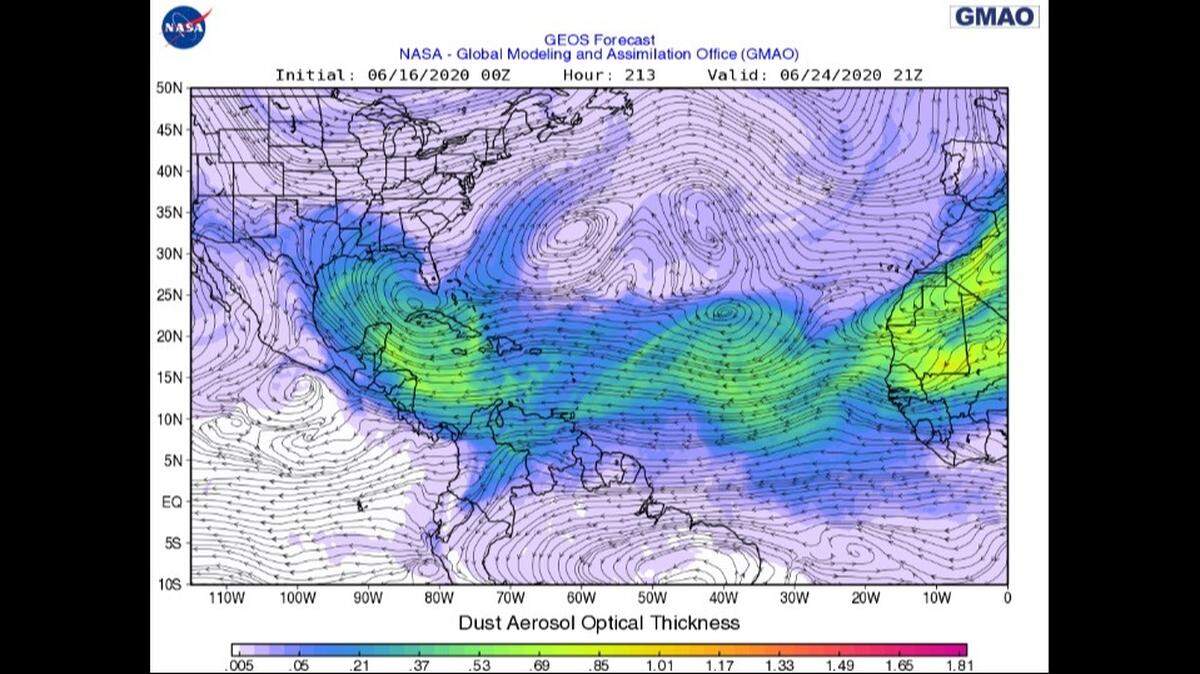
NASA forecasts it to reach southeast Texas, Louisiana, Mississippi, Alabama, Florida and Georgia by June 24-26.
The latest prediction shows Saharan dust will swirl over much of the Southeast by Thursday, according to NASA. Here is a video from NASA’s Scientific Visualization Studio.
The green color in the graphic below shows the heavier concentration of Saharan Dust, while the blue indicates particles from the outbreak.
According to NOAA, the Saharan Dust outbreaks can tamp down hurricane formation and intensity in three ways.
• Extremely dry air — about half the moisture than the typical atmosphere in a tropical storm — weakens cyclones and disturbances.
• Strong winds blowing in the Saharan Air Layer can “disrupt the storm’s internal heat engine.”
• Warmth in the air layer stabilizes the atmosphere, suppressing cloud formation.
Another side effect of Saharan Dust? It can produce some dazzling and blazing sunsets.
Here’s a video from last year by WPTV meteorologist Steve Weagle.
On the downside, Saharan Dust can irritate people with sinus problems, KPRC chief meteorologist Frank Billingsley wrote in a weather blog.
“Sinus sufferers hate this dust and I don’t blame them,” Billingsley says. “You can’t really ‘see’ it as the dust is usually pretty fine by the time it gets here, but itchy eyes, noses and throats are all possible if you are sensitive to it.”
This story was originally published June 16, 2020 at 10:43 AM with the headline "Saharan dust to reach Southeast soon. How it affects hurricanes, sinuses and sunsets."