Why is NASA sending a balloon the size of a football stadium into the atmosphere?
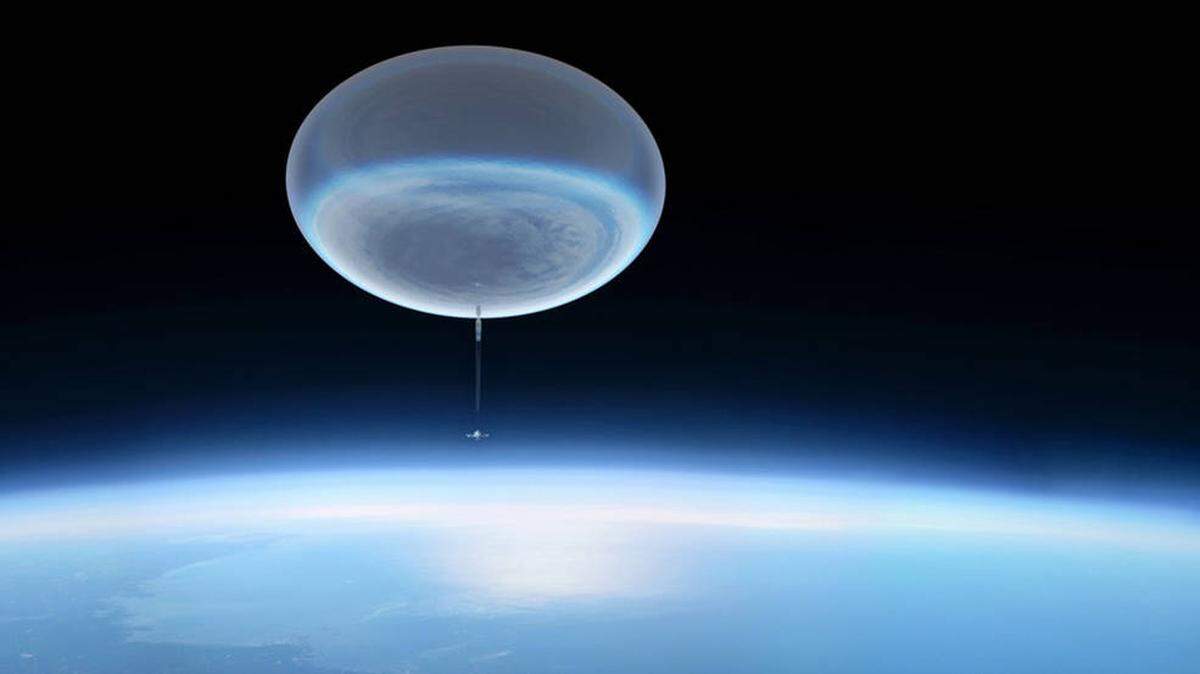
NASA is planning to send an 8-foot telescope capable of detecting lights invisible to the human eye into the stratosphere in a balloon that’s 400 feet wide — or about the size of a football stadium.
The telescope, termed ASTHROS, will carry scientific equipment to measure the motion and speed of gas around newly formed stars to understand how different types of planets form in young solar systems, according to a news release.
The “ambitious new mission” is planned to launch from Antarctica in December 2023 and is expected to span about three weeks, drifting with air currents roughly four times higher than where commercial airplanes fly, NASA said.
ASTHROS is short for Astrophysics Stratospheric Telescope for High Spectral Resolution Observations at Submillimeter-wavelengths.
“Balloon missions like ASTHROS are higher-risk than space missions but yield high-rewards at modest cost,” project manager and NASA’s Jet Propulsion Laboratory engineer Jose Siles, said in the news release. “With ASTHROS, we’re aiming to do astrophysics observations that have never been attempted before. The mission will pave the way for future space missions by testing new technologies and providing training for the next generation of engineers and scientists.”
Inside of the helium-inflated balloon, a gondola will carry instruments and a “lightweight” telescope — tied for second-largest telescope to ever fly in a high-altitude balloon — with an 8.4-foot dish antenna, a series of mirrors, lenses and detectors to capture far-infrared light wavelengths that are usually blocked by Earth’s atmosphere, according to NASA.
These instruments need to be kept “very cold,” so a cryocooler powered by solar panels will maintain a temperature of minus 451 degrees Fahrenheit — the coldest temperature matter can reach, NASA said.
Past missions have carried liquid helium tanks to keep equipment cool, but they are heavier and usually limit how long a mission can last.
What is the mission expected to accomplish?
Flying about 130,000 feet from the ground but still some ways from space, ASTHROS is expected to complete two or three loops with the help of stratospheric winds around the South Pole in about 21 to 28 days, according to NASA.
The mission will accomplish “several firsts,” the agency said. It will make the “first detailed 3D maps of the density, speed, and motion of gas” of two specific types of nitrogen ions.
These ions can reveal regions where winds from “massive stars and supernova explosions” play roles in what kinds of celestial bodies form there; the goal is to “provide new information to refine computer simulations of galaxy evolution,” according to NASA.
ASTHROS will also study two star-forming regions in the Milky Way galaxy, where Earth resides.
“We will launch ASTHROS to the edge of space from the most remote and harsh part of our planet,” Siles said. “If you stop to think about it, it’s really challenging, which makes it so exciting at the same time.”
Although not as modern and complex as space-based missions, balloon missions are cheaper and “can accept the higher risks associated with using new or state-of-the-art technologies that haven’t yet flown in space,” NASA said.
The agency’s Scientific Balloon Program has been operating for 30 years out of Virginia, and launches 10 to 15 missions each year from around the world.
This story was originally published July 27, 2020 at 8:59 AM with the headline "Why is NASA sending a balloon the size of a football stadium into the atmosphere?."