
How are abortion pills different from Plan B? What to know after Supreme Court leak
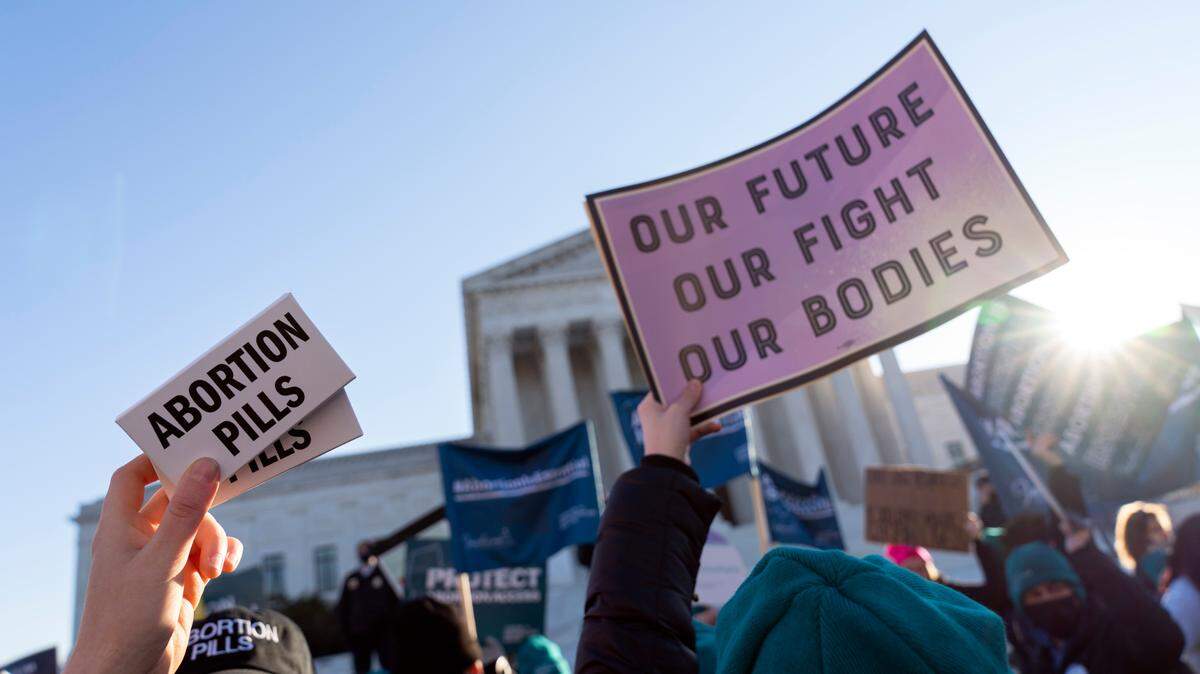
A leak of Supreme Court documents revealed that the court has voted to repeal Roe v. Wade, a landmark decision from 1973 that protects the right to have an abortion. The leaked documents were an initial draft of a majority opinion, meaning that the decision isn’t official, but may be soon, Politico reported.
Medication abortion, or the use of abortion pills, could become a critical resource for people seeking to terminate a pregnancy in a post-Roe America. The pill is already widely used – more than half of all abortions in 2020 were done through use of abortion pills, according to the Guttmacher Institute, a research organization that supports abortion rights.
Abortion-rights activists say that, if Roe is overturned, the demand for abortion pills will soar. Rebecca Gomperts, a physician who founded a nonprofit in Austria to provide abortion pills to U.S. patients, told The Washington Post she already saw that happen when Texas passed a controversial “heartbeat bill” that essentially prohibits abortions six weeks into a pregnancy.
But what exactly is the abortion pill, and how does it work? Here’s what you need to know.
Are abortion pills and Plan B the same thing?
No. Contraceptive pills and abortion medication function in different ways, and they can’t be used interchangeably, according to Planned Parenthood.
Birth control works by preventing sperm from fertilizing an egg. Hormonal birth control methods, such as the pill, patch, IUD and more, prevent ovulation, or the process of an egg being released from the ovary, according to Verywell Health.
In other words, birth control makes it so that there’s no egg for sperm to fertilize.
Emergency contraception, also known as the morning-after pill or Plan B pill, functions the same way. It has to be taken within 72 hours of unprotected sex and is more effective the earlier it’s taken, Healthline says.
A birth control pill will not induce a miscarriage in someone who’s already pregnant, according to Planned Parenthood.
On the other hand, abortion pills are used to prevent a pregnancy from continuing and to empty it from the uterus.
How does the abortion pill work?
Medication abortion requires the use of two types of pills – one containing mifepristone and the other containing misoprostol.
Mifepristone, the pill most people are referring to when they use the phrase “abortion pill,” prevents a pregnancy from progressing by blocking progesterone, a hormone critical to a pregnancy’s development, according to the Kaiser Family Foundation.
Misoprostol, on the other hand, is taken 24-48 hours after mifepristone. The medication triggers cramping and bleeding, which causes the uterus to contract and empty itself in a way “similar to an early miscarriage,” the Kaiser Family Foundation said.
If you’re getting a medication abortion through your healthcare provider, you might take the mifepristone at their office and take the misoprostol home to administer later.
Misoprostol is usually taken in the form of four tablets, Planned Parenthood said.
Cramping and bleeding can start two to four hours after taking misoprostol and may last for several hours. People may also experience side effects like breast tenderness, fever, nausea and fatigue, according to Planned Parenthood.
Is the abortion pill safe?
Yes. The abortion pill is widely considered to be highly effective and to have a very low risk of complications.
In fact, the abortion pill sends fewer people to the emergency room every year than Tylenol or Viagra, Bloomberg News reported.
Medication abortion works more than 95% of the time in early pregnancies, and a 2013 paper that reviewed data from 45,000 women revealed that only 0.3% of them were hospitalized after a medication abortion, the outlet reported.
Who shouldn’t have a medication abortion?
According to the Mayo Clinic, medication abortions are not recommended for people who:
Are nine weeks or more into their pregnancy
Have an IUD
Have a suspected ectopic pregnancy, or one where the pregnancy is growing outside the uterus
Have certain medical conditions, such as various bleeding disorders, severe disease in the lungs, kidneys or liver, or an uncontrolled seizure disorder
Take blood thinners
Are allergic to the medications used
Don’t have access to emergency care
Beyond that, the choice between getting a medication abortion and a surgical one, or an in-clinic abortion, is up to the individual.
Where do people get abortion pills?
People seeking a medication abortion might have several options, according to Plan C, an organization fiscally sponsored by the nonprofit National Women’s Health Network.
Abortion pills may be accessible through clinics, such as reproductive health, family planning or women’s health centers. They can also be ordered online through telehealth services that conduct a video or phone consultation before prescribing the pills.
But that doesn’t mean they’re easy for everyone to access. They can be expensive, ranging from $40 to $600 or more, according to Plan C. In 32 states, only physicians are allowed to prescribe the pills, and in six states, the use of telemedicine to get abortion pills is illegal, according to the Kaiser Family Foundation.
Fourteen other states require a physician to be present when someone is taking the first pill, meaning that telemedicine for abortion is effectively banned there as well, the organization said.
In the wake of such restrictions, some people have turned to online providers of abortion pills in other states or countries to purchase the pills without a prescription.
Will the abortion pill affect my fertility in the future?
No. In most cases, medication abortion is unlikely to have an impact on someone’s fertility, according to Planned Parenthood. It also doesn’t increase the risks associated with pregnancy in the future.
This story was originally published May 5, 2022 at 4:40 PM with the headline "How are abortion pills different from Plan B? What to know after Supreme Court leak."