Dad picking up kids at camp finds destructive forest bug — a first for the West Coast
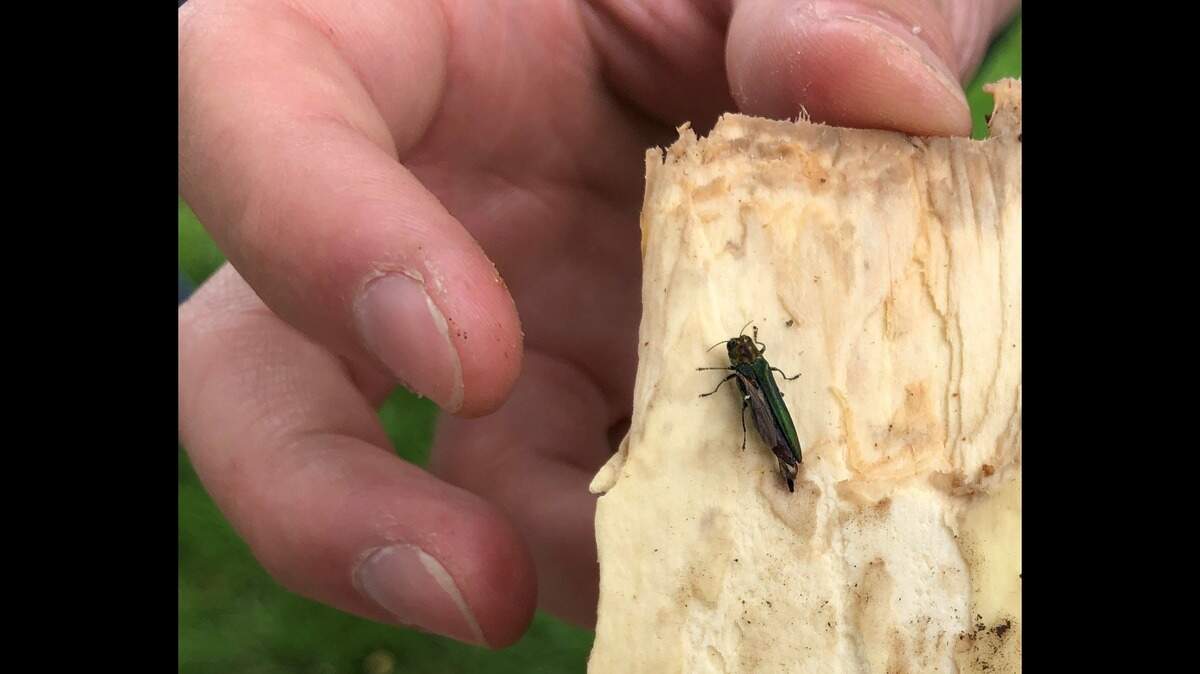
Dominic Maze, an invasive species biologist, was waiting to pick up his kids from summer camp in Forest Grove, Oregon, when he noticed trees that weren’t doing well.
Upon closer inspection, he found the culprit: emerald ash borers, bugs that are considered to be “the most destructive forest pest in North America,” according to the Oregon Department of Agriculture. It is the first sighting of the invasive bug on the West Coast.
When he looked closely at the ash trees in decline, Maze saw that they had “distinctive D-shaped holes” that are created by adult EAB as they leave an infested tree, according to the department.
“When my kids arrived, I asked them to look for adult beetles,” Maze said in a news release from the department. “My son promptly found one crawling on him. Knowing how many millions of ash trees across the country these beetles have killed, I felt like I was going to throw up.”
Though EAB are harmless to humans and animals, they are cause for concern for ash trees in North America, the department said, as the pest has caused the loss of millions of them.
The bug first made its appearance in North America 20 years ago in southeastern Michigan, according to Oregon officials. The bug is “native to China, Mongolia, North Korea, South Korea, Japan, Taiwan, and the Russian far east.”
Since arriving two decades ago, the pest has spread to 35 states and five Canadian provinces, “killing up to 99% of ash trees in some locations,” Wyatt Williams, the Oregon Department of Forestry’s invasive species specialist, said in a previous news release.
“At least five ash species native to the central U.S. have become critically endangered as EAB spreads across the country killing hundreds of millions of urban and wild ash trees,” Williams said.
The bug destroys trees by laying eggs in the crevices of their bark, according to the Oregon Department of Forestry. From there, larvae hatch and consume “the inner phloem, cambium and outer xylem, just beneath the bark.”
“The feeding action of many hundreds or thousands of EAB girdles the tree, cutting off the flow of sugars produced in the leaves to the storage systems in the roots, effectively starving trees to death,” the department says.
The state of Oregon has been anticipating the arrival of the bugs, so much so that it created the Emerald Ash Borer Readiness and Response Plan for Oregon in March 2021, according to the department.
The loss of trees has the potential to create “wide-reaching economic impacts,” and to have a direct impact on human health, the document says.
Spotting an EAB infestation can be difficult, as damage may not appear on a tree for up to three years, but some signs include “branch dieback in the upper crown, excessive epicormic branching on the tree trunk, and vertical bark splits,” according to the United States Department of Agriculture.
To report EAB sightings, contact the National EAB Hotline at (866) 322-4512 or email Report.EAB@usda.gov.