Whale calf keeps eye on entangled mom as rescuers work to free her near MA coast
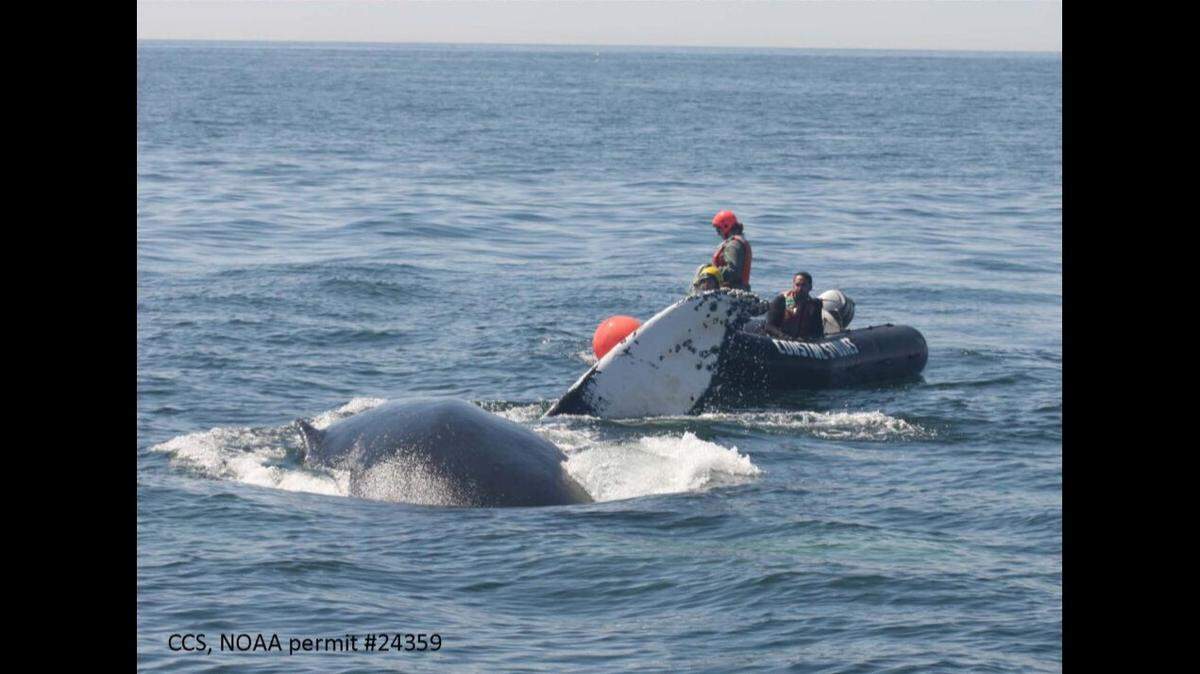
As rescuers worked for hours to free a mother whale entangled in fishing gear off the Massachusetts coast, her 8-month-old calf kept a watchful eye, according to a nonprofit.
Boaters noticed the humpback whale named Pinball was in “distress as she struggled in fishing gear” off Cape Ann on Saturday, Aug. 12, the Center for Coastal Studies said in an Aug. 15 news release.
After reporting the entangled whale, the boaters continued to keep an eye on her and her calf as they began to swim south, the nonprofit said.
A Marine Animal Entanglement Response team arrived on scene, and they began “assessing the whale” and trying to free her by using large floats and drag from their small inflatable boat.
While rescuers worked for hours to free the whale of the gear “lodged in her mouth,” the calf came and went, occasionally nursing on its mother, the nonprofit said.
“In all we removed 150 feet worth of rope,” Scott Landry, director of the entanglement response program, told The Cape Cod Times.
After Pinball was freed, the nonprofit said its team stayed nearby until she returned to her calf.
“Once she (Pinball) realized she was free, she made a beeline for her calf,” Landry told The Cape Cod Times.
Cape Ann is about 40 miles northeast of Boston.
What to know about humpback whales
Humpback whales, which have “14 distinct population segments,” grace the waters of “oceans around the world,” according to NOAA Fisheries.
“They travel great distances every year and have one of the longest migrations of any mammal on the planet,” the agency said.
Typically, calves will stay with their mothers for a year after birth until they are weaned, according to the Pacific Whale Foundation.
In the United States, it is “illegal to harass or kill a humpback whale” under the Endangered Species Act and the Marine Mammal Protection Act, according to the National Park Service. The whale also has protection from the International Whale Commission, making it illegal to hunt humpback whales globally.
This story was originally published August 15, 2023 at 1:05 PM with the headline "Whale calf keeps eye on entangled mom as rescuers work to free her near MA coast."