
‘Mini volcanoes’ appear all over Texas beach, video shows. What’s lurking underneath?
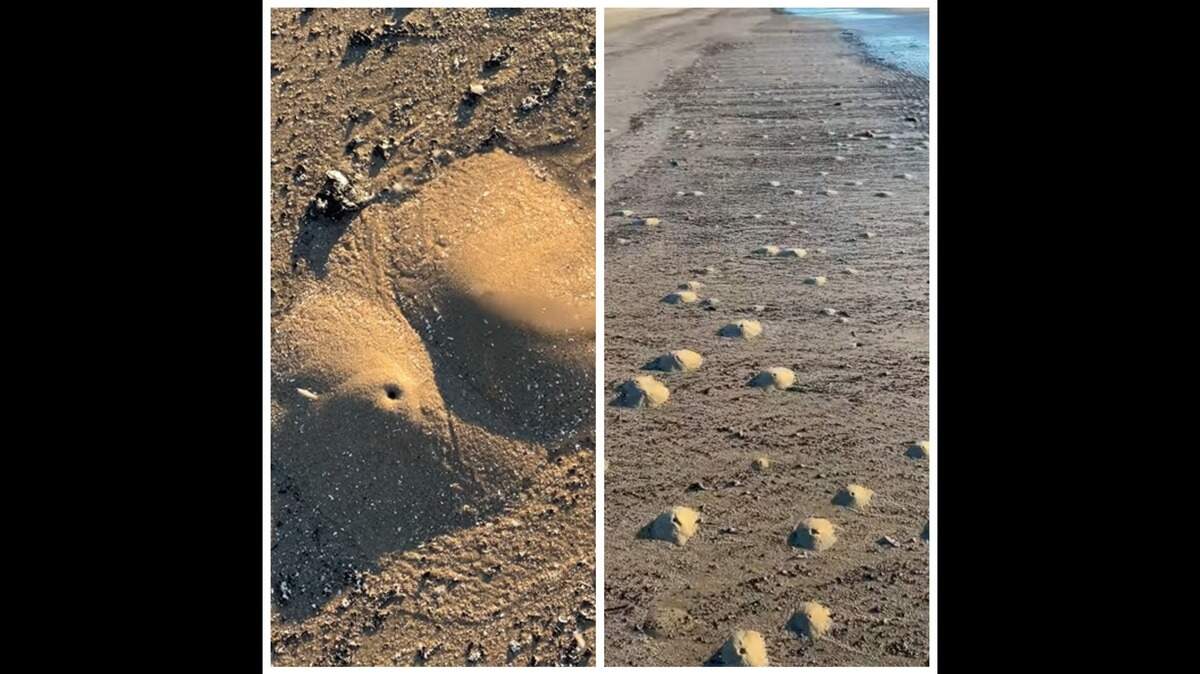
“Mini volcanoes” appeared all over a Texas beach recently, covering the sand in strange scattered mounds, video shows.
But it wasn’t lava sitting at the bottom of these “volcanoes,” according to officials, though sticking a finger or toe inside still might not be a good idea.
The mounds are made by ghost shrimp, Quintana Beach County Park said in a Dec. 10 Facebook post, sharing video of countless burrows sitting where the sand meets the surf.
Normally, land dwellers wouldn’t see them, but the park was “experiencing an extremely low tide,” the post read.
Hidden from view in each subterranean hovel, there’s likely a ghost shrimp lurking.
The ghost shrimp’s name is half misleading, as it’s more closely related to crabs than shrimp, experts say, though it does look akin to a tiny lobster being viewed through an X-ray machine.
_fitted.png "Screenshot (4037)_fitted.png")
Equipped with a pair of claws and a translucent shell, the ghost shrimp is a gifted digger, according to experts. Despite measuring between 3 to 4 inches, the diminutive shellfish can excavate burrows up to 4 feet deep, the park said.
The burrows serve as the ghost shrimp’s home but are also critical to how it feeds, experts say.
Using their legs, the ghost shrimp force water to circulate into their branching burrows, which draws in food particles they can eat, according to the Washington State Department of Ecology.
By creating these spider webbing pathways in the seafloor, ghost shrimp benefit more than just themselves.
“They are an important part of intertidal ecosystems, because they drive oxygen into the sand as they burrow which helps organic matter to decompose, enriching the sediment, and ultimately providing food for more creatures,” Quintana Beach’s post said.
This process is called bioturbation and while it’s often a good thing, ghost shrimps can sometimes take it too far.
“Burrowing ghost shrimp aren’t beloved by all; in fact, if you are a tiny surface-dwelling animal, you may find them to be the worst kind of neighbors,” the Washington State Department of Ecology said. “Excessive bioturbation from the burrowing activities of many ghost shrimp can turn the mud into quicksand, causing anything on the surface to sink.”
Quintana Beach County Park is roughly 70 miles south of Houston.
This story was originally published December 13, 2023 at 1:30 PM with the headline "‘Mini volcanoes’ appear all over Texas beach, video shows. What’s lurking underneath?."