Sea creature with oversized tail was found decades ago. Now it’s labeled a new species
_fitted.png "A male Lea’s angel shark caught off the Laccadive Islands in Southwest India.")
In 1988 and 1989, researchers in the Indian Ocean collected three unusual, small sharks. The creatures appeared to be angel sharks, but they were a different color and size than the only known species of angel sharks in the region, known as Squatina africana.
Now, decades after they were first discovered, a new study has determined that the unusual creatures are actually a new species of angel shark: Squatina leae.
The study — which was published July 8 in Biology — identified the species by its coloration, size, genes and distribution in the Indian Ocean. The new species marks the 24th species of angel sharks identified around the world.
Lea’s angel shark
After the creatures were first discovered in the 1980s, it took years before scientists were able to collect more of the sharks, according to the study. In 2016 and 2017, additional angel sharks were caught off the western coast of India and in the Indian Ocean, and experts were able to more closely study the animal.
Scientists described the small shark as having a stout body and wide tail. Its head is wide and flat and makes up about one-fifth of the creature’s entire size.
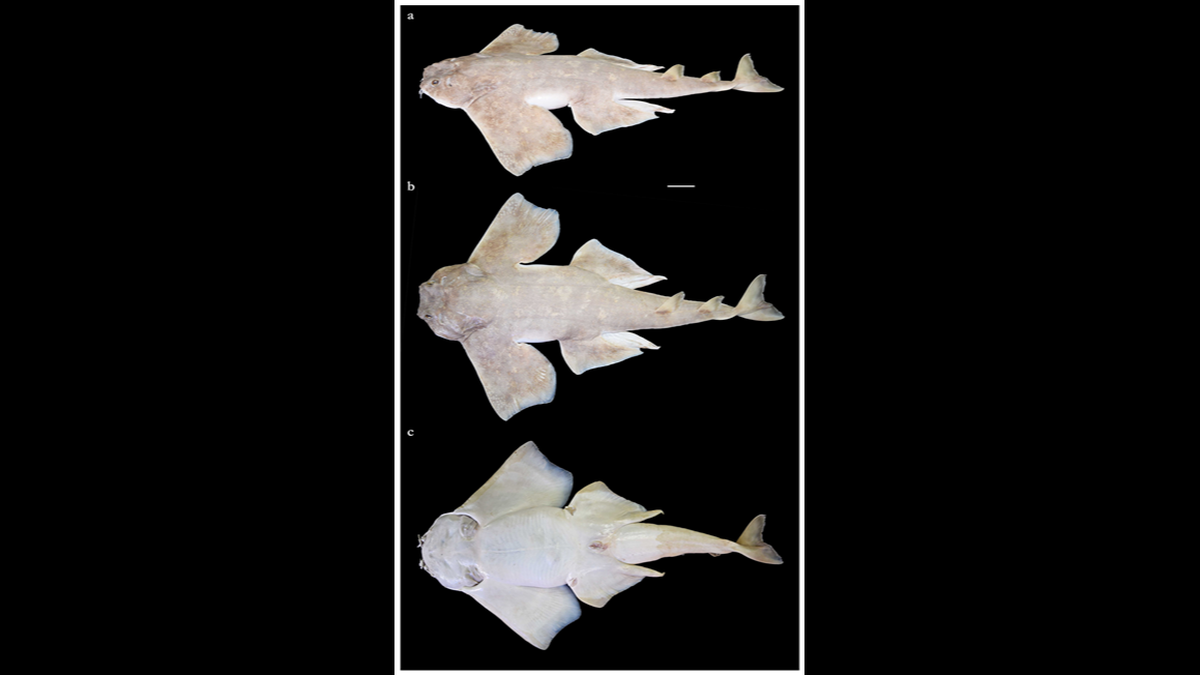
At its maximum size, the shark can grow to be just under 3 feet long, but are more likely around 2 feet, the study said. Their tails are longer than their bodies.
The sharks have a short snout with small eyes, according to the study. Their small teeth are sharp and point in towards the center of the mouth.
_fitted.png "Screenshot (416)_fitted.png")
Unlike other species of angel sharks, Lea’s angel sharks have pale skin that is typically a beige to light gray-brown color, researchers said. Their bodies have yellow flecks and dense areas of dark spots.
The sharks are found in the western Indian Ocean on the Mascarene Plateau and off southwestern India, the study said. They were named after one of the author’s fiancee’s late sister, Lea-Marie Cordt.
A risk of extinction among angel sharks
Angel sharks are found worldwide in tropical and warm oceans where they feed on fish and bottom-dwelling invertebrates, according to Britannica. They spend most of their time on the sandy ocean floor near beaches.
Over half of the known angel shark species are at moderate to severe risk of extinction, the study said.
The creatures are often caught as bycatch by commercial anglers, which has damaged their populations, according to Britannica. Additionally, recreational fishing and habitat degradation have influenced population size.
This story was originally published July 11, 2023 at 2:27 PM with the headline "Sea creature with oversized tail was found decades ago. Now it’s labeled a new species."