Eight-legged creature — with ‘intense blue’ rear end — is a new species in Colombia

Across nature’s rainbow, the color blue is few and far between.
Less than 10% of all plants have blue flowers, and blue birds, butterflies and bugs make up a very small portion of the animal kingdom.
Now, this elite grouping of creatures has a new member, thanks to an “intensely” colored rump.
In the rural towns outside Bogotá, Colombia, researchers sifted through the leaf litter on the forest floor on the hunt for tiny spiders, according to a study published Nov. 13 in the peer-reviewed journal Zootaxa.
The scientists hoped to find species belonging to the Nops genus, a group of spiders that are “active hunters” but “challenging to locate” because of their “orange-red carapace” that blends in with fallen leaves, according to the study.
As researchers approached a crack in a wall near a partially dried river ravine, eight orange legs caught their eye. The spider leapt off the wall toward the leaves below at the first sight of danger, but the scientists were faster, study author Daniel Chirivi-Joya told McClatchy News in an email.
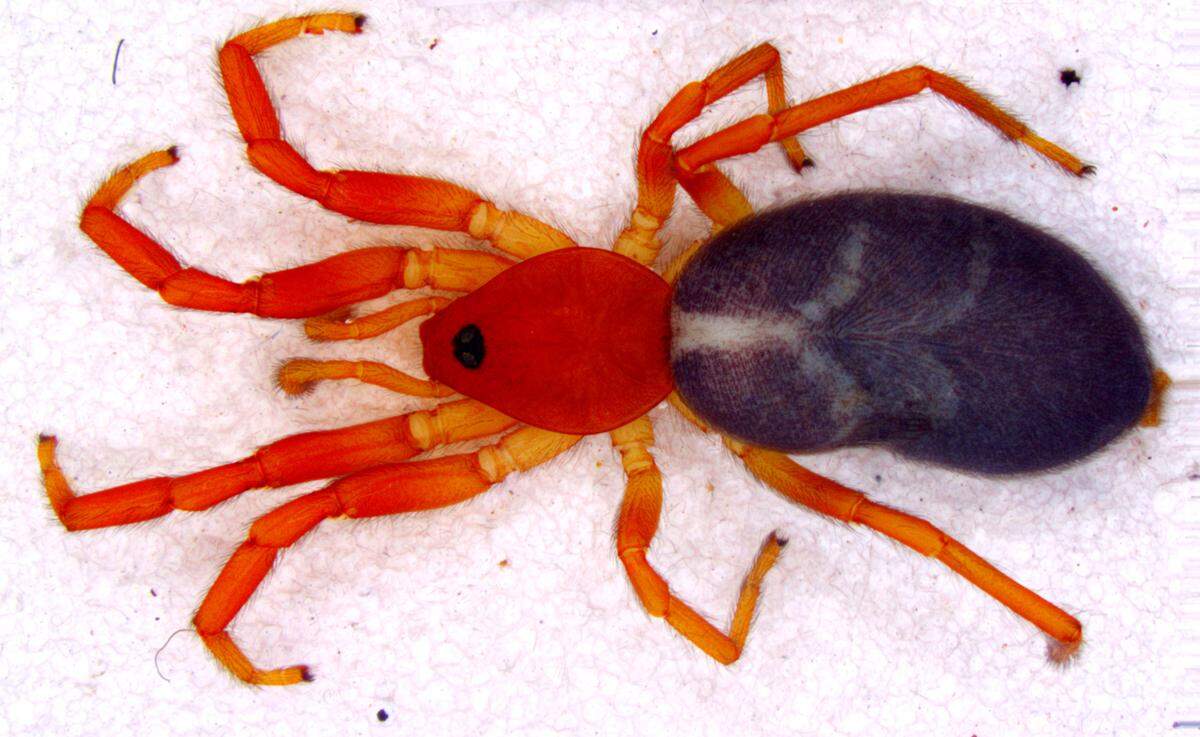
Instead of a uniformly orange-red-colored body, the spider’s opisthosoma is an “intense blue” color, according to the study. The opisthosoma is posterior section of the spider’s body that is an “oval shape,” and “triangle-shaped” patches reach from top to bottom.
.jpeg "WhatsApp Image 2024-11-16 at 5.16.12 PM (1).jpeg")
The new species was named Nops mamoris, a contraction of two Spanish words, “mi amor,” meaning “my love,” according to the study. The name was chosen by study author, and spider collector, Juan Manuel Rodríguez-Sandoval in dedication to his love, María Alejandra Tapias González.
“The coloration patterns allow for fast field identification, especially its bright blue opisthosoma, which is completely distinctive from other similar species,” according to the study.
The tiny spider, just 0.7 inches long with its legs outstretched, is also unique in its “thick and elongated” embolus, the structure on male spiders that delivers sperm, researchers said.
“All specimens were found at the same place, with a distance of about (33 feet) between them,” but they haven’t been found in other locations, researchers said.
The new species is now one of two Nops spiders to be found in Colombia, which may mean more are yet to be discovered, or the landscape makes it difficult for these spiders to thrive, researchers said.
“Pandi has a low Andean forest ecosystem, which is known to harbor variable diversity and short-distributed species,” according to the study. It’s surrounded by mountains that cut off populations of animals from one another, which can lead to the creation of new species.
Pandi is in the department of Cundinamarca in central Colombia, about a 70-mile drive southwest from Bogotá.
The research team includes Chirivi-Joya, Rodríguez-Sandoval and Ana Pardo-Staper.
This story was originally published November 18, 2024 at 1:48 PM with the headline "Eight-legged creature — with ‘intense blue’ rear end — is a new species in Colombia."