‘Abundantly large’ deep-sea creature — ‘all legs’ — found off Antarctica. See it

In the south Atlantic, north of Antarctica, a group of islands is one of the most remote island chains in the world.
The ecosystem is home to seamounts, hydrothermal vents, deep-sea trenches and species found only in its freezing water.
They are called the South Sandwich Islands, and researchers with the Schmidt Ocean Institute are there on the hunt for new species.
An expedition using research vessels and remote-operated vehicles is underway, from Feb. 20 to March 28, according to the Schmidt Ocean Institute, and while the final results of the voyage are yet to come, researchers are already reporting interesting discoveries from the field.
While operating the deep-sea robot nearly 7,000 feet below the surface, the machine’s camera captured a creature that appeared to be “all legs” walking across the seafloor, according to a March 18 Facebook post from the institute.
“Huge spider alert! This is a pycnogonid,” researchers said in the post.
Pycnogonid are distant relatives of the spiders we see on land, the institute said, but look like they are missing a central body for the legs to connect.
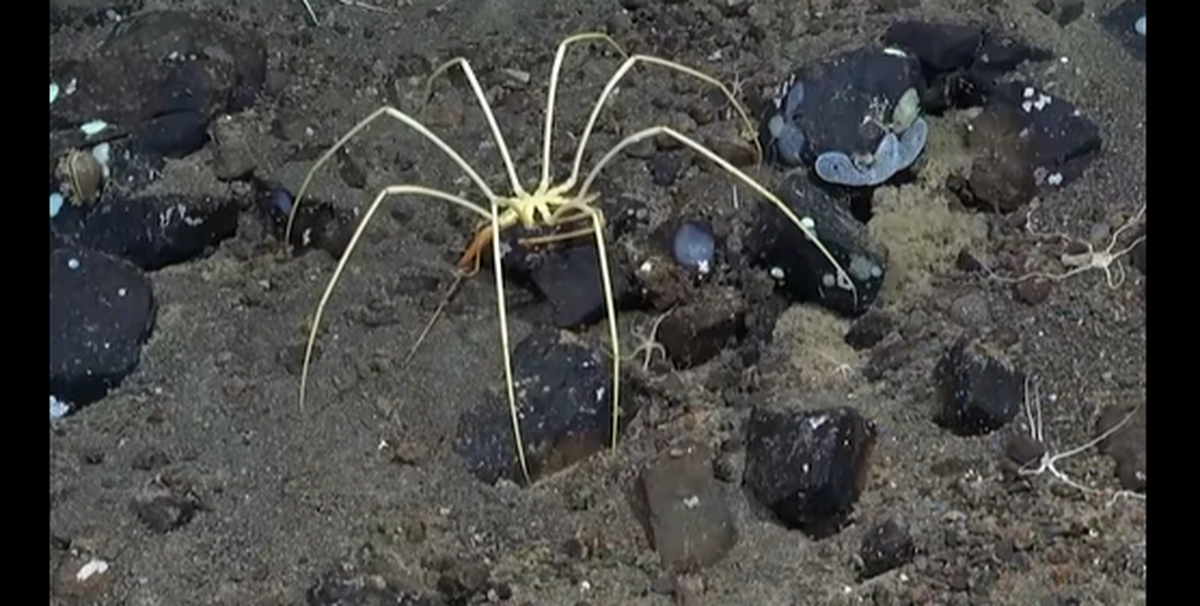
“Technically, they are not all legs; they do have additional appendages. They also lack lungs and breathe through their exoskeleton,” researchers said. “There are about 1,500 known species in our global ocean, and they range in size from infinitesimally small to large enough to rival a dinner plate or moderately-sized serving platter.”
Their sometimes “abundantly large” size is attributed to a phenomenon seen in polar regions called deep-sea gigantism, the institute said.
“Immense pressure and frigid temperatures, while insurmountable obstacles to land-lovers like humans, allow some animals to have very slow metabolisms and the ability to reach gargantuan proportions,” researchers said in the post.
Larger bodies are also sustained by higher concentrations of oxygen in the deep sea, no longer becoming a restricting factor to growth, according to the institute.
Pyconogonids, commonly called sea spiders, are marine arthropods that have eight legs and a long mouthpart called a proboscis, according to the Monterey Bay Aquarium.
The animal’s organs are held inside their legs, including intestines inside pouches in the end of their legs, and they diffuse oxygen through their tissue, the aquarium said.
Sea spiders use their spindly legs to scuttle across the sea floor on the hunt for food, then when they find soft-bodied prey like sponges or molluscs, the animal “thrusts its straw-like proboscis into the animal’s flesh, then sucks out its insides like a smoothie,” according to the aquarium.
The South Sandwich Islands are east of Argentina and north of Antarctica in the south Atlantic.
This story was originally published March 20, 2025 at 9:21 AM with the headline "‘Abundantly large’ deep-sea creature — ‘all legs’ — found off Antarctica. See it."