
Kevin McCarthy joins TX lawsuit to overturn election. What about other CA lawmakers?
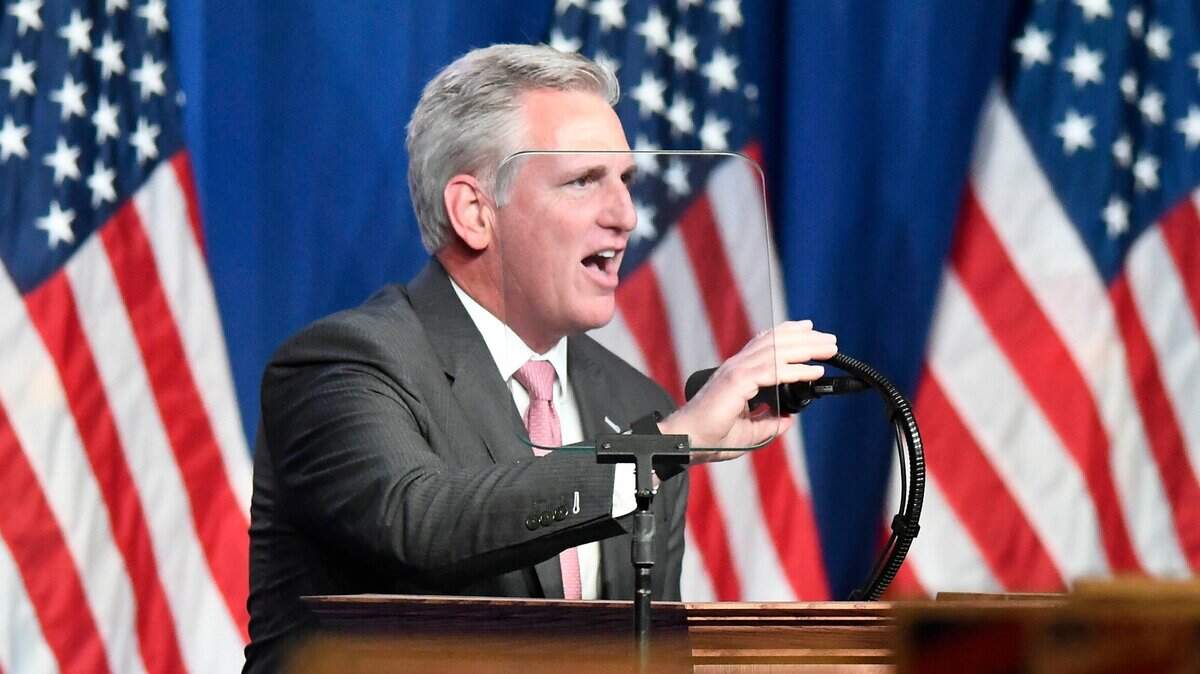
House Minority Leader Kevin McCarthy joined more than 100 other Republicans in backing a Texas lawsuit asking the Supreme Court to review President-elect Joe Biden’s projected victory.
On Friday evening, the Supreme Court rejected the lawsuit in another legal blow to President Donald Trump’s attempts to overturn the election.
“The State of Texas’s motion for leave to file a bill of complaint is denied for lack of standing under Article III of the Constitution. Texas has not demonstrated a judicially cognizable interest in the manner in which another State conducts its elections. All other pending motions are dismissed as moot,” the Supreme Court wrote.
McCarthy, a California Republican endorsed the lawsuit along with 20 additional Republicans on Friday, The Hill reported. The revised amicus brief to the Supreme Court on Friday now includes 126 Republican House members.
The lawsuit is spearheaded by Rep. Mike Johnson, a Louisiana Republican, and was filed by Texas Attorney General Ken Paxton this week. The suit alleges voter fraud and is seeking to overturn results in Pennsylvania, Michigan, Wisconsin and Georgia — battleground states won by Biden.
Trump has refused to concede and has continued to push claims without evidence that the election was fraudulent.
All 50 states and Washington, D.C., have certified their election results. Biden is projected to have 306 Electoral College votes compared to Trump’s 232 and will take office on Jan. 20, 2021.
Trump won Pennsylvania, Michigan, Wisconsin and Georgia in 2016 and the Texas lawsuit accused the four states of certifying “unlawful election results” and said that the Electoral College votes in those states “cannot be counted.”
“Presently, evidence of material illegality in the 2020 general elections held in Defendant States grows daily,” the suit said.
Who has endorsed the lawsuit?
The amicus brief accompanying the lawsuit includes California Reps. Ken Calvert, Doug LaMalfa and Tom McClintock, in addition to McCarthy.
Before McCarthy endorsed the lawsuit, he was asked on CNBC’s “Squawk Box” on Thursday whether he accepts the results of the election.
“Look, the electors have to go through and put forth that,” McCarthy said. “The president, he has to make sure that every legal vote is counted, every recount is done, and make sure every complaint [is being] heard inside court. Once that’s done, I think the election will be over and the electors will make their decision.”
After the election, Calvert said: “Overall, I believe the election was fair, but any time you change the rules while an election is underway — as we saw in many states due to the pandemic — there will inevitably be legal challenges, which our courts will ultimately resolve,” SFGate reported.
LaMalfa was criticized after the election for casting doubt on the election without evidence, The Redding Record Searchlight reported.
“I’m skeptical that we should shut it all down and not finish counting the ballots before we crown the new president, right? So there are many questions to be answered and many lawsuits and investigations underway — a lot of irregularities that I think are deserving of scrutiny,” LaMalfa told the publication in November.
McClintock also said that he was concerned about possible voter fraud.
“I’m very concerned about election integrity. I remember the days when we all voted in person on election day. That’s why we called it ELECTION DAY. What they’ve done to our voting system is a travesty. It undermines confidence in the system and it opens the door to fraud,” he tweeted on Nov. 5.
The signatories also include lawmakers from the four states from which Texas is challenging results — seven from Georgia, seven from Pennsylvania, four from Michigan and one from Wisconsin.
How did the four states react?
The attorneys general for Georgia, Michigan, Pennsylvania and Wisconsin have asked the Supreme Court to throw out the lawsuit, The New York Times reported.
“The court should not abide this seditious abuse of the judicial process, and should send a clear and unmistakable signal that such abuse must never be replicated,” a Pennsylvania brief said.
“Let us be clear,” the brief added. “Texas invites this court to overthrow the votes of the American people and choose the next president of the United States. That Faustian invitation must be firmly rejected.”
The briefs said that Texas doesn’t have the authority to dictate how other states run their elections.
“Texas proposes an extraordinary intrusion into Wisconsin’s and the other defendant states’ elections, a task that the Constitution leaves to each state,” Wisconsin’s brief said. “Wisconsin has conducted its election and its voters have chosen a winning candidate for their state. Texas’s bid to nullify that choice is devoid of a legal foundation or a factual basis.”
Georgia’s attorney general Christopher Carr wrote: “This election cycle, Georgia did what the Constitution empowered it to do: it implemented processes for the election, administered the election in the face of logistical challenges brought on by COVID-19, and confirmed and certified the election results — again and again and again. Yet Texas has sued Georgia anyway.”
What about other Republicans?
Some Republicans have criticized the lawsuit, breaking with their party.
Rep. Chip Roy, a Texas Republican, called the lawsuit “a dangerous violation of federalism” that “sets a precedent to have one state asking federal courts to police the voting procedures of other states,” according to The Hill.
Sen. Lamar Alexander, a Republican from Tennessee, told NBC’s “Meet the Press” that the lawsuit “doesn’t sound like a very Republican argument to me.
“And Texas is a big state, but I don’t know exactly why it has a right to tell four other states how to run their elections. So I’m having a hard time figuring out the basis for that lawsuit.”
What do legal experts say?
Legal experts have said the lawsuit is unlikely to be successful and doesn’t make a case for why Texas can interfere in how other states run their elections.
“They all do what they do,” Edward Foley, a law professor at Ohio State University, told The New York Times. “For Texas to try to complain about what Georgia, Pennsylvania and these other states have done would be a lot like Massachusetts complaining about how Texas elects its senators.”
“This one really is a stretch,” said Josh Blackman, constitutional law professor at South Texas College of Law, according to KHOU. “The purpose of this I think is to keep a dispute about the election alive.”
“I don’t say this lightly, but this is a frivolous case,” Blackman added.
This story was originally published December 11, 2020 at 3:33 PM.