
Why are Californians bankrolling ‘high stakes’ national races in states where they don’t vote?
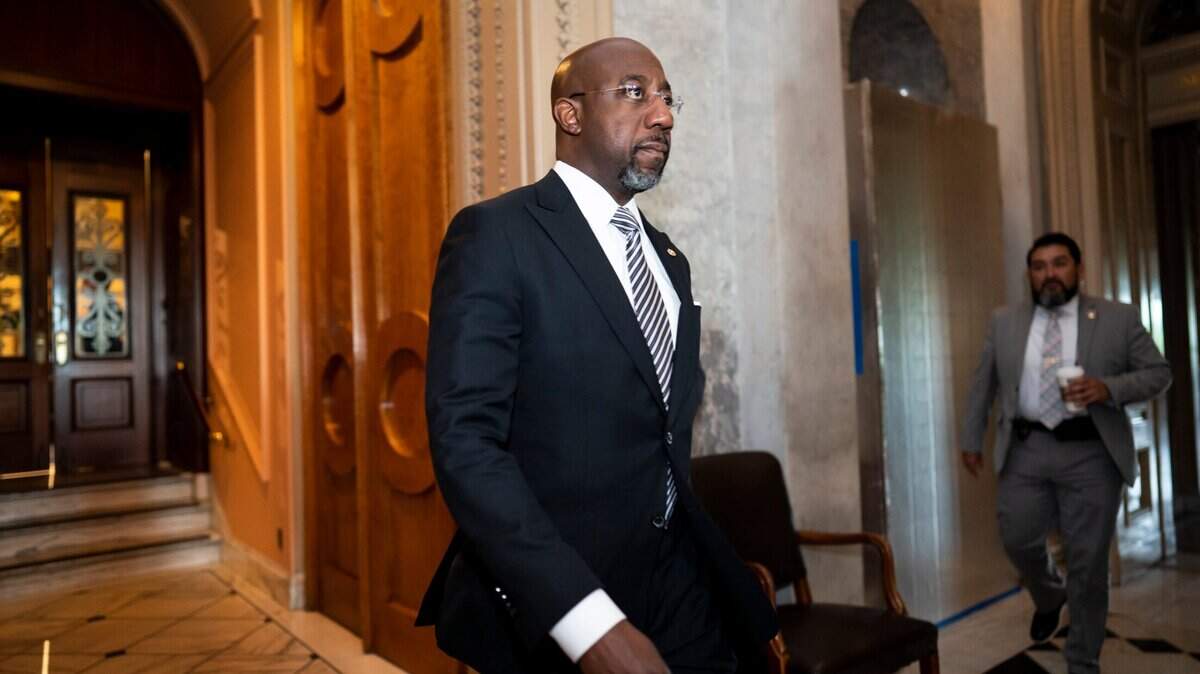
Californians have given more money this election cycle to a candidate running for U.S. Senate 2,500 miles from Sacramento than they have given to any candidate running in their own state.
Raphael Warnock, the incumbent Democratic senator from Georgia, has raised about $7 million in itemized contributions for the 2021-22 election cycle from individual California donors, according to Federal Elections Commission data that runs through March 31.
U.S. Senator Alex Padilla, who is widely expected to win reelection in California this year, is runner-up in terms of donations from Californians. They have given Padilla $6 million.
As U.S. politics increasingly become nationalized, politically-active Californians are paying close attention to congressional races far outside the state’s borders. The phenomenon is not new, but it has become much more pronounced in the past decade.
Individuals from California have given more than $94 million in itemized donations to U.S. House and U.S. Senate candidates running in other states so far during the 2022 election cycle – about $33 million more than they gave to California candidates.
That $94 million is nearly triple the amount given by this point in the 2012 cycle, according to FEC data. It’s also about $49 million more than Texans gave to out-of-state House and Senate candidates, and $25 million more than New Yorkers gave to out-of-state candidates. Itemized contributions are donations from individuals that exceed $200.
The trend, several experts told The Sacramento Bee, is largely due to ubiquitous media coverage of national politics, increased political polarization and tumultuous Supreme Court decisions.
“Everything seems high stakes, like, ‘If we don’t have a majority, we won’t be able to stop all these bad things the other side’s going to do’,” said Diana Dwyre, a political science professor at California State University, Chico, who has published extensively about political campaign funding.
Warnock won a runoff election in January 2021 that is considered part of this election cycle, raising about $2.5 million in itemized donations from Californians in the process.
His victory in 2021, along with the victory of fellow Georgia Sen. Jon Ossoff, gave Democrats control of the U.S. Senate. He is expected to face a tough battle for reelection this year against Republican Herschel Walker, and had raised another $4.5 million in itemized donations from Californians by March 31.
Warnock’s campaign declined to comment. Walker’s campaign did not respond to a request for comment.
Daniel Weiner, director of the Elections and Government Program at New York University’s Brennan Center, said increased donations indicate that California voters are politically engaged and care enough to put money behind their beliefs.
However, Weiner said that the trend also incentivizes candidates to create a national profile, which can cause them to pay less attention to their constituents. It can also contribute to political polarization, as candidates take positions that appeal to the most passionate members of their party.
“I can’t necessarily blame Californians for being interested in the outcome of the Georgia Senate race, because it affects their lives,” Weiner said. “At the same time, I think our politics probably are healthier if people are raising more of the money from the folks who actually are their literal constituents.”
Who is donating to Warnock?
About one-fifth of the money Warnock raised from individuals this cycle has come from Californians, according to itemized campaign finance data. He’s raised about $3 million more in itemized donations from California residents than from donors in his home state of Georgia.
Sacramento lawyer Shawn Ervin gave money to Warnock in the weeks leading to the 2021 election. “When the Georgia Senate seats went to a runoff,” Ervin said, “I saw an opportunity for Democratic control of the Senate.”
Ervin said he typically donates to presidential campaigns and the Democratic Party. But he’s thinking about giving again this year to influence a U.S. Senate contest.
“I may give money in the upcoming midterms if it seems like a race is close and could make a difference in the balance of power,” he said. “That may happen in the Pennsylvania Senate race, but I won’t know until there are some poll results.”
The Senate race in Pennsylvania is widely seen as Democrats’ best chance to pick up a seat during this year’s midterm elections. It’s a crucial race if Democrats want to maintain control of the Senate for the next two years. California individuals gave the Democratic nominee in Pennsylvania, John Fetterman, about $560,000 in itemized donations through March 31.
Other U.S. House and Senate candidates bankrolled by Californians
Warnock had raised an astonishing $33 million in itemized contributions nationwide by March 31. A few other candidates this cycle have also raised about one-fifth of their itemized donations from Californians; they just haven’t kept pace with Warnock’s overall fundraising.
Other out-of-state House and Senate candidates who raised more than $1 million from California donors by March 31 of this cycle are Chuck Schumer (NY); Mark Kelly (AZ); Val Demings (FL); Catherine Cortez Masto (NV); Maggie Hassan (NH); Tim Scott (SC); Kelly Loeffler (GA); Michael Bennet (CO); Marco Rubio (FL); Jon Ossoff (GA) and Steve Scalise (LA).
Seven of those candidates are Democrats; four are Republicans. More broadly, individual California donors have given about $61 million in itemized donations to Democrats running for the U.S. Senate or U.S. House in other states. They’ve given about $31 million to Republican candidates, and another $2 million or so to independent and third-party candidates.
Those totals are undercounts. The Federal Election Commission only reports individual donations – including the donor’s state of residence – after donors give more than $200 in cumulative donations. Candidates are raising tens of millions more in unitemized, small donations.
In addition, The Bee only looked at contributions from individuals given directly to candidates, earmarked for a specific candidate, or transferred from a joint committee featuring the candidate. Millions more in donations come from businesses and political action committees, and many people give to political parties, which then spend the money in ways that help individual candidates.
Even more money flows from Californians to “Super PACs,” which spend money to influence elections independently of official candidate campaigns.
Matt Lesenyie, a political science professor at California State University, Long Beach, said more Californians are giving to out-of-state candidates partially because races closer to home aren’t very competitive.
California hasn’t had a Republican Senator since John Seymour left office in 1992, so Lesenyie said California donors who want to be part of the dramatic struggle for the Senate must look elsewhere.
“If you went to a sporting event or a tournament of champions and all of the things were already decided, you’d go to the arena where the match was happening,” he said.
It’s easier than ever for Californians to give
A lot of the trend also has to do with technology, several experts said. Anyone who reads a lot of political news is likely to see targeted ads on social media asking them to give to a political campaign. Once a donor gives, they can be expected to receive pitches from similar candidates.
In addition, it is easier to give money today than it was even 10 years ago. Sites such as ActBlue and WinRed allow users to donate in a few minutes, or less. They also make it easy to set up recurring, often small, donations that add up to large numbers.
“These systems, they really match donors with the next candidate they may contribute to,” said Rob Stutzman, president of Stutzman Public Affairs and former deputy chief of staff for communications to then-Governor Arnold Schwarzenegger.
Brendan Glavin, a senior data analyst at Open Secrets, a nonprofit that tracks campaign donations, said the increase in California contributions to out-of-state candidates is part of a broader increase in donations from people across the country to a huge swath of candidates.
Put another way, this trend is happening all over the nation. Texans so far this cycle have given three times as much to out-of-state House and Senate candidates as they did by this point in the 2012 cycle. Contributions by New Yorkers to out-of-state candidates have more than doubled over the same period. Individuals in both states have given more to out-of-state candidates so far this cycle than to their home state senators and representatives.
In addition, some of the increase is due to changes in reporting. Campaign contribution limits have risen by $400 since 2012. Also, until recently, the Senate was only “itemizing” - listing details about donors - contributions of $200 or more, even when a donor cumulatively gave more than $200 through a series of donations, Glavin said. Today, donations to a Senate candidate will appear after donors hit the $200 mark, even if they hit that level by making several small donations.
How out-of-state donors affect elections
Experts disagree on the influence of individual donations on political campaigns.
Lesenyie said political donations are often most useful to established elected officials who can “point to a war chest that scares off opponents.”
“But once there’s a well funded opponent,” he added, “it really has about the most diminishing returns of any investment,” he added.
Warnock and Ossoff are examples of candidates who raised a lot of money from Californians and won – with huge consequences. But some candidates raise a lot of money even when they have little chance of success. Often, these candidates challenge an elected official broadly disliked by a particular political party – and lose badly.
For instance, Kentucky Democrat Amy McGrath raised $9.4 million in itemized donations from California individuals during her 2020 challenge to then-Senate Majority Leader Mitch McConnell, FEC records show. McGrath received 38% of the vote, and McConnell easily won reelection.
At the same time, Congressional candidates in “swing” districts that either party could feasibly win need a lot of money to compete.
“It depends on the race,” said Rose Kapolczynski, a veteran political strategist who ran campaigns for then-Sen. Barbara Boxer. “We saw some Senate races in 2020 that ended the campaign with huge surpluses. … But typically campaign donations are essential to a successful campaign. Otherwise you can’t get your message out through advertising. You can’t recruit and train a grassroots army to go door-to-door for you. You can’t travel around your district or state talking to voters.”
Several experts broadly agreed that the rise in donations from California and other places has changed candidate behavior.
“It creates this incentive structure for a lot of politicians in each party to create a profile for themselves, as opposed to, maybe, governing,” Stutzman said.
Stutzman and Lesenyie both mentioned Madison Cawthorn, the Republican congressman from North Carolina who just lost a close primary. California donors gave more than $130,000 in itemized donations to Cawthorn this cycle – a significant amount for a House race.
“In a lot of ways, the Twitter diva moment that we are in bodes poorly for us,” Lesenyie said. “The implications are, ‘I get my money, my armament, to run for reelection from my tweets, not from paying attention to this actual district’.”
The amount of contributions from Californians this election cycle are likely to increase sharply during the next few months. FEC records at the moment for many candidates only go through March 31. Hundreds of congressional elections will occur in November, likely a couple of months after the U.S. Supreme Court issues a major ruling that could affect abortion access in America.
“These are numbers from before the Roe v. Wade opinion leak,” Dwyre said. “So I would bet that it’s really supercharged now.”
A significant majority of Californians support abortion rights. About 77% of California adults don’t want to see Roe v. Wade, the landmark Supreme Court abortion decision, overturned, according to a July 2021 survey from the nonpartisan Public Policy Institute of California.
California donors who want to affect abortion rights have a keen interest in which party controls the U.S. Senate, which must affirm all Supreme Court nominees. Also, if Democrats gain a large majority in the House and Senate, they could codify abortion rights; on the contrary, a large majority of Republicans could codify further restrictions.
Longer term, Kapolczynski said, the amount of California money flowing into future elections will likely rise.
“People are going to continue to give to national elections as long as the Congress is closely divided, and as long as the White House is truly up for grabs every four years,” she said. “Because these donors want to make a difference.”