
GOP: No COVID-19 aid for pensions + Newsom daily updates + Poll finds blame for China
Happy Monday!
DETAILS, DETAILS
Time to get to work on the new budget.
The Legislative Analyst’s Office’s released its take on Gov. Gavin Newsom’s spending $203.3 billion spending plan late Sunday. It encourages lawmakers to get serious about multi-year budget fixes even if the federal government gives states billions of dollars to get through the coronavirus crisis.
Newsom last week when unveiling his plan to close a $54.3 billion pleaded with Congress and President Donald Trump to help. Newsom said he’d curtail many of this spending cuts in his plan if the money comes.
“Federal government, we need you,” Newsom said. “These cuts can be negated. They can be dismissed with your support.”
The LAO says Newsom’s and the Legislature’s push for for assistance “is warranted,” but cautioned the extra money from the feds probably won’t last.
“Even if flexible funding materializes, however, it likely would only be available for a year or two. Consequently, significant budget problems likely would reemerge in a few years,” the LAO report reads. “Should additional federal assistance become available, we suggest the Legislature reconsider the structure of the budget using all available tools. Doing so would allow the state to phase in spending reductions more slowly, mitigating the negative economic consequences of pulling back spending too quickly.”
For your radar: Assembly Budget Committee Chairman Phil Ting announced he’s hosting a budget roundtable today at 10 a.m. at his Facebook page, https://www.facebook.com/philtingsf/. Legislative Analyst Gabe Petek and Assemblyman Jay Obernolte, R-Hesperia, are expected to participate.
In the Senate, the Budget and Fiscal Review Committee is scheduled to hear an overview of Newsom’s May Revise beginning at 1:30 p.m.
PENSION BATTLE
Top Washington Republicans determined not to send federal money to states say their biggest fear is Democrats will use it to help reeling public employee pensions funds.
The GOP leaders insist they won’t enable what they call years of mismanagement. Their stance is proving to be an obstacle to federal help for the decimated budgets of California and states and cities all over the country.
“Why should residents of Wisconsin or Tennessee have to pay for the pension benefits of workers in Illinois and California?” asked Rachel Greszler, research fellow in economics at the Heritage Foundation, a Washington-based conservative group.
Those and other state and local governments are eager for federal help to address the economic effect of the coronavirus shutdown.
In California, Gov. Newsom unveiled a dramatically revised state budget Thursday, but says he’ll cancel $14 billion in state budget cuts if he gets enough federal aid. One part of his plan would redirect a $2.4 billion prepayment of long-term pension debt to instead pay for more immediate school needs.
The Democratic governor did not, however, propose using federal money to help the California Public Employees’ Retirement System or the California State Teachers’ Retirement System.
Like most pension funds, CalPERS relies on investments, and volatility in the stock market represents a continuing risk. As of Friday, the system’s total value stood at about $371 billion, which is about what its value was at the end of the last fiscal year.
Following the Great Recession, California lawmakers overhauled the pension systems to make them more resilient. California public employees hired after Jan. 1, 2013 chip in money toward their retirement and have to worker longer to receive full benefits, for instance.
The systems have taken their own actions since then to strengthen them further, such as requiring local governments and schools to pay more money for their employees’ pensions.
Pensions concerns, though, are triggering conservative anger as Democrats and some Republicans seek federal help for state and local governments.
“Why should the people and taxpayers of America be bailing out poorly run states (like Illinois, as example) and cities, in all cases Democrat run and managed, when most of the other states are not looking for bailout help? I am open to discussing anything, but just asking?” President Trump asked in a tweet.
Read more on the pension battle in David Lightman’s story today.
SO LONG, DAILY PRESS CONFERENCES
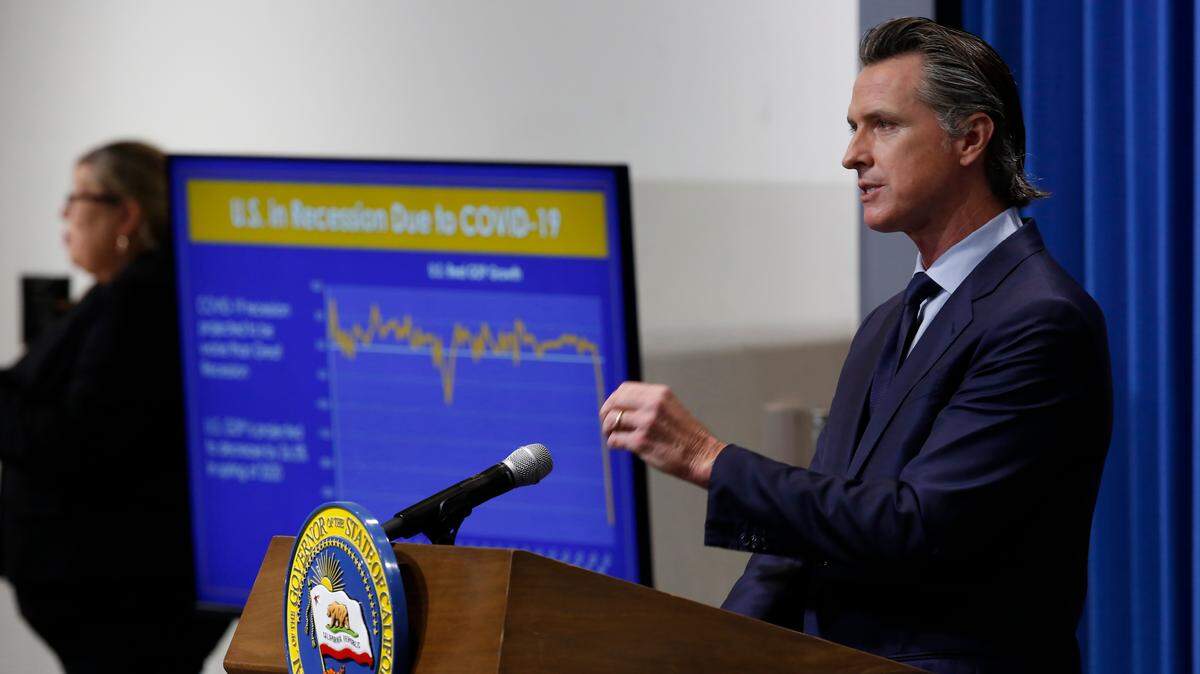
After two months of daily press conferences, Gov. Newsom is cutting back.
Moving forward, Newsom will give updates a few times per week instead of the daily updates he’s been doing for the past couple of months, Newsom spokesman Jesse Melgar said.
On Friday, he didn’t give a daily briefing and instead met with legislative leaders to begin negotiations on the revised budget proposal he unveiled the day before. He’s scheduled to give one today from a location in Napa.
Newsom began giving daily updates every weekday (and many weekend days, too) in March as the coronavirus pandemic swept through the state. He’s used the daily updates to give major announcements, from laying out conditions for reopening to warning that schools will remain closed through the summer, and to encourage Californians to volunteer in their communities.
The press conferences will likely continue to be by phone, Melgar said. Since the governor issued his stay-at-home order, reporters have had few opportunities to ask him questions in person, instead calling into the telephone press conferences, where opportunities for follow-up questions are essentially nonexistent.
POLL FINDS ANGER AT CHINA
The coronavirus has sparked more than just fear over getting sick.
It’s also incited racism against Asians and anger toward China for what some say was the country’s failure to contain COVID-19 before it spread globally.
In recent months, President Trump has stoked those frustrations by calling COVID-19 the “Chinese virus” and claiming the disease was manufactured in a Chinese laboratory.
Eighty percent of the 8,800 registered California voters surveyed in an April Berkeley Institute of Governmental Studies and Initiative for Health Equity and Action poll blame China on some level for the mishandling of the crisis.
But a majority of those voters, 60 percent, disapprove of Trump’s characterization of COVID-19 as the “China virus,” “Chinese virus,” or the “Wuhan virus.” But among the 30 percent who approve of the president’s work, 76 percent said they agreed with this terminology.
“We will continue to hear messages of blaming the Chinese government and individuals through November,” said Alein Haro, president of the IHEA. “This racialized messaging is a political strategy to foster racial fears with the sole purpose of clearing President Trump from his slow response to and dismissive attitude toward the virus.”
The poll underscores the kind of discrimination that the California’s Asian and Pacific Islander Legislative Caucus has raised concern about in recent months.
More than 1,700 instances of discrimination against Asians had been reported since March 19 to the STOP AAPI HATE reporting center. Even before the virus swept California and the rest of the national into a political, emotional and economic hurricane, Asian businesses had taken a hit in revenue.
To understand the full effect of the virus on Asian and Pacific Islander communities, the caucus proposed legislation that would free up $1.4 million in one-time research funding.
“Our API communities are not only under attack from COVID-19, but also from the virus of racism,” said caucus chair and Assemblyman David Chiu, D-San Francisco. “This package seeks to alleviate some of the economic, political, and societal burdens on our API communities in California.”
ROAD RUNNER
Congratulations to Roger Salazar, well-known to the press corps as California’s top media professional and president of Alza Strategies — and clearly a well-rounded spokesman — for his appointment to the Off-Highway Motor Vehicle Recreation Commission.
Newsom announced Friday Salazar’s appointment to the commission, responsible for approving general plans, writing grants and taking public comments related to recreation areas. The commission represents “recreation enthusiasts,” scientists, rural landowners, law enforcement, environmentalists, per its website.
QUOTE OF THE DAY
“In light of the difficult budget circumstances and in the spirit of the Governor’s call for shared sacrifice, today I asked the Assembly Rules Committee to reduce my pay by 10%. We are in difficult and turbulent times but – together – we can and will get through this.”
- Assemblywoman Susan Eggman, D-Stockton, on Twitter.
Best of the Bee:
How a single insurance company came to dominate Gavin Newsom’s COVID-19 testing team, via Sophia Bollag and Jason Pohl
Faced with a state budget deficit, Gov. Gavin Newsom on Thursday proposed “pausing” three-quarters of a billion dollars worth of renovation work planned for three aging state buildings in downtown Sacramento, via Tony Bizjak.
Gov. Gavin Newsom is proposing a $5 billion cut in funding to California’s K-12 schools, a grim projection that could have been worse without a pot of money he wants to use from the economic stimulus package Congress allocated in March, via Hannah Wiley and Sawsan Morrar.
To soften blow of state worker pay cuts, California might suspend $2,600 health deductions, via Wes Venteicher
This story was originally published May 18, 2020 at 4:55 AM.