
Half a billion in half a year: The ticking clock on California’s newest homeless plan
“We need a new approach,” Gov. Gavin Newsom said in February when he dedicated his State of the State address to California’s worsening homelessness crisis.
Now we have one: acquiring $600 million of hotel properties before the federal funding clock, which controls the vast majority of acquisition funding, runs out in six months.
The strategy outlined in California’s latest budget, which carves out a total of $1.3 billion for housing and homelessness, turns Project Roomkey — an emergency hotel and motel lease effort to house California’s most vulnerable homeless — into a permanent housing plan dubbed Project Homekey.
That model entirely replaces the state’s pre-pandemic approach of giving $750 million directly to service providers — a strategy that was set to overhaul a flexible block grant system Newsom touted just one year prior.
“We have not taken our eye off the ball of focusing with intentionality on addressing the needs of the most vulnerable Californians, particularly those out on the streets and sidewalks,” Newsom said in a Tuesday press conference against the backdrop of a Project Roomkey hotel in Contra Costa County. “(We need to) take ownership and to recognize that this state has failed to address homelessness in a meaningful way.”
Advocates and officials herald Project Homekey as a demonstration of California’s ability to mobilize quickly to get people off the streets. But some warn that the state may struggle to turn leases into purchases and keep current residents housed — and those residents, advocates caution, represent just a small subset of California’s ever-growing homeless population.
Homeless population rising
Despite funneling $1.15 billion into homelessness over the past two years, California saw its homeless population swell to 151,000 in 2019 — a 17 percent uptick from the previous year.
Los Angeles County just reported a 12.7 percent increase from 2019 to 2020, based on a one-time count conducted months before the pandemic hit. Researchers have projected that the COVID-19 outbreak could push another 250,000 Americans out of their homes, increasing the nation’s homeless population by 40 to 45 percent.
“A crisis like this, where people are gonna lose income and really struggle, will result in people becoming homeless at a rate we haven’t seen before,” Housing California’s Chris Martin said, noting that the majority of newly homeless in Los Angeles in 2019 cited economic hardship as the driving force.
Of particular concern, Martin said, California’s statewide eviction ban is set to expire at the end of September. Lawmakers are looking at options to extend the moratorium and give renters more time — potentially, until 2034 under a relief bill that just cleared the Senate — to make up missed payments.
California is also contending with the release of 3,500 non-violent inmates, many of whom do not have stable housing and will struggle to find it, Martin said. Former inmates, according to a Prison Policy Initiative report, are ten times more likely to be homeless than the general public.
While the California Department of Corrections and Rehabilitation offered shelter to 400 prisoners released under its supervision, department representative Terri Hardy said, most inmates were released under county watch without state oversight or housing guarantees.
Project Roomkey to Project Homekey
Newsom in mid-March gave cities and counties $150 million in state funding to house high-risk homeless individuals in empty hotels and motels. Two weeks later, he became the first governor to secure 75 percent federal reimbursement for homeless expenditures — a critical step that laid the groundwork for financing California’s current approach.
As of June 30, Project Roomkey has surpassed Newsom’s 15,000-room goal. Of the rooms set aside for asymptomatic individuals, 85 percent are filled. The governor estimated in a Tuesday press conference that 14,200 Californians now call those rooms home.
Los Angeles County, which set its own 15,000-room goal — a reflection of the 15,000 Angelanos who meet federal reimbursement criteria for age and health risk — was around one-fourth of the way there as of June 24, Homeless Services Authority Executive Director Heidi Marston said.
State officials now want to turn leases into purchases with a budget deal that leverages $550 million from the CARES Act and $50 million from the state general fund to buy hotel and motel properties. But federal funding only helps California buy hotels — not maintain them.
“Shelters solve sleep,” Newsom said on Tuesday. “Housing and supportive services solve homelessness.”
To help with operating and service costs — especially for cities and counties that can’t rely heavily on emergency funding from Washington, said founder and CEO of All Home Tomiquia Moss — the budget allocates $300 million from the general fund based on existing formulas.
The remainder of the $1.3 billion total housing and homelessness budget goes to cities and counties for a variety of projects outside of Project Homekey.
Ten housing advocacy organizations urged the state in May to supplement federal funds with a more robust long-term hotel operations budget and create local incentives to participate in housing efforts. Moss, whose organization provides technical assistance to counties pursuing Project Homekey purchases, said the federal government needs to provide a second round of funding for operations costs that the CARES Act neglected.
Project Homekey deadline
Project Homekey’s budget comes with a major caveat: California has to spend its federal funding by the end of this year, or the money disappears. That’s a stiff timeline, the Senate subcommittee on housing and homelessness warned last month.
“[Reliance on federal funds] limits the ability to provide ongoing support to local housing and homelessness programs through this approach, and raises questions about the ability of the state to acquire $600 million in properties in a six month time period,” a subcommittee report on the May budget revision reads.
Advocates worry about an uphill battle in turning temporary leases into permanent dwellings. Many hotels are unwilling to sell, Martin said, and those that are willing require significant building rehab to become suitable, sustainable accommodation — starting with kitchen installments, which Martin said remove one room for every two that they refurbish.
The budget includes language to speed things up. Motel conversions are exempt from environmental review — a locally controlled process that could otherwise delay construction for two and a half years, according to a Legislative Analyst’s Office report.
But the requirements for exemption are “pretty onerous,” said Matt Schwartz, President and CEO of California Housing Partnership, which has consulted with the governor on his plan. Of particular concern, cities forego exemption if they finance acquisition with any private money, which Schwartz said often forms a significant portion of local homelessness budgets.
Cities also need to give construction contracts to a “skilled and trained workforce” — a proxy, Schwartz said, for unionized workers who require higher wages and are hard to come by in some regions.
Moss said that she feels “cautiously optimistic” about implementing Project Homekey but underscored that state officials will need to be flexible and adaptable with exemption requirements as California moves into “uncharted territory.”
But even if everything goes perfectly, Schwartz said, California still won’t be able to purchase all the properties currently under lease: To do so would require double or triple the current budget.
Cities and counties
There remains another prerequisite to Project Homekey’s success: cities and counties have to actually take the state up on its funding offer.
“We’re rewarding good behavior,” Newsom said on Tuesday. “This is not a requirement ... We’re looking forward to working with those counties that haven’t participated and encouraging them to participate, and of course we’re gonna make sure that those that are participating very actively and successfully, that they’re rewarded in that process as well.”
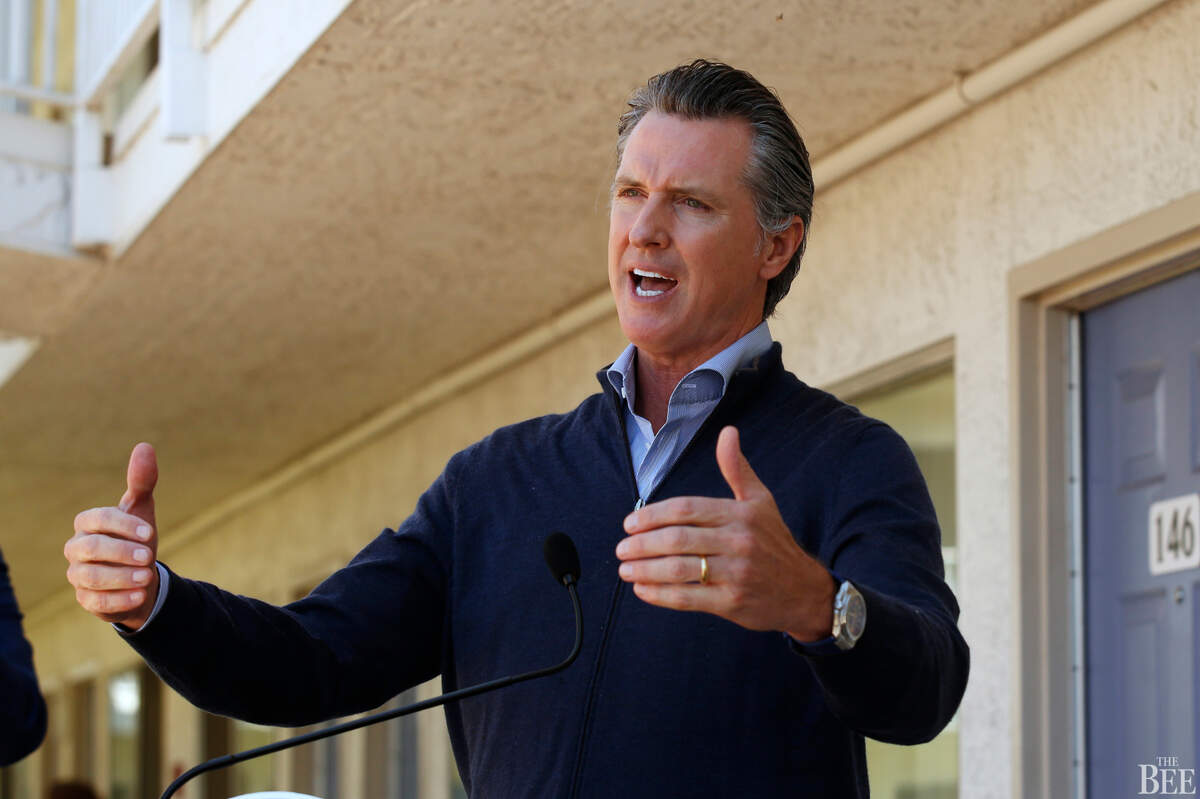
The vast majority of California’s counties — 52 of 58 — have procured hotel and motel properties under Project Roomkey. Those that transition to Project Homekey will receive “unprecedented” financial backing from the state, Newsom said.
Some officials, including those in Alameda, Santa Clara, Sacramento counties, have expressed enthusiastic support for transitioning those properties to Project Homekey sites, Moss said. She added that purchasing efforts were underway in Alameda County months before the state began spearheading the project.
But in some places — including cities within Los Angeles County, which itself is eager to pursue Project Homekey — local leaders have resisted hotel housing efforts over the past several months.
Los Angeles County lawyers recently prevailed over two cities — Bell Gardens and Lynwood — that had previously barred local hotels from housing homeless residents. The cities on June 24 dropped local Project Roomkey moratoriums that the county had contested in court. Litigation continues in Norwalk, which has maintained its ban.
Marston declined to comment on whether the county had acquired any hotels thus far and noted that Los Angeles has nearly exhausted state and federal funds. Right now, county officials are working to extend soon-to-expire leases negotiated at the beginning of the pandemic, Marston added, and trying to turn leases into purchases.
“To the extent that we have interested owners and we have funding from the state and other resources to leverage that will allow us to either acquire or long term lease these sites, we certainly want to do that because our need is not going away,” she said.
Most still need housing
The vast majority of the state’s homeless will never see the inside of a recently-converted motel room. To date, under ten percent have.
A comprehensive solution, advocates say, requires a permanent funding source in a state that has produced three separate homelessness programs in three years. California Democrats want to make that wish list item a reality with a right to housing and a $2 billion annual homelessness fund.
Although Project Homekey is limited in scope, government officials and housing advocates agree that housing over 14,000 residents in three months is an unprecedented achievement — a silver lining of the COVID-19 pandemic.
“[Project Roomkey] demonstrates that we can house a large group of people in a short amount of time if you have the intent and you have the resources to back it up,” Martin said. “[But] it really is just a drop in the bucket compared to the overall need … Our hope is that the state can start to think about the other 140,000 people currently experiencing homelessness.”
Editor’s note: This story has been updated to reflect that California’s statewide eviction ban is now set to expire at the end of September.
This story was originally published July 1, 2020 at 5:00 AM.