Give COVID vaccine to teachers and these other key workers next, California panel proposes
Essential workers at risk of exposure to the coronavirus at their job such as teachers, child care workers, grocery store clerks, farmworkers, first responders and those 75 and older should be next in line to be vaccinated, according to a proposal put forth Wednesday by a key California panel.
Vaccination of those workers and seniors could start as soon as mid-to-late January, according to the proposal by a workgroup to the state’s community vaccine advisory committee.
The proposal is similar to one made Sunday by a federal advisory panel, which endorsed vaccinating “frontline essential workers” as well as seniors 75 and older after healthcare workers are protected.
The proposal will be refined and sent to Gov. Gavin Newsom’s administration for approval within the next week or so, Surgeon General Dr. Nadine Burke Harris said at the committee meeting.
“Importantly and fundamentally, there is less vaccine than people who need it,” said Dr. Oliver Brooks, who co-chairs the state’s drafting guidelines work group. “So we are just having to make the very difficult decision.”
California, like the rest of the nation, is first vaccinating healthcare workers. But with the next phase of vaccination just weeks away, who gets to be the next in line has been an open debate, with unions and groups from school districts to credit unions pushing to prioritize vaccinating their workers.
The committee got more than 170 pages of written comments in the last eight days.
“I am a physician anesthesiologist who intubates and takes care of COVID-19 patients,” wrote Tessa Walters in San Mateo County. “I wish that I could donate my dose of vaccine to teachers.”
Each state is taking its own approach, with Texas prioritizing seniors and those with chronic health conditions and Nevada prioritizing teachers, essential public transportation workers and essential retail workers, among others.
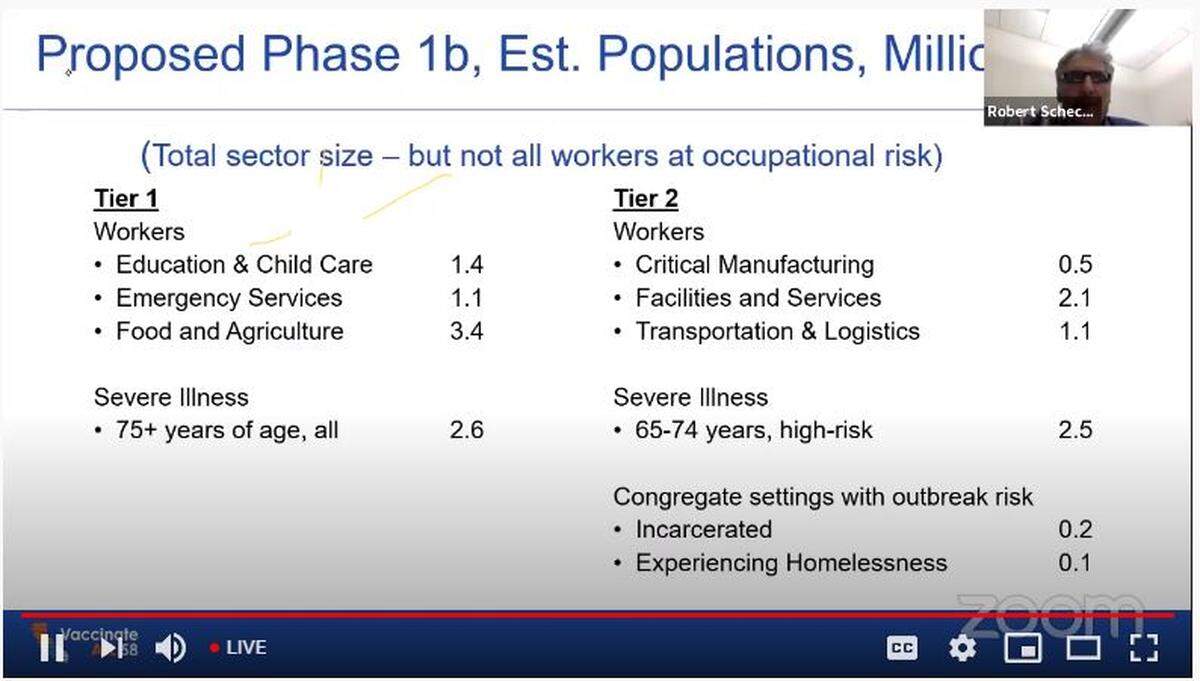
Based on examining factors such as equity as well as the sectors’ impact on economy and society, California’s workgroup proposed first vaccinating those working in education and child care, emergency services and food and agriculture, said Dr. Robert Schechter, who co-chairs the state’s drafting guidelines workgroup.
Schechter also noted seniors 75 and older have a much higher death rate from COVID-19 — more than 50% of the COVID-19 associated deaths in California have come from those 75 and older — to explain why those Californians are recommended to be on the next in line for the vaccine. The state’s guideline aims to strike a balance between preventing severe illness and death as well as preserving functions of the society, he said.
As many as 8.5 million Californians could qualify in the next tier. However, some of the workers described may not be eligible for the vaccine if they are not at risk of exposure to the coronavirus at work, Schechter said. It’s uncertain how the state will decide who is at risk.
The proposal also laid out what will likely come next.
The next tier would contain as many as 6.5 million Californians, including seniors 65 to 74 years old with medical conditions or disabilities that place them at high risk of severe illness from COVID-19.
Some of the essential workers at risk of exposure to the coronavirus at their workplace not included in the first tier – such as those in critical manufacturing, transportation and logistics industries – would be included in this second tier.
Those who are incarcerated or homeless are also included in the second tier, although Schechter noted the state doesn’t have control over vaccinating those in federal prisons.
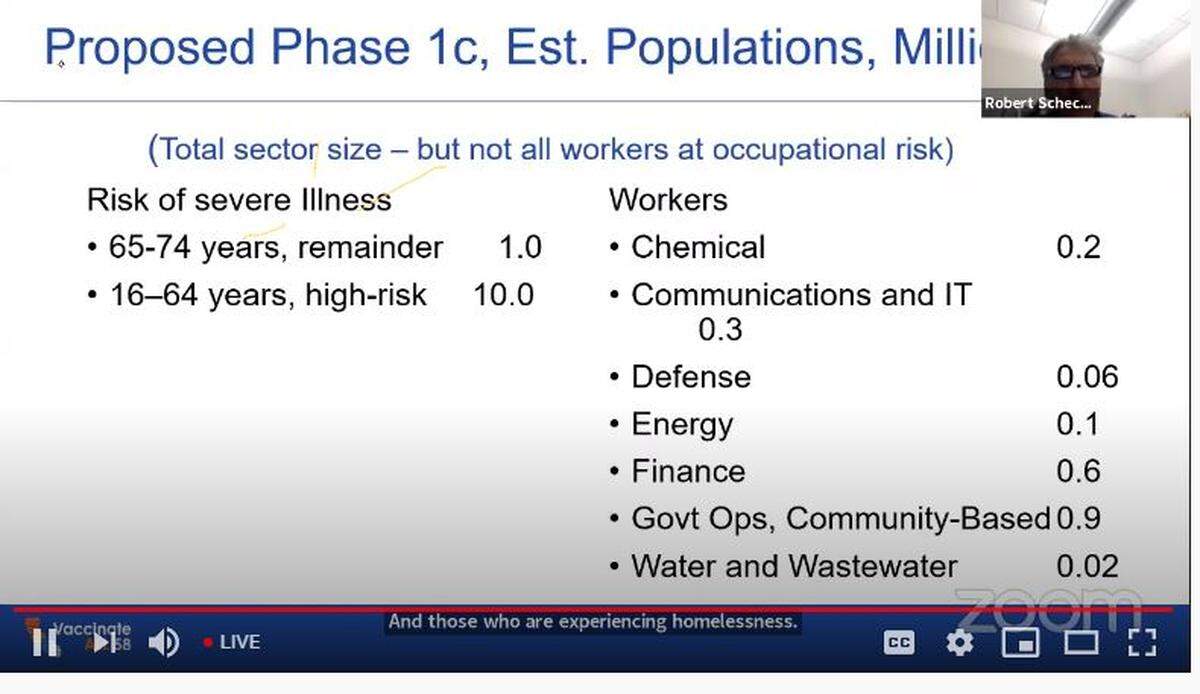
As many as 13 million Californians would come next. They would include the rest of those 65 to 74 years old, those older than 16 and at high risk of severe illness from COVID-19 as well as the rest of the essential workers at risk of exposure to the coronavirus at their workplace, such as those in communications, finance or water industry.
Vaccination for that group could start as soon as February, according to the timeline.
Newsom said Wednesday that he would not be vaccinated until it his turn in line.
“When the guidelines workgroup makes an independent adjudication as to when I should, when it’s appropriate for someone of my age and my vulnerability, whatever that may be. And not before,” he said. “That’s just my personal choice.”
Newsom said he didn’t begrudge election officials who have gotten the vaccine.
“In fact, in many ways I applaud that because it’s important to show folks that it’s safe and efficacious,” he said. “But for me, there’s just simply too many people that contact me, and contact my office, desperate for the vaccine, and I honestly in good conscience I just can’t get ahead of them in getting vaccinated.”
Andrew Sheeler of The Sacramento Bee Capitol Bureau contributed to this report.
This story was originally published December 23, 2020 at 4:38 PM.