
California schools could lose money under Newsom plan if they don’t fully reopen
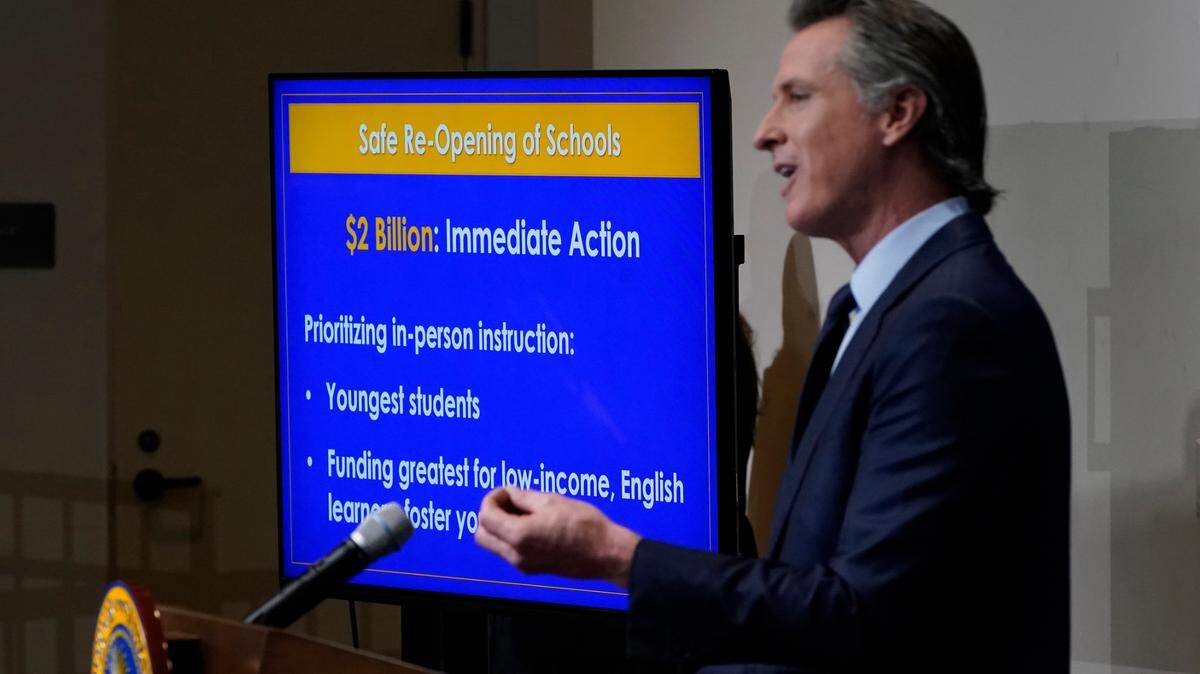
California Gov. Gavin Newsom wants to withhold billions of dollars from schools that don’t return to pre-pandemic learning with full in-class instruction this fall as part of a budget proposal that emphasizes an economic recovery from COVID-19.
The blueprint would shift the K-12 system back to what was offered before the coronavirus forced kids into “Zoom school” in spring 2020 and initiated a yearlong battle between districts, legislators and teachers unions over reopening strategies.
Under Newsom’s plan, most students would return to a “default” in-person, classroom-based instruction. Families who aren’t ready for a physical return to school could instead enroll their kids in already-existing independent study programs offered by school districts.
Each of the options are “generally one of only two ways in which local educational agencies can earn state apportionment funding in 2021-22,” Newsom’s budget plan includes.
Each year, the California Department of Education determines schools’ funding using daily attendance records. Under Newsom’s proposal, schools that decline to offer in-person instruction wouldn’t be able to submit the information, which means they could lose access to $67.9 billion in funding, according to the Department of Finance.
The temporary education rules that authorized widespread distance learning in California are also scheduled to expire June 30, which will force school districts to reopen more widely. Newsom, who is facing a recall election later this year, has repeatedly rejected any idea to extend that distance learning deadline.
“We want kids back in-person this fall, full time,” he said during a May 14 press conference to unveil his budget. “And on June 30 at midnight, the statute in the state of California will make that crystal clear that that is indeed a requirement.”
Newsom’s budget proposal would make a “series of improvements” to the independent study program. He also wants to allocate $2 billion as part of his greater $93.7 billion education budget for schools to safely reopen their doors. That money builds on a $6.6 billion package Newsom already approved in March.
‘Money is not going to be the problem’
His proposal kicks off a month of negotiations with the Legislature, which by law must pass a state spending plan by June 15.
“Money is not going to be the problem going back to school this year,” said Kevin Gordon, president of the education lobbying firm Capitol Advisors. “Overall, this is a budget nobody really can complain about with a straight face.”
California Teachers Association spokesperson Lisa Gardiner also said the union supports and expects “safe, in-person instruction” to be the “norm in the fall.”
“There’s no question that the classroom remains the best place for teachers to teach and children to learn. But as we emerge from the pandemic, we recognize the need for a high-quality independent study or distance learning option for students with diverse and complex needs,” Gardiner wrote in an email. “This is about equity.”
Alternative to classroom instruction
Newsom’s budget would mandate revisions to the independent study program, which is an “alternative to classroom instruction,” according to the California Department of Education.
Students who enroll in the decades-old program include actors, athletes, those with health issues and homeless, pregnant and parenting youth. They follow the same curriculum as kids learning in the classroom, but the program affords them much-needed scheduling flexibility.
Newsom’s budget would mandate access to technology and internet connectivity for program participants, a rigorous curriculum and a re-engagement strategy for those who don’t log on for instruction.
The plan would also require schools “track and record daily student participation and interaction” between educators and students.
But those amendments, specifically the daily interaction, could jeopardize the program’s success, Gordon said.
“Some of these new bureaucratic requirements just make things more complicated,” Gordon said. “I think their hearts are in the right place, but practically I think it will mess up programs that have been working for years for students.”
During a legislative hearing on Tuesday, Assemblyman Phil Ting, D-San Francisco, also raised concerns with the independent study program.
Newsom’s current proposal has no limits on how many parents can opt out of in-person instruction. Ting, who’s been a strong critic against districts refusing to open in recent months, said not establishing a cap for the program and effectively repeat a distance learning model would be a “pretty catastrophic mistake.”
“I think it would not be very good policy knowing what we’ve witnessed,” he said. “If we don’t define that in greater detail, I think we’d live to regret this next year when we’re having this hearing.”
This story was originally published May 19, 2021 at 5:00 AM.