New California redistricting maps would make tough elections for Devin Nunes, Josh Harder
Preliminary visualizations for California’s new congressional districts would put Central Valley Reps. Devin Nunes and Josh Harder in tougher elections in 2022 for their seats in the United States House of Representatives, experts say.
The visualizations, released Wednesday, are the first time viewers could see the puzzle pieces of various legislative districts put together. Drafts will change multiple times over the next couple of months before the nonpartisan commission charged with making them sends a final one to California’s secretary of state for certification.
Redistricting, the process by which legislative boundaries are redrawn following population shifts revealed by the Census, can alter the makeup of voter preferences in an area. California lost one seat in the U.S. House because of sluggish population growth, dropping its legislative delegation to 52.
The state started using an independent commission to oversee redistricting before the last time maps were redrawn in 2010 to counter alleged gerrymandering in past processes.
Paul Mitchell, a political consultant who specializes in redistricting and data, said that maps which infuriate or show huge legislative changes are forms of trial and error.
“It’s like a ‘redistricting Roomba,’” he said. “The commission is meant to bump into things, see what works and what doesn’t work.”
Rep. Josh Harder’s district could get away from him
Andrew Acosta, a Democratic political consultant, said that these preliminary visualizations should make Republicans feel pretty good, since the district lost seems to be a Democratic one in the Los Angeles area and at least one other district represented by Democrats might swing into jeopardy: Harder’s.
Harder’s district, which centers around Modesto, would expel Tracy, a largely-liberal commuter town in San Joaquin County. Tracy would join a crescent-shaped district that drops down to Gilroy through San Jose.
The proposed district that Harder, D-Turlock, has would keep Manteca and Lathrop, which are both more liberal, and the entirety of Stanislaus County.
But without Tracy, among other minor changes, the district would go from one that voted for President Joe Biden to one that would have supported former President Donald Trump in the 2020 presidential election, an editor for The Cook Political Report, which analyzes elections, wrote on Twitter.
Harder has held the seat since 2018, when he ousted Republican incumbent Rep. Jeff Denham.
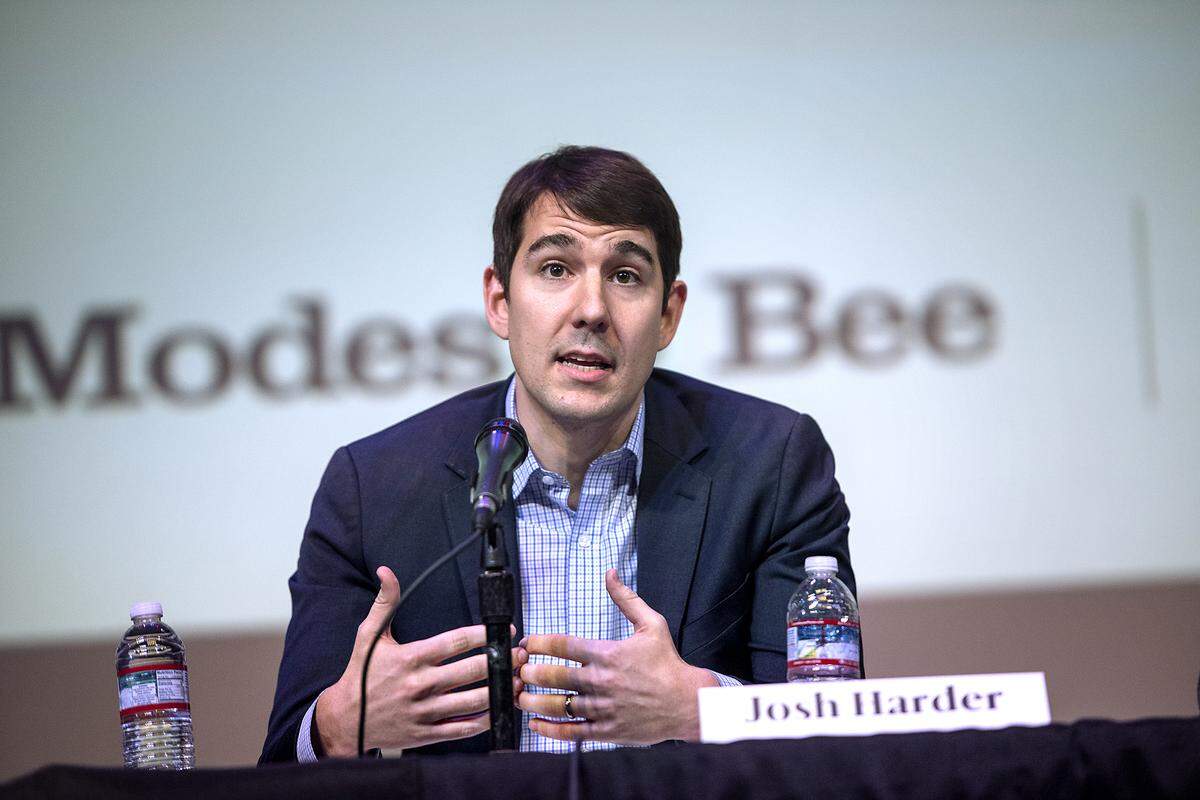
Harder was already considered to be one of the most vulnerable Democratic incumbents by some experts, even though only a handful of competitors have entered the race, none of them with political experience. His district voted to recall California Gov. Gavin Newsom last month, suggesting that voters there are open to Republican candidates.
Mitchell, the redistricting expert, said that a district that is not contiguous — unable to be reasonably driven through from one end of another to — is not permissible. He said that topping San Jose’s district with Tracy might not make the cut as a result.
Letter writers, some with Republican ties, had lobbied the commission to remove Tracy from that district, writing that its demographics do not match those of Stanislaus County. They wanted to add Lodi, but the commission put the conservative farming town in a district with Stockton and Elk Grove. That district is currently represented by Rep. Jerry McNerney, D-Stockton.
Rep. Devin Nunes’ district could become more Democratic
The district that Nunes, R-Tulare, sits in would stretch northwest and south into the swing district that Rep. David Valadao, R-Hanford, holds. The proposed district, shaped like a pirate hook, would rub up against Delano in the south and capture Riverdale and more of Fresno in the north.
The editor for The Cook Political Report, Dave Wasserman, predicted that Nunes’ new district would go from having voted for former President Donald Trump by five percentage points to President Joe Biden by three, indicating that more of the population would lean Democratic.
Nunes has represented that district since 2013, when redistricting altered it. He held the equivalent seat since 2003.
The congressman consistently won re-election by more than 20 percentage points until former President Donald Trump took office in 2017 and Nunes gained a natioanl reputation as a Trump ally. In 2018, Democratic challenger Andrew Janz came within six percentage points of Nunes; in 2020, Democratic opponent Phil Arballo came within nine. Arballo is running in 2022.
Nunes is drawing and retaining a lot of campaign cash, with more on hand than any other Republican in the first half of the year, suggesting his seat could still be safe.
Mitchell and Acosta said the initial maps should not be taken too seriously as the “redistricting Roomba” keeps bumping along and revealing potential conflicts.
For example, the map would also put Democratic Reps. Mike Thompson and Jared Huffman, who represent areas in Northern California, in the same district. Candidates for the House do not have to live in the districts that they are running to represent, noted Acosta, and the surrounding area there is still largely Democratic, meaning neither representative should fear for their seat.
“But it still makes for awkward conversations in the hallway,” Acosta said.
This story was originally published October 29, 2021 at 5:00 AM.