
Can anything be done to unclog holiday supply chain? How Biden, Newsom are trying to help
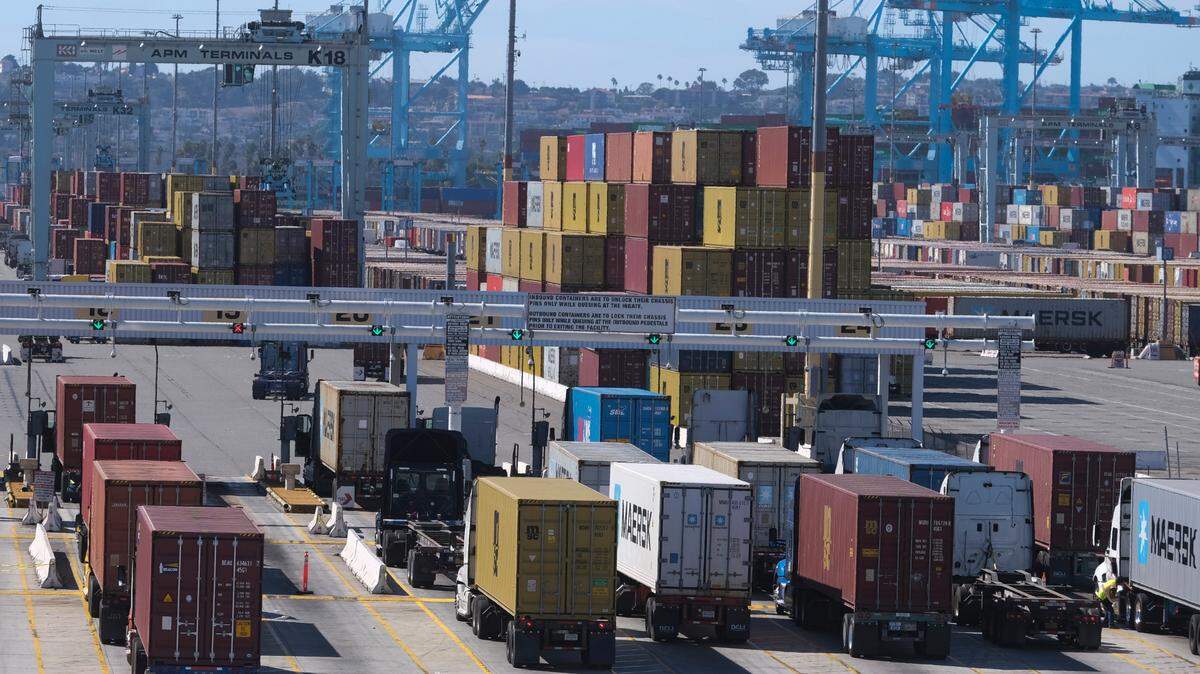
Don’t count on Gov. Gavin Newsom or President Joe Biden to clear up supply chain problems this holiday season.
“In the short term there’s not a lot politicians can do,” said Sam Abuelsamid, principal research analyst at Global Insights, a market advisory firm.
Both Democrats announced plans in the past few weeks to speed up the movement of cargo in Calfiornia ports.
Newsom issued a detailed executive order last month aimed at unclogging ports and getting supplies moving again. Biden also acted last month to keep the ports working around the clock. Both men took steps to get different government agencies to pursue new approaches to ease the backlog.
This week, the numbers of ships waiting at the Los Angeles and Long Beach ports, which handle 40% of the nation’s imports, remains high. Truckers continue to cite labor and storage problems.
The underlying problems causing the supply chain disruptions, like labor shortages and high shipping container costs, can’t be fixed with an executive order from the governor, said Sanjay Varshney, a professor of finance at California State University, Sacramento.
“This could just be making sure that, as the head of the largest state… they probably want to make sure they’re at the table somewhere,” Varshney said, describing Newsom’s recent executive order.
The key solutions will take time. One of the more ambitious programs has the state and federal government implementing a plan for Washington to provide California with low interest loans that could serve a wide variety of purposes.
Alex Stack, a Newsom spokesman, cited incremental progress that should help this holiday season.
“The state is doing everything it can, and it’s making a real difference — but there’s no overnight solution to this,” he said.
In the short term, merchants are concerned that spot shortages of popular products will be appearing throughout the holiday season. That’s likely to be a major topic Wednesday when the Legislature’s Ports and Goods Movement committees will hold a hearing.
What can Newsom do?
A big reason the executives can’t quickly make supply chains smoother is that there’s no simple solution to a mess that’s taken months to develop.
Even if the ships can be unloaded more quickly, the goods still need to get to consumers and stores.
Newsom acknowledged the challenges in his executive order, telling several different state agencies to develop both short- and long-term plans. His administration launched a Supply Chain Working Group in March 2020, the month COVID-19 began to spread. Some of Newsom’s actions last month accelerated their recommendations.
He told transportation agencies to work with industry officials to identify by the end of this month freight routes that might need a temporary exemption to weight limits so they can move goods more freely.
Newsom also ordered his Office of Business and Economic Development to find sites that could be used for short-term storage needs. He told the Department of General Services to finish a review by December 15 of state owned property near ports that could handle storage.
After the Newsom order, the city of Long Beach has taken steps to ease shortages by allowing more stacking of shipping containers, one way to ease the problem of storing them.
Clogged supply chains
Biden’s Oct. 13 order focused on the ports, describing a new effort to keep them running around the clock. Companies such as WalMart, Target, UPS and FedEx pledged cooperation.
But ships continue to wait. On Monday, Captain Kip Louttit, executive director of the Marine Exchange of Southern California, reported 159 total ships in port at anchor or “loitering” at Los Angeles and Long Beach, six more than Friday. Of the 159, 102 were container ships. Loitering ships are those nearby waiting to dock.
And once they’re unloaded, there have been problems getting their goods to stores and customers. Starting Monday, the Los Angeles and Long Beach ports began imposing fines on shipping firms if they take too long to move the containers.
“You need more people to drive the trucks, to work the docks,” said Tim Murphy, chief executive officer of the Sacramento Regional Builders Exchange. “It’s more complicated than just hiring people.”
Drivers have to get a license. They may need sophisticated training. They may want more money than the employer is willing to pay. The ports need to get rid of empty containers that are taking up space.
“Ideally, additional space on dock should allow terminals to receive empties to free up chassis for more import movement off dock,” said Matt Schrap, chief executive officer of the Harbor Trucking Association. Chassis is the metal frame that truckers use to transport a container to the shipper.
The other complication involves problems with raw materials and components. The shipping containers are full of finished products. But to make those products, companies need computer chips and other materials whose production is scattered in different countries, often countries where COVID-19 forced cutbacks.
American politicians can’t simply build a chip facility overnight. “It can cost billions and take two to four years,” said Abuelsamid. “There’s nothing you can do to speed up that process.”
Sophia Bollag of the Sacramento Bee contributed to this story
This story was originally published November 3, 2021 at 5:25 AM.
.jpg)