
California farmers to get boost under federal-state plan to buy $43 million worth of food
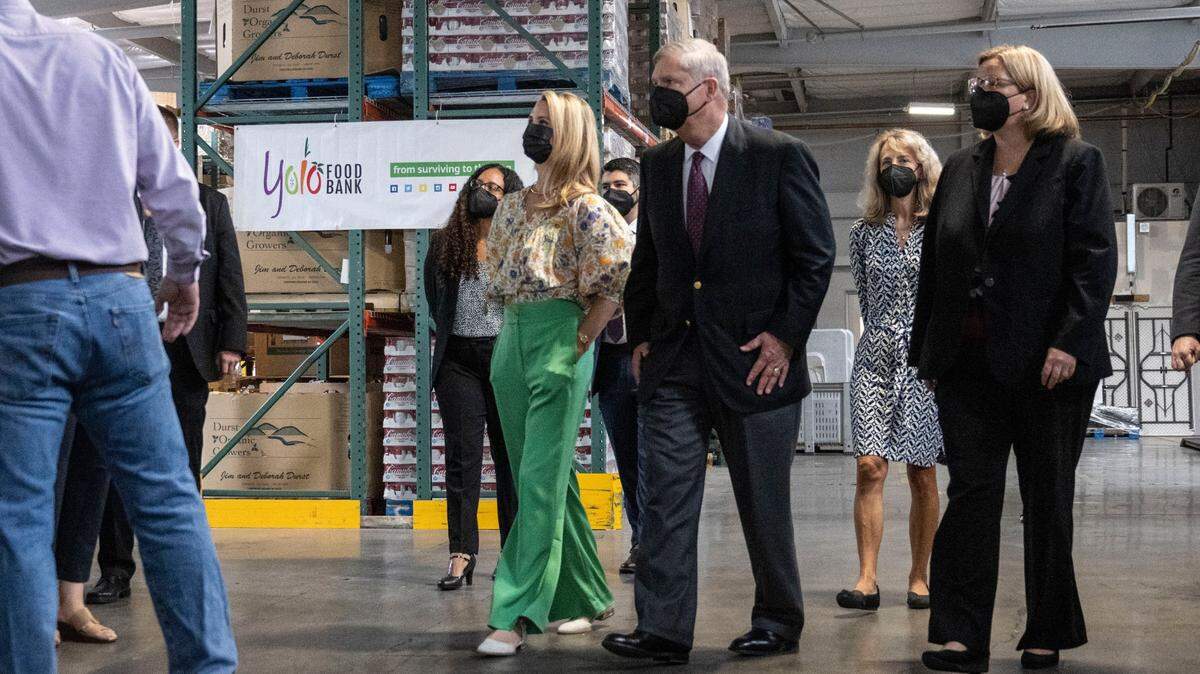
The federal government will channel $43 million into efforts to purchase and distribute locally grown food from California’s underserved farmers and producers, U.S. Agriculture Secretary Tom Vilsack announced Wednesday in Woodland.
Funds will be distributed through the Local Food Purchase Assistance Cooperative Agreement Program, which was established this year to stabilize agricultural supply chains throughout the country. Through the new partnership between the USDA and California, a handful of state agencies will partner to buy food from local and underserved farms. Food will then be distributed to sources including schools and food banks.
Vilsack introduced the partnership to members of the agricultural community and media on Wednesday at the Yolo Food Bank, which stores more than 10 million pounds of food annually from a network of grocers, farmers and distributors. The secretary unveiled the programming alongside state officials and California First Partner Jennifer Siebel Newsom. Officials hope the new program will aid producers hampered by the effects of the COVID-19 pandemic and inflation while boosting access to healthy, locally sourced foods.
“Whether it’s concerns and issues with supply chains or inflation, we’ve been through a very, very difficult time,” Vilsack said. “You get through a tough time by coming together and focusing on trying to provide help and assistance to those most in need.”
The announcement came as President Joe Biden and others in his administration have rejected arguments that COVID-related benefits — including stimulus checks, tax credits and enhanced unemployment benefits — drove up the cost of food, gas, clothing and other common household items.
Earlier this month, Biden sought to reassure Americans that price increases wouldn’t spiral further amid the highest inflation in more than four decades.
Economists fear that demand will continue to outstrip supply, which historically pushes up prices.
Earlier this year, Biden on a visit to the Midwest said American farmers were pivotal in keeping food prices stable and ensuring supplies remained balanced in the face of persistent supply chain issues and the ongoing war in Ukraine that has halted exports of wheat and other items to markets around the world.
“Our farmers are helping on both fronts: reducing the price of food at home and expanding production and feeding the world,” Biden said in May in Illinois.
Stability for California farmers
The largest grant recipient so far, California is the 23rd state to partner with the USDA’s cooperative agreement program, which has also served two territories and one tribe in an effort to utilize $400 million of the department’s relief resources, Vilsack said.
State Agriculture Secretary Karen Ross said that creating “ready-made markets” provides a sense of stability for California farmers, the vast majority of whom she said farm less than 200 acres of land apiece.
“In supporting these local farmers with this scale of procurement, we are supporting local economies and we’re building stronger and more resilient communities that are coming together to do the most important and most noble cause that I know of, and what a farmer does every day — grow food for people,” Ross said.
Helping food banks, addressing climate change
The partnership will, in turn, provide support to California food banks whose resources may have waned over the course of the pandemic.
“We know that there was a high level of interest, high level of donations, high level of concern at the early onset of the pandemic,” Vilsack said. “But, as is often the case when things begin to return to normal, folks have the tendency to think the problem is solved. It’s not solved for food banks.”
Vilsack also highlighted several initiatives that will provide relief to farmers over the coming years. Congress recently provided USDA with $10 billion to distribute to farmers struggling due to climate-related disasters — funds that could be especially useful in the Golden State, where wildfires burn for months every year.
Vilsack will continue his trip to the West on Thursday in Reno, Nevada, where he’ll unveil expanded investments in internet broadband access across rural Nevada and beyond.
This story was originally published July 27, 2022 at 3:50 PM.