
Sports betting to solve homelessness? Dodgy claims made by Prop. 26 and 27 campaigns, fact checked
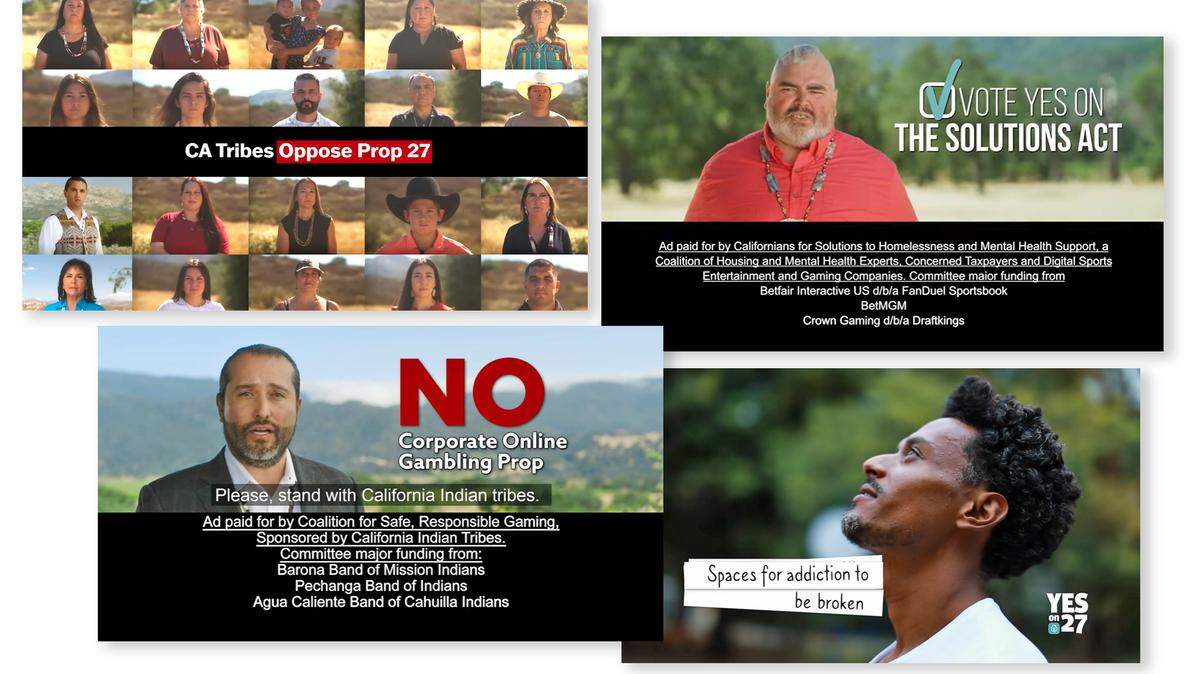
Whether they follow politics closely or not, most Californians have probably seen or heard about competing ballot measures to legalize sports betting. Ads for Propositions 26 and 27, which may be slowing down, have ranged from confusing to misleading.
Today the state has 66 tribal casinos, 84 card rooms, 33 horse racing facilities and 23,000 stores selling lottery tickets. To add sports betting, advocates for and against each measure have raised a record total of $470 million.
At stake is a multi-billion dollar industry’s access to the vast California market and the financial future of the state’s Native American tribes. If both initiatives pass, they might both go into effect. Or, the result could be decided in court — depending on which proposition gets more “yes” votes.
If neither pass, other efforts are likely to be on the ballot in 2024. To clear up some of the confusion around Props. 27 and 26, here are the fact-checked claims of the various sides.
Proposition 27
Legalizes online sports betting for major companies DraftKings, FanDuel, and BetMGM and licensed tribes.
Claim: Tax revenue will create permanent solutions for homelessness, addiction and mental health.
Rating: False
Prop. 27 would potentially generate hundreds of millions in state revenue, but not more than $500 million annually, according to the Legislative Analyst’s Office. Sports betting companies would have to pay 10% of their profits (totaling tens of millions) into a new fund to cover state regulatory costs. Then 85% of the rest would go toward addressing homelessness and gambling addiction.
The state already spends billions on homelessness — over $3 billion earmarked for this year and $4 billion spent last year — making more cash an unconvincing “solution.” The promise of long-term funding has not drawn widespread support from California’s homeless service providers and low-income housing builders.
Claim: All tribes will benefit, including small rural disadvantaged tribes that don’t own casinos.
Rating: Mostly false
Fifteen percent of all profits would go to tribes that aren’t involved in online sports betting for services such as government, health, and education. But tribes that don’t have casinos or operate only small ones already receive nearly $150 million each year from large tribal casinos through the Indian Gaming Revenue Sharing Trust Fund. Apart from the two tribes that support Prop. 27, Big Valley Rancheria and Middleton Rancheria Pomo, a coalition of 50 tribes oppose it. California is home to 110 federally recognized Native American tribes. Several oppose both measures, and others haven’t taken public positions. Many tribal leaders want to avoid the loss of a near-monopoly on the gambling business in California, which has become a crucial source of revenue for tribal governments.
Claim: The measure provides strong protections to keep minors from gambling.
Rating: Unclear
Prop. 27 would create new a regulatory unit within the state Department of Justice, to set licensing requirements for tribes and regulate the kinds of bets are allowed. This unit would also investigate illegal activities, including underage gambling. The measure says online sports betting operators should use “age-verification technologies and information-sharing” between sports leagues, companies, and the DOJ to protect people under 21. It also does not permit betting at “youth” sports events.
Claim: Online gambling will foster more addiction, financial ruin, and homelessness.
Rating: Mostly true
Problem gambling is defined by the California Council on Problem Gambling as “gambling behavior patterns that compromise, disrupt or damage personal, family or vocational pursuits.” A massive expansion of access to sports betting will inevitably lead to an increase in addiction, experts say, and make it more difficult to avoid for those already struggling with it. The more than 2,500 people who called California’s problem gambling hotline in 2019 for themselves or someone they knew, reported an average debt of about $24,000. A 2006 statewide survey found that nearly 4% of California adults, mostly low-income people of color or the disabled, identified as problem or pathological gamblers at some point in their lives. The state has not commissioned a similar survey since.
Claim: Sports betting companies will send 90% of profits out of state.
Rating: True
To take advantage of Prop. 27, gambling companies must be licensed in at least 10 U.S. states. DraftKings is headquartered in Massachusetts, FanDuel in New York, and BetMGM in New Jersey. The legislative analyst’s office predicts the online sports gaming industry would generate $3 billion in annual profits.
Proposition 26
Legalizes in-person sports betting, roulette and dice games at tribal casinos and racetracks.
Claim: No tax revenue will go to homelessness.
Rating: Mostly true
While racetracks must pay the state 10% of betting profits after issuing prize payments, tribes with casinos will negotiate with the officials to determine the state’s cut. Revenue could amount to tens of millions of dollars annually, according to the LAO analysis, but could be offset by regulatory costs. Of what is left over, less than half will be used to meet the state’s spending requirement for K-12 schools and community colleges. The rest, which may not be very much, would go into the general fund that finances homelessness programs.
Claim: There are no benefits for “disadvantaged” tribes that don’t operate casinos.
Rating: False
It’s true that there’s no 15% share of profits funneled to non-casino owning tribes like in Prop 27. But as mentioned above, Native American tribes in California that do not own and operate casinos already receive a profit share — albeit small — from those that do. Offering in-person sports betting at casinos would likely increase casino profits and indirectly benefit all tribes. Tribes prefer that Native American casinos continue to dominate the industry, which is why 30 tribes support 26. A coalition of eight tribes oppose both 27 and 26 and don’t want to see sports betting offered anywhere outside Native American operated casinos.
Claim: Card rooms would be forced out of business.
Rating: Mostly true
Prop. 26 allows anyone to sue entities that they believe are breaking state gambling laws for penalties up to $10,000 per violation, if the DOJ does not act. Tribal casinos have long seen card rooms as competition, and allege they skirt the law by letting the house deal in poker, blackjack, and baccarat. The state’s card room industry generates $1.6 billion in wages a year, according to the California Gaming Association. Card rooms say Prop. 26 would make them vulnerable to frivolous lawsuits that could put them out of business.
Claim: There are no gambling protections for minors.
Rating: False
In-person sports betting is easier to regulate than online for obvious reasons. While the minimum age to place bets at tribal casinos will be determined by individual compacts between tribes and the state, casinos are required to pay state and local government regulation costs.
This story was originally published September 27, 2022 at 5:00 AM.