
Funding cuts, ridership dips, a ‘fiscal cliff’: What’s happening with California public transit?
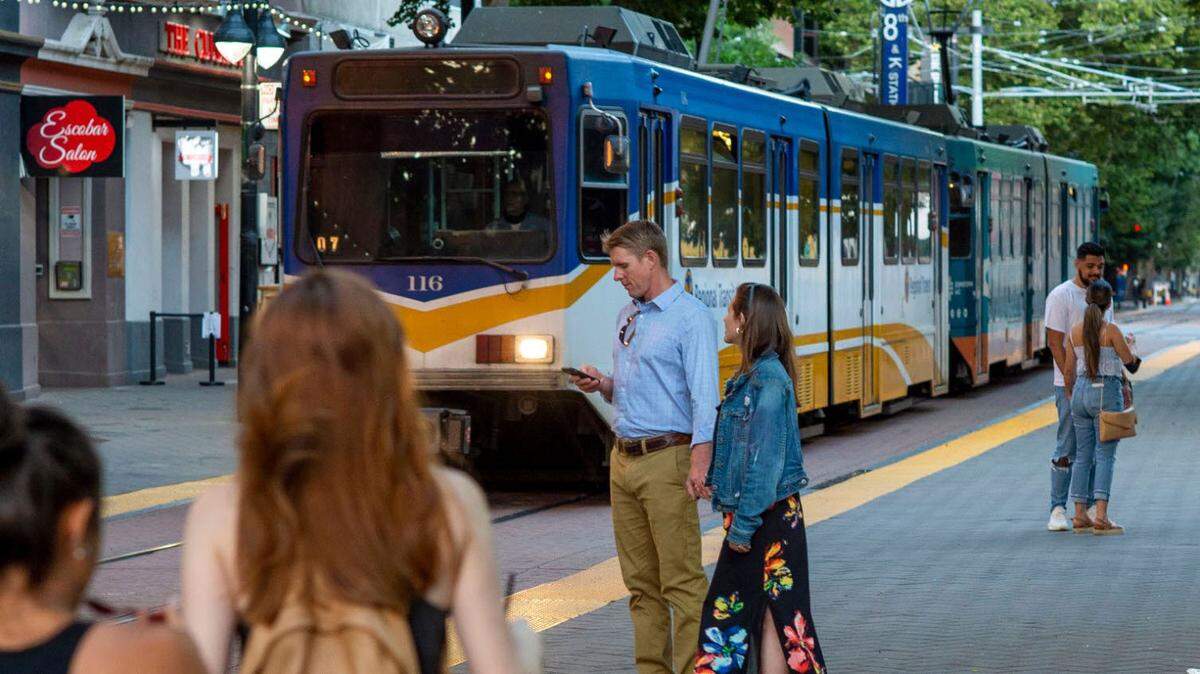
Public transit is a lifeline for low-income Californians, essential for increased housing density and the key to realizing the state’s goal of drastically reduced carbon emissions.
But the state’s major public transit agencies are facing a myriad of issues — from slumped ridership to proposed state funding cuts to a looming “fiscal cliff.” They’re looking to California lawmakers for a solution.
Transit systems and their advocates argue that Gov. Gavin Newsom’s proposed budget would steer the state in the wrong direction and jeopardize efforts to convince more Californians to leave their cars at home and hop on a bus or train. They’re trying to convince legislators to double down on their investments and allocate new money to help maintain current service levels.
“Inaction is not an option,” said Laura Talkoff, transportation policy director at the San Francisco Bay Area Planning and Urban Research Association, SPUR. ”Public transit is simply too important to the state’s climate, equity, housing and health goals.”
The State Senate and Assembly transportation committees will hold a joint hearing Monday afternoon to discuss the financial state of California’s public transit systems, potential avenues to bring back riders and possible ways to address what some are calling an impending “fiscal cliff.”
California public transit ridership slumps
Transit ridership plummeted three years ago at the start of the COVID-19 pandemic, as millions of Californians were instructed to stay at home. Although it has started to pick back up, the shift toward more at-home work has stopped most agencies from reaching their pre-pandemic levels. In turn, transit systems are collecting less money at the fare box.
The unprecedented flow of federal relief funding that helped agencies maintain operations throughout the pandemic is running out. Systems that have historically relied more heavily on fare box revenue — those in the Bay Area and Southern California — are forecasting the most dire financial situations.
The Bay Area’s Metropolitan Transportation Commission earlier this month reported that the region’s operators faced a total revenue shortfall of up to $3.3 billion over the next five years. The Bay Area Rapid Transit system, which previously received more than half of its revenue from riders, is considering running trains less frequently and reducing its hours of operation in order to balance its future budgets.
Sacramento Regional Transit District, which operates bus routes, light rail and ADA paratransit across the county, isn’t as bad off. Ridership across the SacRT is averaging approximately 70% of pre-pandemic totals but fares make up a much smaller portion of its revenue sources.
On top of ridership and revenue issues, Newsom last month proposed addressing the state’s projected $22.5 billion deficit, in part, by cutting $2 billion for transit capital construction projects. Asked why he was trimming back those funds, Newsom said, “because of the magnitude” of the investments still committed to that budget line.
Senator Scott Wiener, D- San Francisco, said the funding cuts on top of the operational challenges agencies face were “too much.”
“This really is a slow-moving train wreck, and I’m concerned that we don’t have enough of a sense of urgency to prevent it from happening,” said Wiener, one of the industry’s top advocates in the legislature.
Transit funding across California
Newsom’s budget proposal received almost immediate backlash from transit advocates. They argued that a loss of capital funding would slow the expansion of their systems, limiting the chance to draw more riders and secure the local funding needed to match federal grants. They pleaded for lawmakers to keep the money for new infrastructure intact.
Since then, a coalition of advocates, organized by the California Transit Association, has added a secondary request — to set aside additional money over multiple years to address short-term operational needs.
California’s more than 200 public transit agencies receive funding from multiple sources, including state and federal government, county or regional sales taxes and passenger fares. Historically, federal and state governments have provided funding assistance for transit construction projects but little for operating the trains and buses once they’re carrying passengers.
Brian Taylor, director of UCLA’s Institute of Transportation Studies, said the state’s role in supporting public transit remains an unsettled question. But one possible answer to the funding woes, according to Taylor, could be to reform the law that guides the allocation of state transit funding.
“It’s structured in a way that limits the flexibility and the movement,” said Taylor, pointing to a provision that ties funding eligibility to fare box revenue.
Assembly Transportation Committee Chairwoman Laura Friedman, D- Glendale, said she believes the state should focus on helping to address near-term transit operational needs rather than worrying about funding future capital projects. Friedman has authored a handful of transportation bills this legislative cycle, including one that would restrict funding for freeway expansion. Another would form a task force to look at new ways of growing transit ridership and explore new funding sources.
“We know that the agencies facing operational struggles and that is compounded when they don’t have money for services and people leave the system,” she said. “Our main focus needs to be getting riders onto public transit.”
Public transit is key to California’s climate, housing goals
Newsom and state Democratic leaders have championed infill or transient-oriented development as one of the top tools for addressing both the state’s housing and climate goals. The thinking goes: more dense development built around public transit will make mass transit a more enticing mode of daily transportation and reduce suburban sprawl.
Transportation accounts for the largest share of greenhouse gas emissions in California, topping the industrial, electrical and residential sectors. Despite leading the nation in zero-emission vehicle standards and statewide climate policy reforms, California’s cars, trucks, trains, buses and airplanes continue to pollute the air at high levels.
Zak Accuardi, a senior transportation advocate at the Natural Resources Defense Council, blames that on the state’s continued investment in highway infrastructure and expansion while failing to properly prioritize public transportation and zero-emission vehicle infrastructure.
“Public transit is the most effective tool that we have to provide people better alternatives for driving,” Accuardi said. “... But it takes a lot of investment and again, very different prioritization to actually shift driving behaviors in a state as big as California.”
The vast majority of Californians commute on a daily basis by driving alone in their own vehicle. But in order to reach the state’s climate goals, the California Air Resources Board aims to reduce car dependence – measured by the number of miles traveled by vehicles across the state – to 25% below 2019 levels by 2030.
The board’s 2022 scoping plan states that such reductions will “play an indispensable role in reducing overall transportation energy demand and achieving the state’s climate, air quality, and equity goals.”
This story was originally published February 27, 2023 at 5:30 AM.