California’s most anti-immigrant law passed 30 years ago. Do Latinos care about it today?
In the summer of 1993, Heidy Sarabia and her family left Mexico City in search of the American Dream. By the next year, that dream was nearly shattered as the family settled in Sacramento.
The family arrived in California when residents, struggling with economic turmoil and demographic shifts, came to believe immigrants like Sarabia were the cause. That fear led to the passage of Proposition 187, an initiative to bar undocumented immigrants from accessing state services including public education and health care.
“It meant I couldn’t attend school, and my parents would send me back to Mexico,” said Sarabia, then 14.
Though federal courts ultimately struck down Proposition 187, its effects galvanized young Latinos and altered California’s political landscape. Latinos from this era are now leaders across the state — guiding college classrooms, at the helm of statewide organizations and spearheading laws in the Legislature.
But today, a generational gap in awareness about the initiative persists. Sarabia, a Sacramento State sociology professor, says she’s fortunate if two students in a class of 40 have heard about Prop. 187. Interviews with Latino professors and advocates across the state reveal few young Latinos know about it.
“I present about Prop. 187 to my own staff,” said Angélica Salas, executive director of the Coalition For Humane Immigrant Rights, California’s largest immigrant rights organization.
This generational divide is particularly noteworthy in 2024. Experts say the anti-immigrant rhetoric that dominated California in the 1990s offered a playbook for national leaders, helping them win elections by appealing to nativist fears.
On Tuesday, American voters re-elected former President Donald Trump who has promised to oversee mass deportations and repeatedly stoked anti-immigrant nativism on the campaign trail. Early exit polls, from NBC News, CNN and The Washington Post, signal that he will likely receive the highest support among Latinos for Republican presidential candidate in decades.
“There’s a reason politicians keep doing that,” said Lorena Marquez, chair and associate professor of Chicano/a Studies at UC Davis. “It provides them with success. They get elected.”
‘I need to stay’
“They keep coming,” said warned a 1994 campaign ad, pairing ominous narration and grainy footage. These ads warned that undocumented immigrants were coming, by the millions, to claim taxpayer-funded public services in California.
These messages helped then-California Gov. Pete Wilson turn a struggling re-election campaign around. Polls showed Wilson losing to his Democratic challenger before releasing the campaign ads and backing Prop. 187, an initiative spawned by conservative political consultants. The measure number mirrors the state’s penal code designation for murder.
“Proposition 187, the Save Our State initiative, is the 2-by-4 we need to . . . finally force Washington to accept its responsibility for illegal immigration,” Wilson said at the California GOP convention in September 1994.
Pushback was immediate, with some of the largest protests in California since the Vietnam War. Despite the backlash, California voters approved the landmark initiative on Nov. 8, 1994 by a 59% to 41% margin. At the time, the state’s population was estimated at 31.3 million, with Hispanics making up about 26% of the residents.
“It was a brilliant political move, in the short term,” said Mike Madrid, a longtime Latino Republican voting expert.
But in the long term, Madrid and other experts say it created an entirely new structure of Latino politicians and galvanized both legalized and undocumented residents.
“It was enough to even inspire folks who had not participated in traditional or mainstream activism,” said Sen. Monique Limón, D-Santa Barbara.
Limón was a high school student in 1994. She participated in anti-Proposition 187 rallies that year alongside her immigrant parents.
Years later, she joined a generation of Latino legislators at the Capitol who became motivated to enter politics as a way to fight back against anti-immigrant rhetoric. In 2019, 25 Democratic Latino lawmakers commemorated the anniversary of Proposition 187 with a video “thanking” Wilson for unknowingly sparking a movement.
“Because of Proposition 187, I went to law school and came here to Sacramento,” said Lorena Gonzalez, then-Latino Caucus chair, in the video.
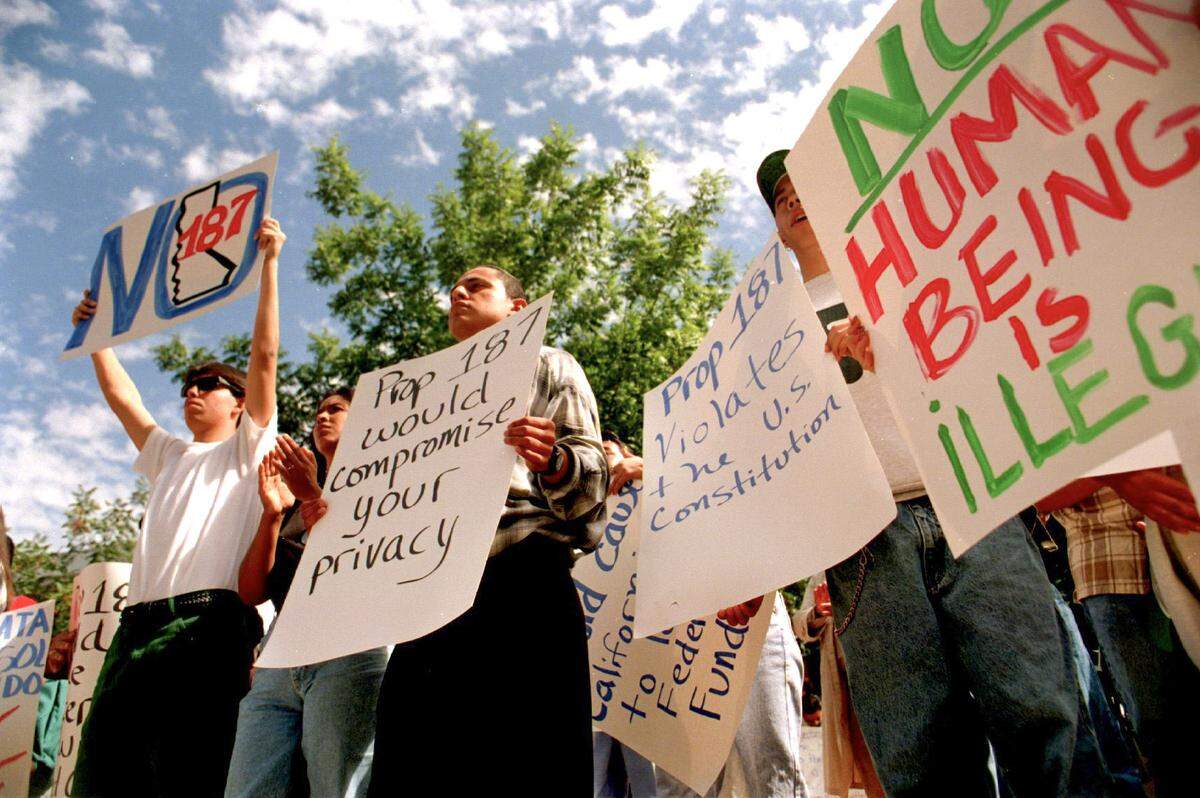
Today, Latino lawmakers hold 40 seats — a third of the Legislature — and have enacted groundbreaking pro-immigrant policies that include state-funded healthcare for undocumented residents, access to driver’s licenses and sanctuary protections.
“You can’t talk about California without talking about Prop. 187,” Salas said.
Back in 1994, Salas was a recent college graduate considering returning to school for her master’s degree. In the aftermath of Prop. 187’s passing, she began volunteering at the Coalition For Humane Immigrant Rights. There, she worked the phone hotline and received calls from Latinos detailing experiences of racism and discrimination.
Salas eventually deferred graduate school and committed to a decadeslong career in immigrant advocacy. She’s never regretted the decision.
“My family were immigrants,” Salas said. “My family was undocumented, and I just felt compelled at that moment. I just needed to not go. I needed to stay.”
‘We have not gotten the results’
While Proposition 187 galvanized an era of Latino representation, Madrid has long warned of potential pitfalls. He argued that Latino politicians, while focused on immigration issues, have failed to adequately address economic gaps that continue to challenge the community.
“After 30 years, we can look back and see what we were wrong about as much as what we were right about,” Madrid said. “We’ve got the representation we were shooting for, but we have not gotten the results. If we ask this new generation what’s more important, they’re going to tell us overwhelming results matter a hell of a lot more than representation.”
That failure has led to growing disillusionment among California Latinos, Madrid said. Latinos who are overrepresented in low-income brackets and struggling to buy homes, vote at lower rates than any other race or ethnicity in California.
“We have so ignored the economic prioritization and concerns of voters that we are more segregated now than we were then,” Madrid said.
Disillusionment may also be fueling a political shift among Latinos. A recent Public Policy Institute of California report found Latinos switching to the Republican Party at the highest rate among any ethnic group over the last two years. Earlier in the year, a Latino legislator made headlines for switching parties.
Some leaders, like Sen. Melissa Hurtado, D-Bakersfield, acknowledge these shifting concerns. Hurtado, who grew up in the Central Valley and is a daughter of immigrants, learned about the initiative in college. She — respectfully — called Proposition 187 “irrelevant” today for Latinos. For her, these voters mainly care about the economy and building toward their American Dream.
“What people want to know is how they’re going to make ends meet, so I don’t think it’s necessarily playing a role,” Hurtado said. “What they feel is relevant is how the economy or the lack of opportunities is impacting them.”
‘Another moment in history’
With nearly half of California Latinos under 30, many lack a direct connection to the Prop. 187 era. Recent census data shows that about 50% weren’t alive when the measure passed. Those born in the years after likely don’t even remember when the last Prop. 187 appeal was dropped in July 1999.
“People just don’t know because they weren’t part of the fight, and to a certain extent, it becomes part of the norm of their existence in California,” Salas said. “In some ways, isn’t that what we want?”
Prop. 187, despite its influence, isn’t mandated in California’s education standards. Some textbooks for fourth, ninth and eleventh grades briefly reference it, according to passages provided by the state’s Department of Education.
“In 1994, California voters passed Proposition 187 to deny all social services to undocumented residents. Neither proposition went into effect, but the sentiment behind them created, at times, an unwelcome environment for immigrants to California,” says one paragraph in a page of a fourth-grade history textbook that also referenced 1986’s Proposition 63, an attempt to establish English as the state’s official language.
“In California, Propositions 187, 209, and 227 attacked illegal immigration, affirmative action, and bilingual education, respectively,” says another sentence in one page of an 11th-grade textbook.
Back at Sacramento State, Sarabia is one of four Latino professors interviewed who include Proposition 187 in parts of their courses. For these professors, all of whom grew up in that generation, the history is personal.
Some drove for hours to attend protests. Others cried on the day of its passing. All of them spent the next 30 years driven by Proposition 187 and its intended attack on them and their families.
“It was painful as a child,” Sarabia said. “That feeling never quite goes away and right now it’s another moment because you hear these things again, again and again.”
These Sacramento professors and Marquez believe the limited educational opportunities on the issue are problematic. Students should learn that anti-immigrant eras, and their leaders including Wilson and Trump, are examples of patterns throughout history.
“My students are shocked (when they find out),” Marquez said. “But to me, this is just another moment in history.”
This story was originally published November 8, 2024 at 5:00 AM.