California state employees still enjoying remote work — in some departments more than others

Unlike federal employees who were called back to their offices when President Donald Trump returned to the White House, California state workers are still enjoying some telework privileges.
The majority of public servants who are eligible to work remotely are turning up to state offices at least twice a week, per Gov. Gavin Newsom’s directive issued last April. But the provision included language to allow employees to keep working remotely full-time on a case-by-case basis, notably for reasonable accommodations or “individual circumstances and the specific needs and objectives of the department.”
Newsom’s office said in a statement most departments were in compliance with the telework policy. Nearly nine in 10 public employees who are eligible for hybrid working conditions come into state offices at least twice a week, based on the most recent numbers from the state.
From those numbers, though, it also appears that some departments have allowed a portion of their employees to continue working remotely full-time, including the Department of Social Services and Department of Housing and Community Development.
The uneven enforcement of the unpopular telework policy might be intentional, experts said — and ultimately good for the state.
“What I would suspect will emerge is that the government will get better retention of the most talented employees from a lack of blanket enforcement,” said Gleb Tsipursky, a business consultant who specializes in hybrid work.
Tsipursky calls this phenomenon the “hush-hybrid trend,” when employers establish telework policies but don’t strictly enforce them. As a result of managers’ lackadaisical enforcement, he said, employees are happier, more productive and less likely to leave their jobs.
Meanwhile, when employers closely monitor workers’ telework habits, they run the risk of driving employees away, he said. Often, the highest-performing workers are the first to leave to seek opportunities with more flexible telework options, Tsipursky and other experts of remote work said.
By the numbers
Within the first few months of the telework policy going into place, the overall percentage of employees who come into offices hasn’t dramatically changed.
In June, the first month Newsom’s directive was in effect, the overall percentage of telework eligible employees showing up to offices two days a week was 82%. By September, that number had increased to 85%.
State departments self-report telework data on a quarterly basis to the Department of General Services, which provided the numbers showing how many employees are meeting the governor’s directive to come into state offices at least twice a week.
It’s not clear how many of those employees who are not coming into the office twice a week have exemptions or reasonable accommodations that allow them to work fully remote. The data DGS collects does not indicate why some state employees are not coming into office in accordance with the telework policies.
Roughly half of the 90 state departments under the governor’s administration that DGS provided data for reported in September that 95% of their employees were coming into the building at least twice a week. Other departments, some of which employ thousands of workers who can work from home, have much lower rates of compliance.
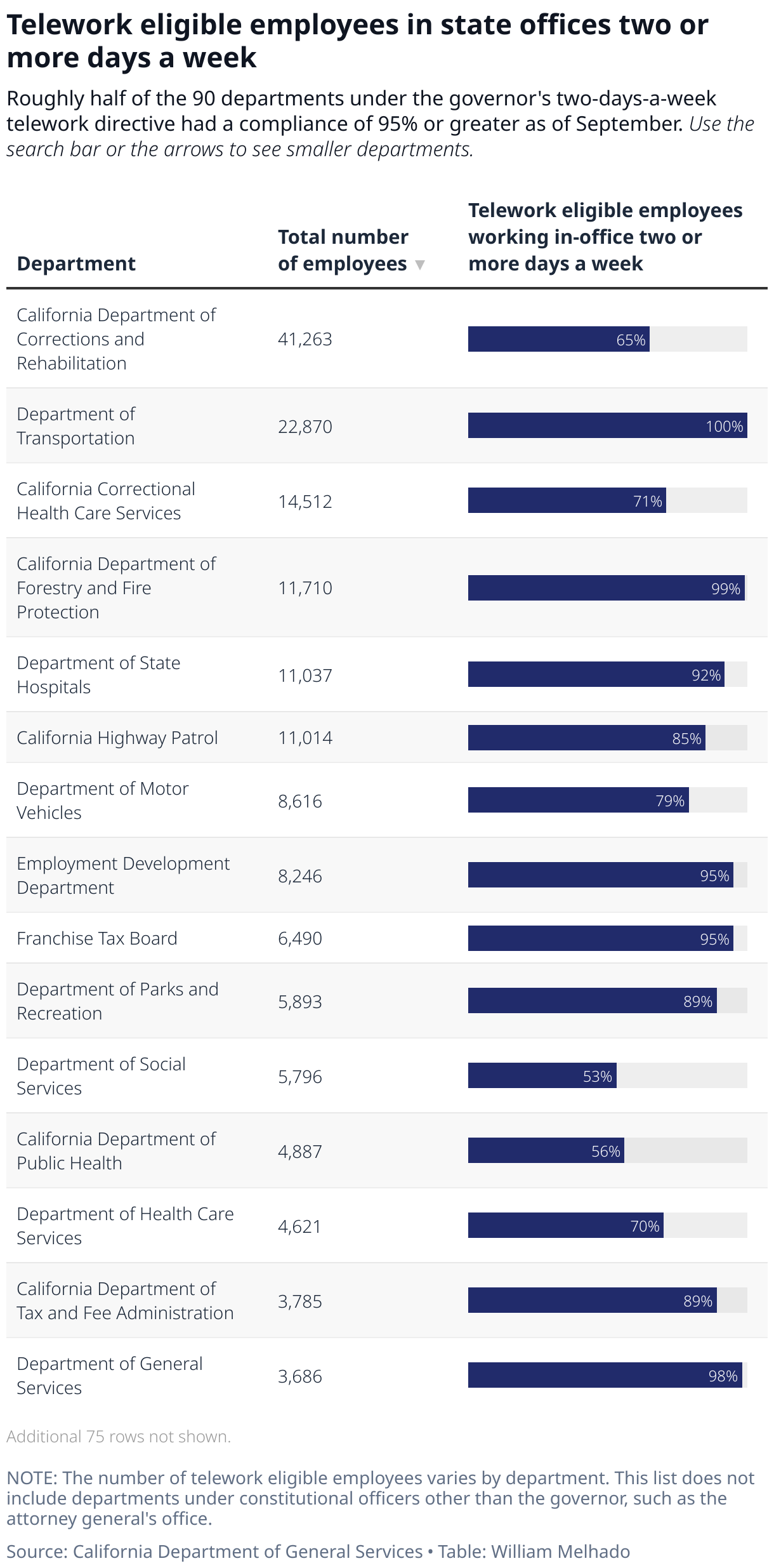
The Department of Social Services, for example, with 5214 telework eligible employees, had just over half — 53% — coming into offices as of September. A spokesperson for the department said it is currently in a renewal period for telework agreements which will see more employees coming into offices twice a week.
The California Department of Housing and Community Development reported to DGS that 66% of telework eligible employees were back in the office two days a week last year.
In a statement, the department said all applicable HCD staff were in compliance with the governor’s directive. Employees who did not work in HCD offices were hired under a 100% telework agreement or have an approved reasonable accommodation, said Matt Schueller, the deputy director of administration and management.
Swiss cheese management
Just as Trump pushed federal employees back to offices full time, in the last year there has been a push by some leaders to return to the office five days a week, Tsipursky, the business consultant, said.
The end of hybrid work conditions will likely push some employees to leave, he said.
For employees who might feel envious of their colleagues who work for more-lenient supervisors, Tsipursky said he has seen workers in government agencies and corporate offices attempt to get new jobs working for bosses with more-flexible attitudes toward remote work.
“There’s some of that resentment, but it leads to people trying to get that same advantage for themselves,” Tsipursky said.
Nicholas Bloom, another remote work expert and professor of economics at Stanford, has another name for uneven enforcement of policies. He called it “swiss cheese management.”
He noted it can be onerous for management to be constantly tracking employees’ whereabouts, so most organizations accept some slippage. By allowing some, usually high-performing, employees to skirt telework policies, managers ensure their best workers remain happy in their roles and with the organization.
Bloom published research last year that showed hybrid work policies that ask employees to spend part of the week don’t negatively impact productivity. But telework does improve retention, he found.
Neither Bloom nor Tsipursky expect California to follow the federal government’s new approach to in-person working conditions for public servants.
“If the state of California were to push the five-day return, I don’t think you would see any improvement in productivity at all,” Bloom said. “What I think you would see is a large spike in quit rates, which is costly.”
This story was originally published February 5, 2025 at 4:55 AM.