
California legislators forge ahead with budget — but with some hesitation
Good morning and welcome to the A.M. Alert!
BALANCING ACT
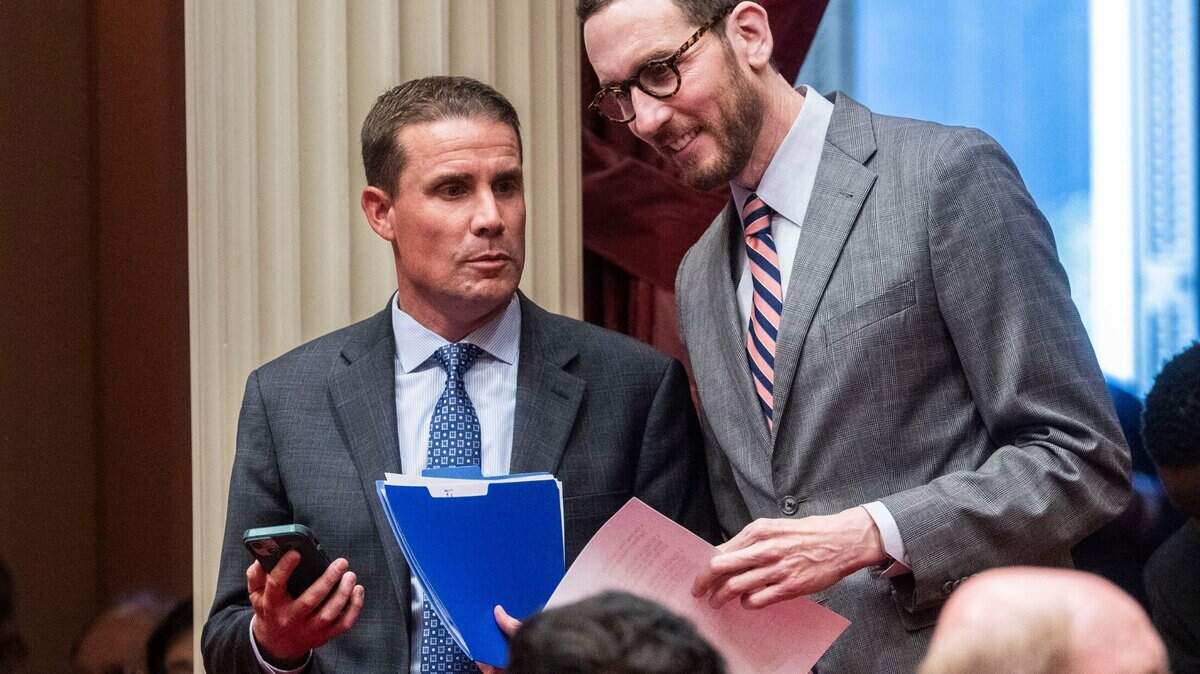
California lawmakers who weren’t in the room crafting the Legislature’s response to Gov. Gavin Newsom’s budget proposal had the chance to respond Wednesday morning ahead of an anticipated Friday vote.
Many members of the Senate Budget and Fiscal Review Committee seemed to accept the proposal, thanking budget staff and leaders for their hard work. Opposition remained from Republicans, and, on the other end of the spectrum, from lawmakers like state Sens. María Elena Durazo, D-Los Angeles and Caroline Menjivar, D-Panorama City, who are both staunchly opposed to cuts to Medi-Cal for residents with “unsatisfactory” immigration status.
“It’s been difficult to manage or go through this budget and then also see people that look like me get arrested while working,” Menjivar said, emotion in her voice.
Menjivar said in a news release Tuesday that she was removed from a budget subcommittee due to her refusal to approve the Medi-Cal proposals, including an enrollment freeze for undocumented immigrants, and new premiums for the population.
But even as a few spoke out against reductions in spending, a bipartisan span of legislators said leadership could have gone farther.
Lawmakers like state Sen. Catherine Blakespear, D-Encinitas, expressed worry about the extent to which the state would be pulling from reserves, and about future cuts that may need to happen down the road. The Legislature wants to pull $2.5 billion from the Special Fund for Economic Uncertainties in 2025-26 in addition to a pre-planned withdrawal of $7.1 billion from the Rainy Day fund. That would leave $2 billion in the SFEU and $11.2 billion remaining in the Rainy Day Fund.
“It’s important to recognize that we are not yet in a recession, and that we may be, and that’s really what our rainy day ultimately is for,” Blakesepear said.
State Sen. Christopher Cabaldon, D-West Sacramento, brought his more than 35 years in the Capitol’s orbit to the conversation, assuring colleagues the difficult balancing act is “normal.” He said recent years of lawmakers looking around and seeing “who needed stuff” was not the norm.
“Perhaps our discipline was eroded about what our real role is here,” he said, “which is to govern California, and make sure that the essential services that we’re providing are sustainable fiscally.”
The budget proposal passed out of both the Senate and Assembly budget committees, and must be approved by Sunday. In the following weeks, the governor’s team will weigh in again.
CALIFORNIANS UNHAPPY WITH THEIR GOVERNMENT
Via Rebecca-Ann Jattan
The Public Policy Institute of California released a survey on the state of “Californians and their Government” on Thursday, finding that Californians largely disapprove of national and state leaders, and have a bleak outlook on the state’s future.
Responses were gathered from 1,591 California adult residents, 1,080 of whom were likely voters. Survey collection began on May 22 and ended May 29.
In terms of national leadership, 29% of Californian adults approve of President Donald Trump’s performance. The US.. Congress has a 20% approval rating and the U.S. Supreme Court has a 31% approval rating among Californians. Just over half, 57%, support downsizing the federal government.
State leadership faced low ratings. Majorities of Californians disapprove of Gov. Gavin Newsom’s performance, with a 54% disapproval rating. Four in ten or more approve of the state Legislature’s job, around 41%. Sens. Alex Padilla and Adam Schiff received 41% and 37% performance approval ratings respectively.
Sixty percent of participants believe the state is generally going in the wrong direction with three in four respondents anticipating bad economic times statewide over the next year. One half of respondents say price increases have caused financial hardships for them or their household, with 16% classifying it as serious hardship.
Over a third of Californians — 37% — see cost of living, the economy and inflation as the state’s most important issue, while 15% said the same of housing costs and availability.
On the governor’s recently revised state budget, more than four in 10 California residents viewed it as a big problem, with 55% opposing the May revision. Fifity-six percent were opposed to using $7.1 billion from the Rainy Day Fund while 56% were in favor of “the key strategies in Governor Newsom’s May Revision for bridging the gap between spending and revenues.”
Californians deemed its Department of Health and Human Services, followed by k-12 public education, as the highest spending priorities, per the response of 46% and 39% of respondents, respectively.
A majority of participants — 58% — opposed providing healthcare coverage for undocumented immigrants, a finding which opposes another recently released poll commissioned by The California Endowment, a nonprofit organization.
On national issues, 53% of respondents support cutting aid to foreign countries and 40% approve of cutbacks on environmental regulations on oil and gas drilling. Majorities oppose the imposition of tariffs on goods from Canada, Mexico and China, with approval ratings of just 27%, 29% and 36%, respectively.
DEMOCRATS FROZEN OUT OF BILL
Via David Lightman
Sen. Adam Schiff isn’t optimistic Democrats will have much influence over the Republicans’ “Big, Beautiful Bill.”
After all, the California Democrat told The Bee, “There’s not a lot of common ground here.”
Often when Congress is considering massive legislation, minority party members look for some ways to have a say.
That’s highly unlikely this time.
“There will be a lot of amendments we want to offer but I can’t imagine Democrats supporting the bill, and Republicans don’t have much incentive trying to bring Democrats along on any amendment,” Schiff said.
Democrats have railed against big cuts in Medicaid and food assistance, and say that extending the current federal income tax rates beyond this year would disproportionately benefit the wealthy.
The nonpartisan Congressional Budget Office said last week that an additional 10.9 million people would be without health insurance by 2034 under the bill’s Medicaid and other provisions.
Historically, the minority party can have some influence, as most Senate action needs 60 votes to succeed. The problem for Democrats this time is that this measure needs only 51 votes to pass because of special rules governing the bill. Republicans control 53 seats, and Vice President JD Vance would break a 50-50 tie.
Republicans won’t say Democratic clout is minimized. Though Senate Republicans remain uncertain how to proceed, so far there’s been little talk of aligning with Democrats.
“At the end of the day, the math is very simple,” Senate Majority Leader John Thune, R-South Dakota, told reporters.
The bill “does everything that we set out to do. It modernizes our military, secures our border ... extends tax relief and makes permanent tax relief that will lead to economic growth and better jobs in this country, and makes America energy dominant — coupled with the biggest spending reduction in American history,” Thune said.
“Those are our agenda items and that’s what we campaigned on,” he added.
QUOTE OF THE DAY
“By last Friday, Trump was drowning in negative headlines. Just as he’s done throughout the years, he turned to the same tired playbook. Attack immigrants. Blame immigrants. Manufacture a crisis to try to change the news cycle.”
— California Sen. Alex Padilla
Best of The Bee:
- Two men handcuffed at Sacramento Immigration Court, taken to ICE office via Stephen Hobbs
- Gavin Newsom establishes himself as Democrats’ chief social media trollvia Lia Russell
- California Legislature rejects state worker salary freezes. Negotiations continue via William Melhado